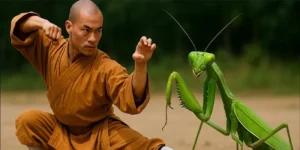
To understand the praying mantis fighting style, one must understand that it is a style of “long reach and short hitting,” utilizing the arms to bridge gaps while delivering power at close quarters.

This blog introduces the praying mantis fighting style, characteristics, and distinct types. Legend credits Wang Lang with founding it after observing a mantis defeat a cicada, blending animal observation with existing Shaolin techniques.
Characteristics of Praying Mantis Fighting Style
Praying mantis fighting has explosive power and the ability to link techniques together without interruption. Below are the primary characteristics.

- The “Mantis Hook” is the basic hand structure for trapping and striking.
The hook (Gou) is formed by bunching the fingers together to create a point of contact that can hook, pull, or deflect. Unlike a closed fist, the hook allows a practitioner to transition from a block to a grab in a fraction of a second, effectively “sticking” to the opponent’s limb to control their balance.
- High-frequency striking ensures the opponent is overwhelmed before they can react.
We prioritize “the short and fast” (Duan Da). Instead of one heavy blow, a mantis stylist delivers a flurry of strikes—often targeting the eyes, throat, and joints—to saturate the opponent’s defensive capabilities.
- Circular footwork provides the means to attack from the opponent’s blind spots.
We rarely attack in a straight line. By utilizing “Monkey Footwork,” we move at angles to the side of an opponent’s strike, allowing us to counter-attack while their centerline is exposed and their momentum is committed.
- “Seven Long and Eight Short” governs our range management.
The “Seven Long” refers to extended techniques like long-range punches and kicks, while the “Eight Short” focuses on close-quarters combat using elbows, knees, and shoulders. This balance ensures that a mantis master is dangerous at any distance.
Praying Mantis Fighting Styles
Northern Praying Mantis Fighting
The Northern Praying Mantis stresses speed, footwork, and continuous strikes for versatile mid-range combat. Developed in Shandong, it incorporates Shaolin elements, with forms like Beng Bu emphasizing chains of attacks. It’s athletic, suitable for dynamic environments.

- Seven Star Mantis (Qixing Tanglang Quan) structures techniques around seven key stances for balanced offense and defense. Named after the Big Dipper, it includes kicks and long-range hands, with mobile footwork. Popularized by masters like Luo Guangyu, it features weapons training.
- Plum Blossom Mantis (Meihua Tanglang Quan) uses circular, adaptive patterns resembling flower petals for evasion and counters. It promotes fluidity and internal energy, with evasive steps. Founded by Feng Huan Yi, it’s meditative.
- Six Harmony Mantis (Liuhe Tanglang Quan) integrates mind, body, and spirit for harmonious internal power. A softer variant, it employs narrow stances and unbalancing tactics. Attributed to Wei Delin, it balances softness and ferocity.
- Eight-Step Mantis (Babu Tanglang Quan) relies on eight-directional footwork for rapid positioning and throws. Compact and integrative, it excels in locks. Created by Jiang Hualong, it blends with other arts.
- Tai Chi Mantis (Taiji Tanglang Quan) merges Tai Chi softness with mantis speed for flowing, yielding combat. It focuses on internal cultivation and health. Invented by Zhao Zhu, it’s suitable for all ages.
Southern Praying Mantis
Southern Praying Mantis specializes in close-range, explosive short-power strikes with rooted stances. Influenced by Hakka culture in Guangdong, it’s less acrobatic, prioritizing hand techniques and limited kicks. It resembles street fighting for practical defense.

- Chow Gar Southern Mantis employs phoenix eyes and ginger fists for penetrating impacts. It uses “float, sink, spit, and swallow” for structure, with forearm conditioning. In the Hakka style, it’s aggressive and direct.
- Jook Lum (Bamboo Forest) Mantis incorporates Buddhist principles for sensitivity and explosive power. Practiced in temples, it features short bridges and pole weapons. It emphasizes internal aspects.
- Chu Gar Southern Mantis focuses on linear attacks with narrow stances for close combat. Sharing Hakka roots with Chow Gar, it includes conditioning for resilience. It’s compact and efficient.
FAQs
Is Praying Mantis Kung Fu Effective?
Yes, Praying Mantis Kung Fu is effective for self-defense and combat when trained properly.
Praying Mantis fighting style emphasizes speed, precision, trapping, and redirection, making it suitable for close-range encounters where quick counters can overwhelm opponents; however, effectiveness depends on the practitioner’s skill, physical conditioning, and real-world application rather than just forms.
How Do You Practice Praying Mantis to Fight?
To practice Praying Mantis for fighting, focus on building fundamentals through stances, drills, forms, and sparring under guidance.
Start with basic stances like the mantis hook and seven-star position; progress to hand techniques such as trapping and strikes; incorporate footwork for mobility; then apply them in partner drills and light sparring to develop timing and adaptability, ensuring consistent training 3-5 times weekly to translate techniques into effective combat skills.
How Difficult Is the Style of Praying Mantis in Your Opinion?
In my opinion, praying mantis fighting style is moderately difficult, requiring good coordination and dedication but accessible with proper instruction.
It demands precise timing, flexibility, and sensitivity for techniques like sticky hands and rapid combinations, which can challenge beginners, but its structured forms and progressive drills make it learnable over time, typically taking 1-3 years to achieve basic proficiency compared to simpler styles like basic boxing.