Five Animals Qigong, also known as Wu Qin Xi, draws inspiration from the movements of the tiger, deer, bear, monkey, and crane. Developed by the legendary physician Hua Tuo during the Han Dynasty over 1,800 years ago, this practice mimics the animals’ natural behaviors to promote physical health, mental clarity, and energy flow (Qi).
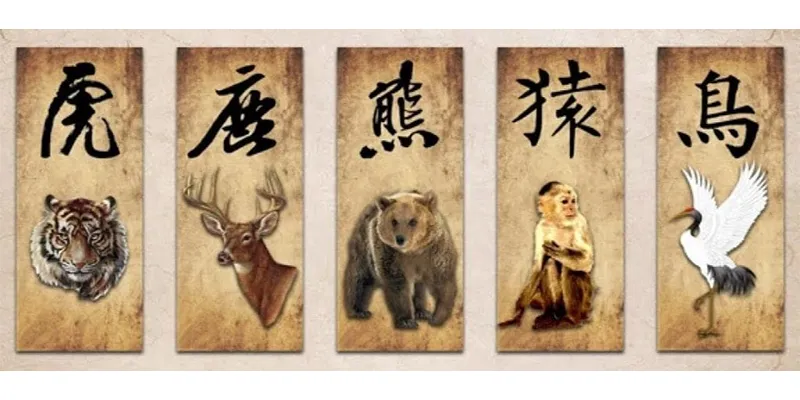
Whether you’re a beginner or seasoned martial artist, these steps will guide you through a complete practice.
The First of Five Animals Qigong: Tiger Qigong
Tiger (Hu Xi): Building Strength and Spine Health
The Tiger Qigong focuses on powerful stretching and “clawing” movements to improve grip strength and spinal flexibility.
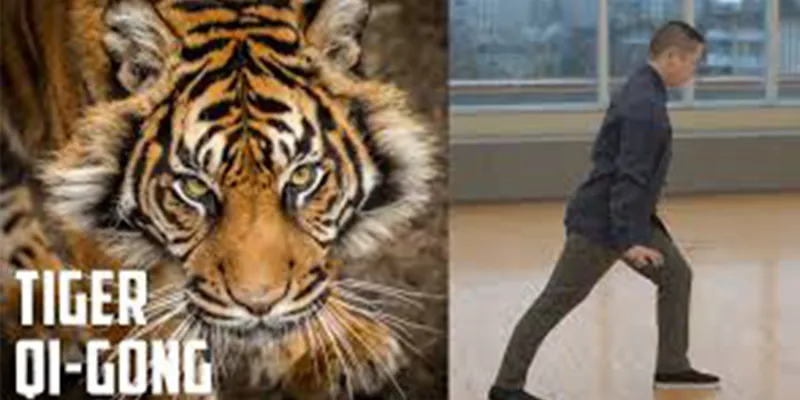
Tiger Pounces and Pushes Practicing Steps:
- Shape the Claws: Start from your centering posture. Softly bend your knees a little more, sinking your weight. Form “tiger claws” by curling all ten fingers strongly, as if you are gripping a ball.
- The Pounce (Right Side): Inhale as you bring your claw hands to your waist, palms up. Feel the power gathering. As you exhale, step forward slightly with your right foot. Simultaneously, thrust your right claw forward (palm turning down) while pulling your left claw strongly back to your hip. Your body weight shifts forward. Your eyes, wide and alert, follow the forward claw.
- The Stretch (Right Side): Inhale, shifting weight back to center. Now, raise both claws in front of you. Exhale as you separate them—the right claw arcs up and over to the right, the left down and to the left, in a long, deep stretch. Arch your back gently and look up at the upper claw. Feel the stretch along your entire side.
- Return and Repeat: Inhale, gathering back to center. Repeat the entire sequence (pounce and stretch) on the left side, stepping with the left foot. Perform 3-5 times on each side.
Spirit: The tiger’s spirit is fierce, proud, and powerful. Emit a sense of contained strength. The movements should be deliberate, angular, and strong. Focus on the stretching of the spine and the tightening and releasing of the tendons in your hands and along your sides.
The Second of Five Animals Qigong: Deer
Deer (Lu Xi): Enhancing Grace and Kidney Vitality
The Deer Qigong uses twisting motions and a specific hand gesture to nourish the kidneys and improve waist flexibility.
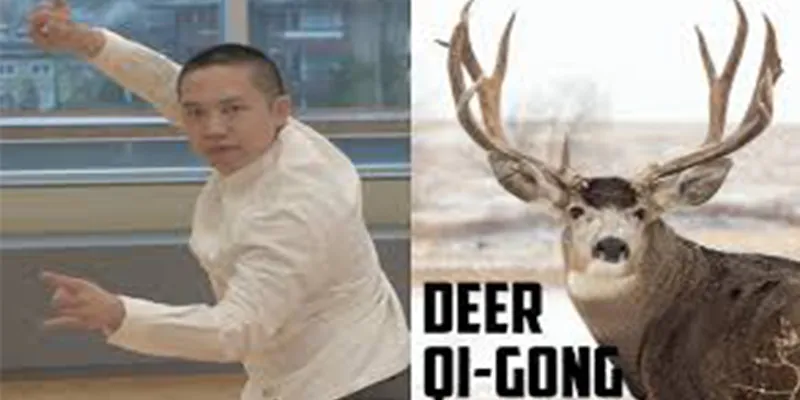
Deer Turns to Gaze Practicing Steps:
- Assume the Antlers: From your center, form “deer antlers” with your hands: extend your thumbs, index, and little fingers, while tucking your middle and ring fingers down. Hold your hands at chest level.
- The Turn (Left Side): Inhale gently. As you exhale, slowly turn your upper body to the left, leading the turn from your waist. Your left “antler” hand moves back, pointing behind you, while your right “antler” moves forward, pointing across your body. Your gaze follows the left hand, looking softly backward. Imagine you are a gentle deer in a forest, calmly turning to listen.
- The Sink and Return: As you hold the turn, gently sink your body weight down slightly, then rise as you begin to inhale and unwind back to the center. The movement is a smooth, horizontal coil and uncoil of your torso.
- Repeat on Opposite Side: Exhale and repeat the turn to the right side. Practicing 3-5 times per side.
Spirit: The deer’s spirit is serene, graceful, and alert. There is no sharp force here. The power comes from the gentle twisting of the waist, massaging the kidneys and lower back. Keep your shoulders relaxed and the turns smooth and even. Your gaze should be soft and mindful.
The Third of Five Animals Qigong: Bear
Bear (Xiong Xi): Strengthening Digestion and Stability
The Bear Qigong emphasizes heavy, grounded movements and a rotating torso to aid the stomach and spleen.
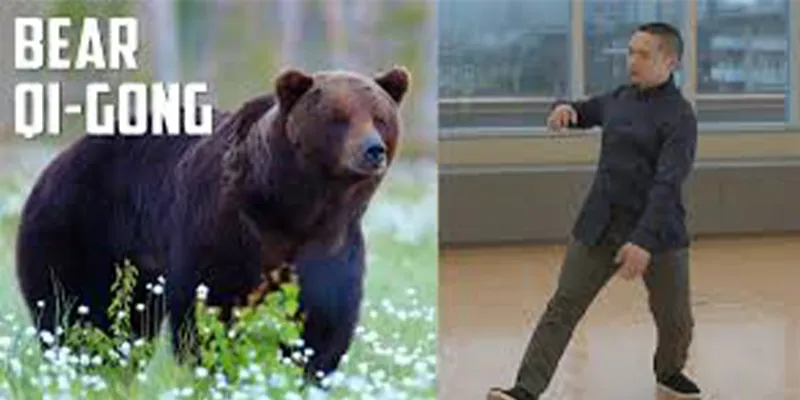
Bear Sways and Rolls Practicing Steps:
- Sink into the Bear’s Body: Stand with feet a little wider than shoulder-width. Let your arms hang loose. Sink deeply into your knees, feeling solid and heavy like a bear. Allow your back to be naturally rounded.
- The Rock (Side to Side): Inhale as you shift your weight completely onto your right leg, allowing your left foot to lift lightly onto its toes. Your whole body tilts to the right, with your left shoulder dipping down. Exhale as you slowly rock your weight across to the left leg, reversing the tilt. Rock back and forth 3-5 times, like a contented bear shifting its weight.
- The Roll (Circular): Place your hands on your lower abdomen. Now, using your waist and abdomen as the driver, make slow, large circles with your torso. Roll forward (exhale), right (inhale), back (exhale), and left (inhale). The movement should feel like you are rolling a ball around your middle. Do 3 circles clockwise, then 3 counter-clockwise.
Spirit: The bear’s spirit is steady, ponderous, and grounded. Feel your connection to the earth. There is no lightness here; embrace the feeling of solid, slow, weighty motion. The focus is internal, on the center of your body and the digestive core.
The Fourth of Five Animals Qigong: Monkey
Monkey (Hou Xi): Sharpening Reflexes and the Heart.
The Monkey Qigong involves quick, nimble movements and “shrugging” to release tension around the heart and neck while improving mental agility.
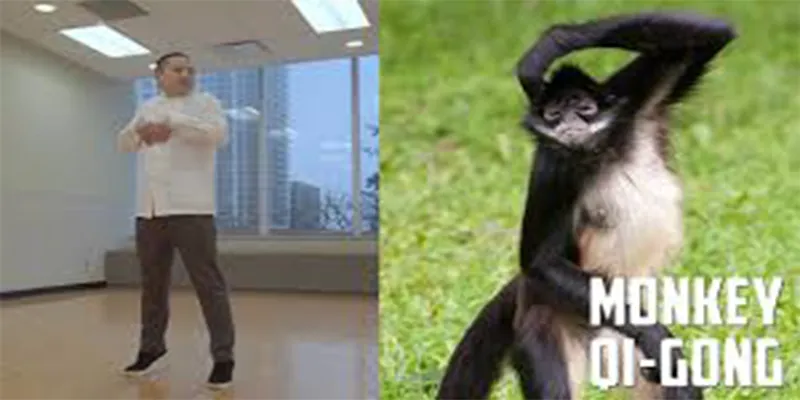
Monkey Reaches and Withdraws Practicing Steps:
- Adopt the Monkey’s Readiness: Stand with feet together, knees slightly bent. Hold your hands with fingers together (not claws) at chest level, wrists loose. Your whole posture should feel light, springy, and ready to move.
- The Reach and Grab (Right Side): Inhale quickly as you step to the right with your right foot, your body leaning and reaching to the right. Your right hand darts out as if to grab a fruit from a branch, then swiftly pulls it back to your chest. Your left hand moves in coordination, pulling back as you reach. Your head turns sharply to follow the action.
- The Withdraw: Exhale as you snap your body back to center, feet together. Immediately repeat the motion to the left side. The pace is faster than previous animals—a quick inhalation on the reach, a quick exhalation on the return. Practicing 3-5 reaches per side.
Spirit: The monkey’s spirit is clever, mischievous, and incredibly fast. Be light on your feet. The energy is outward and alert. Coordinate your darting eyes with the hand movements. Imagine you are in the treetops, playfully grabbing and retreating.
The Fifth of Five Animals Qigong: Crane
Crane (He Xi): Balancing Breath and Lung Capacity.
The Crane Qigong focuses on soaring arm movements and one-legged balance to open the chest and strengthen the lungs.
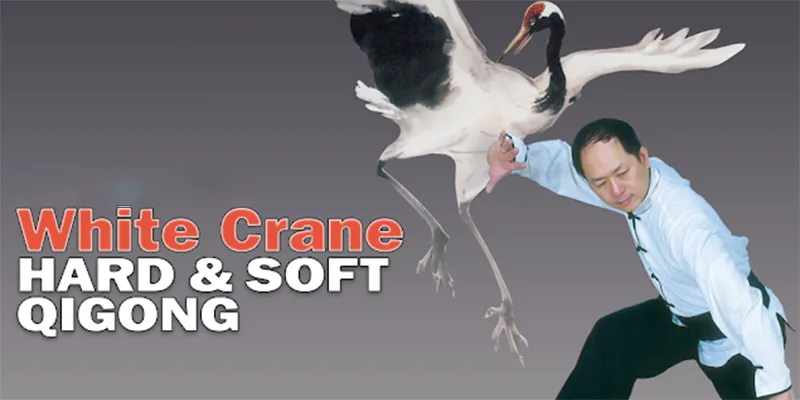
Crane Spreads Its Wings Practicing Steps:
- Find the Crane’s Grace: Begin from your center. Let your arms rest at your sides. Feel tall and poised.
- The Ascent—Wings Open (Inhale): Slowly inhale as you raise your arms gracefully out to the sides and up overhead. As your arms rise, lift your left knee up in front of you, balancing on your right leg. Your body forms a single, elegant line from right toe to fingertips.
- The Descent—Wings Close (Exhale): Gently and slowly exhale as you lower your arms back down and place your left foot on the ground. Return to the starting posture.
- Repeat on Opposite Side: Inhale, and repeat the motion, this time lifting your right knee as your arms rise. Practicing 3-5 lifts on each side.
Spirit: The crane’s spirit is peaceful, elegant, and soaring. The movements are the slowest and most expansive of the set. Focus on deep, full breathing. The rising motion is for inhalation and expansion; the lowering is for exhalation and release. If balancing is difficult, simply lift your heel instead of the full knee. Strive for a feeling of lightness and openness in your chest.
Closing Your Five Animals Qigong Practice
Bring your feet together. Gently rub your palms together until they are warm, then place them over your eyes, then your face, and finally over your lower abdomen.
Stand quietly for one to two minutes, feeling the circulation of energy you have stimulated. Observe any warmth, tingling, or deep calm in your body. This quiet integration is where much of the healing occurs.
FAQs
What are the benefits of Five Animals Qigong?
Five Animals Qigong enhances physical strength, flexibility, mental clarity, and overall vitality while promoting emotional balance and stress reduction.
Five animals Qigong practice, inspired by animal movements, improves circulation, boosts immunity, and supports organ health according to traditional Chinese medicine, making it suitable for all ages to foster a harmonious mind-body connection through gentle, flowing exercises.
What does “five animals qigong frolics where winds meet” mean?
“Five Animals Qigong Frolics Where Winds Meet” refers to an interactive in-game event in the video game Where Winds Meet, drawing from traditional Five Animals Qigong practices.
In this activity, players perform exercise-like movements for rewards, but there’s a risk of temporarily transforming into an animal, requiring help from others to revert, adding a fun, social element to the Qigong-inspired gameplay.
Five animals qigong teaching video recommendations
Top recommendations for Five Animals Qigong teaching videos include beginner-friendly tutorials on YouTube.
For a complete English-instructed routine, check out “Five Animals Qigong with English Instruction | Wu Xin Qi,” which covers all five animals in detail.
A quick session is “6-Min Shaolin Five Animal Qi Gong (Wu Qin Xi),” focusing on emotional transformation and organ health.
Another great option is “Wu Qin Xi Five Animals Qigong—Mirror-Image with Audio” for mirrored guidance to follow along easily.
Finally, “Five Animals Qigong Full Routine” links all movements smoothly for practice.
These videos are free and accessible, ideal for starting your practice at home.