Xingyiquan alligator fight, also known as the crocodile or water lizard form. This form shows the alligator’s predatory patience, explosive power, and unyielding grip on the earth.
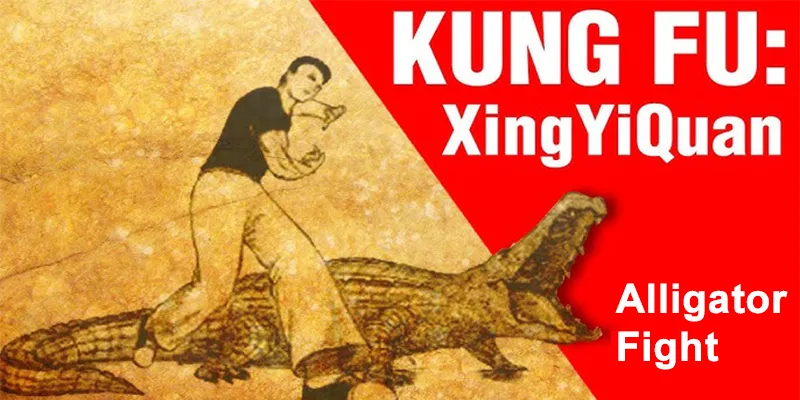
Today, we will explore how the alligator “fights” within Xing Yi Quan, breaking down its unique characteristics, mechanics, and combat philosophy.
Clarification of Alligator Fight In Xingyi
The Chinese character 鼍 (Tuó) specifically refers to the Chinese alligator (Yangtze alligator), a smaller, armored creature known for its resilience, powerful tail, and ability to lie in wait for long periods before launching a sudden, devastating attack.
This is not the African crocodile of sheer brute force. The Tuo’s power is one of coiled strength, sudden whipping action, and an almost impervious defense.
In Xingyiquan, we are not imitating the literal animal but extracting its fighting spirit and animal principle and forging it into a human martial expression.
Alligator Fight Principle: Rolling, Drilling, and Whipping
If I had to distill the Alligator Form’s summary into one principle, it would be Spiral Force. The alligator’s movement in water is not linear; it rolls, twists, and uses its tail in a whip-like manner to propel itself and attack. It is used in Xingyiquan and includes:
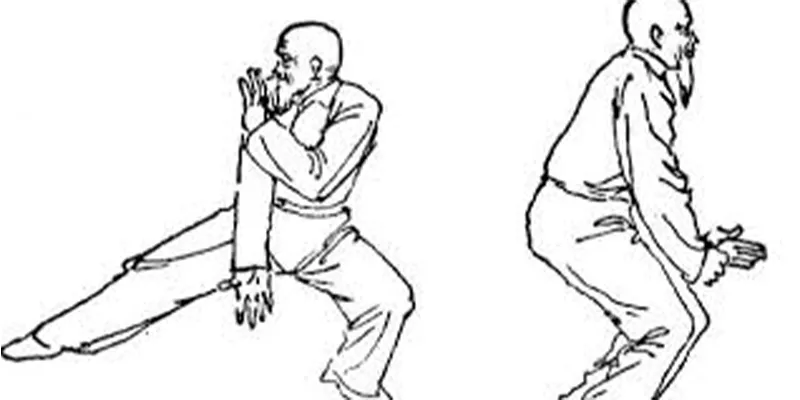
Drilling Fist: While Drilling Fist is a vertical spiral driving upward, the Alligator incorporates this spiraling action across the entire torso, limbs, and waist.
Its power is hydrodynamic. The force doesn’t start and stop; it rolls through the body in a wave, from the feet through the waist, up the spine, and out through the limbs, much like an alligator’s tail whip.
Its defensive quality is like a rolling log. An attack directed at it is deflected, rolled off, and destabilized by these forces.
How to Do Alligator Fight?
1. Sliding Steps:
The stance is not as dramatically low as in some other animal forms. It is alert and ready, with the weight subtly shifting. It often employs a “sliding” or “gliding” step, reminiscent of the alligator’s belly-slide on land—a low, stable, advancing movement that doesn’t telegraph intent. The feet are never crossed.
2. “Tuó Shakes Its Body”
The arms are never completely straight nor completely bent. They move in paired, coordinated circles and arcs.
One hand may rotate inward (pronate) while the other rotates outward (supinate), creating a twisting tension across the chest and back—the “rolling” power.
The forearms and wrists are active, performing parries, deflections, and binds. It looks like “swimming” through the air, but each movement has a martial purpose: to deflect an incoming strike, to hook the opponent’s limb, or to create an opening.
The power is not a punch per se, but a crushing, wrenching, whipping force that follows the control of the opponent’s limb. For example, you wrap your arm around an opponent’s block and, with a whole-body roll, whip your other forearm into his ribs or neck.
3. Rolls of the Waist and Spine
Every roll of the arms is driven by a slight rotation or undulation of the waist and spine. It is a full-body kinetic chain, like the alligator’s body coiling and uncoiling.
4. Whipping and Crushing
The strike of the alligator is rarely a straight line. It is an arc, a whip.
The “Tail Whip”: This can be expressed with the forearm (a backfist or hammer fist originating from a roll) or even with the leg.
The “Jaw Crush”: This is the closing technique. Once the opponent’s structure is broken and their limb controlled (hooked, deflected), the final strike moves in with a crushing, downward or inward spiraling force, akin to the alligator’s jaws clamping down after the tail has destabilized the prey.
Xingyiquan Alligator Fight Combat Characteristics
The alligator’s fight is cunning strategy, not frontal assault.
The Principle of Covering: The constant circling, rolling motion of the arms creates a defensive “shield” or “cloud” around the upper body. It is very difficult for an opponent to find a clean line of attack, as their punches and kicks are constantly being deflected, parried, and redirected by this rolling barrier.
Close-Quarters Dominance: The Alligator Form excels at what we call “inch power” and trapping range. It is not a long-range fighter. It seeks to glide in, engage the opponent’s limbs, and once in contact, use its spiraling actions to stick to, control, and dismantle the opponent’s structure from the inside. It is a master of Qin Na and short, devastating whips.
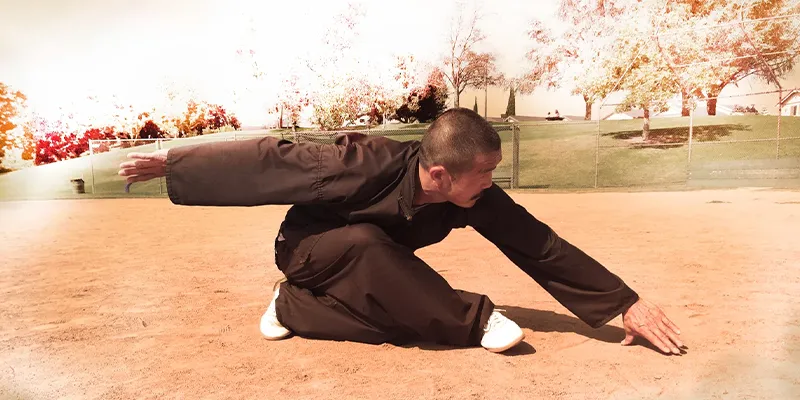
Patience and Suddenness: The alligator can float motionless for hours. In combat, this translates to a calm, waiting guard, seemingly passive.
The moment the opponent commits—the moment they extend their limb or shift their weight—the alligator “strikes like lightning.” Its attack is preceded by a subtle deflection that simultaneously opens a gate and launches the counter. Defense and offense are one.
Uprooting and Destabilizing: The spiraling force is exceptionally good at breaking an opponent’s balance. By rolling into their attack and applying force perpendicular to their structure, you can easily twist them off their root.
Benefits of Training Alligator Fight
- Develops Integrated Spiral Power
Alligator fight trains the body to generate force through coordinated rotations of the waist, spine, and limbs.
The alligator emphasizes a coiled, whip-like power that originates from the feet, propagates through a rotating waist, and releases through the arms in spiraling motions.
- Suits Close-Range Control and Limb Seizing
It specializes in techniques for dominating the trapping and clinch range through deflection and hooking.
The characteristic rolling and circling arm movements are practical methods for deflecting incoming attacks, hooking an opponent’s limbs, and creating openings for locks or throws. This trains crucial close-combat sensitivity and control, enabling a fighter to disrupt an opponent’s structure at a short distance.
- Cultivates Stability in Motion
The form teaches how to maintain root and balance while applying complex upper-body techniques.
Through its stable, gliding steps and rotating torso, the Alligator Form develops the skill of separating upper and lower body movement. This allows for agile deflections and strikes without compromising posture, ensuring the practitioner remains balanced and rooted even during aggressive exchanges.
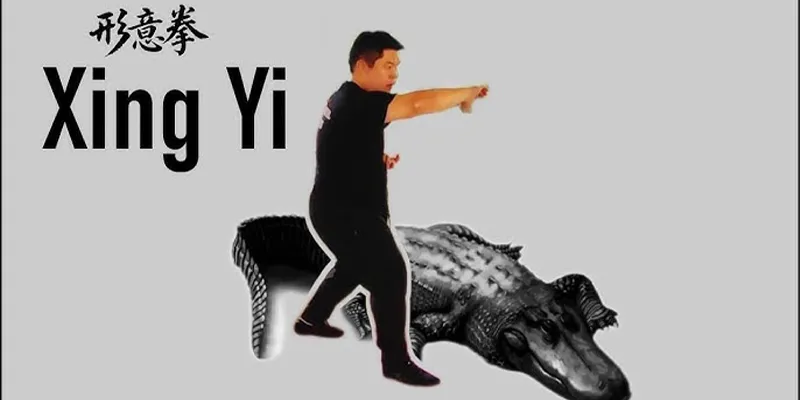
- Unifies Defense and Attack into a Single Action
Alligator Fight applies interception and counterattack simultaneously.
Each circular parry in the alligator fight is mechanically linked to an immediate striking opportunity along the same tangent. This eliminates the pause between blocking and hitting, making the practitioner’s responses faster, more energy-efficient, and tactically unexpected.
- Develops Patience and Precise Timing
Training instills the strategy of waiting for the optimal moment to engage rather than forcing an action.
The alligator’s core—calm guarding followed by explosive movement. Practitioners learn to observe, cover, and draw out an opponent’s attack, responding only when the opening is created, thereby maximizing tactical advantage.
- Energy-Efficient Combat Fight
Alligator fight is a framework for neutralizing force with minimal expenditure of energy.
By employing rolling deflection and yielding to redirect incoming force, the Alligator Form teaches fighters to use an opponent’s aggression against them. This approach conserves the practitioner’s energy while efficiently disrupting and damaging the opponent.
Conclusion
If you’re interested in learning more, consider joining a local Xingyiquan class or exploring resources from masters like Sun Lutang. Practice diligently, and remember: like the alligator fight, true strength lies in quiet preparation. Questions? Feel free to comment below.