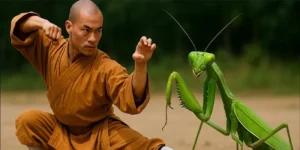
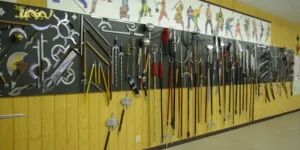
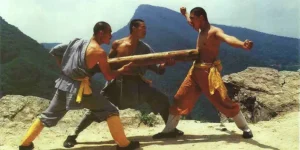
Shaolin Kung Fu weapons are vast, known as the “Eighteen Weapons.” These are mainly divided into long weapons, short weapons, flexible weapons, and unconventional weapons, including staffs, spears, knives, swords, halberds, shovels, whips, and hooks, which serve both practical combat and fitness purposes.
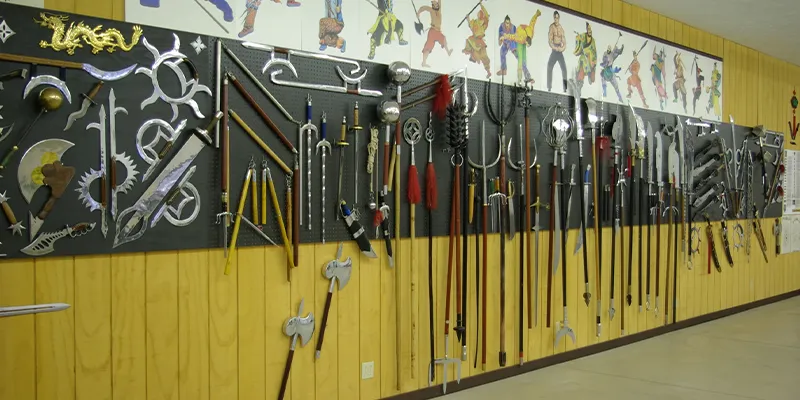
This blog post mainly explains Shaolin kung fu weapons, their uses, and their applications in kung fu.
Staff (Gun)
The staff, known as Gun in Chinese, is one of the most fundamental and versatile weapons in Shaolin Kung Fu, often regarded as the “grandfather” of all weapons due to its simplicity and effectiveness in both offense and defense.
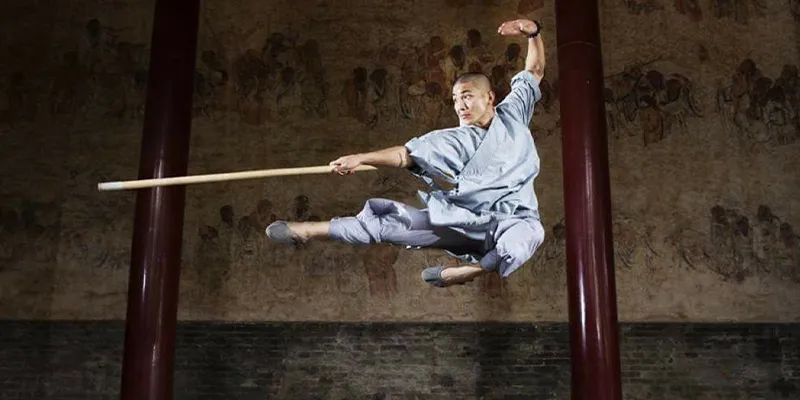
The staff is the foundation of all Shaolin kung fu weapon training. Physically, it is a long, wooden pole, traditionally made of wax wood, which offers flexibility and durability. It is the first weapon a Shaolin monk learns because it teaches the fundamental principles of extension, leverage, and two-handed coordination.
The staff is vigorous and fast-paced, focusing on broad sweeping strikes to manage multiple opponents and precise pokes to vital points. Key energies include Pi (splitting), Beng (smashing), and Sao (sweeping).
Because the staff has no blade, it relies on speed and the generation of centrifugal force to cause damage. It is also an excellent defensive tool; a spinning staff creates an impenetrable barrier against attacks.
Applications in Shaolin Kungfu Styles:
Yin Shou Gun: Focuses on unconventional grips and confusing the opponent.
Shao Huo Gun: A famous form derived from the kitchen monks who used fire pokers to defend the monastery.
Liu He Gun: A two-person set that teaches distancing and timing.
Broadsword (Dao)
The broadsword, or Dao, is the “marshal of all weapons” and is a single-edged curved blade weapon in Shaolin Kung Fu. The broadsword utilizes circular force to overwhelm opponents with continuous slashing attacks.
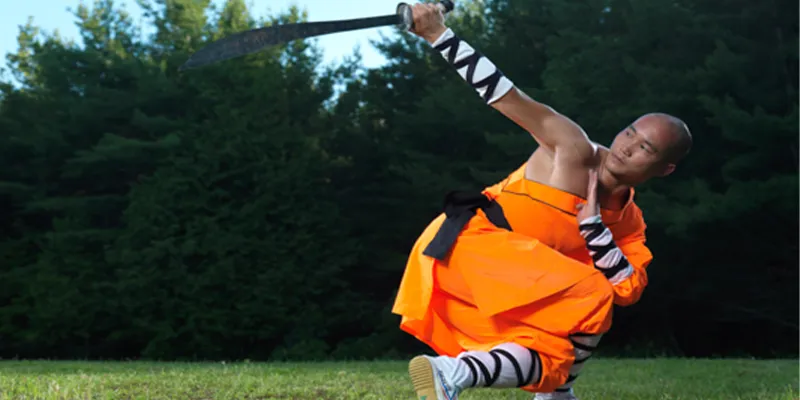
While the staff represents the monk, the broadsword represents the soldier. It is a single-edged curved blade. In Shaolin philosophy, we say, “The saber is like a ferocious tiger.” It requires a spirit of fearlessness.
The broadsword is a short-range weapon that relies on constant motion. Unlike the straight sword, which is precise, the broadsword is brutal and hacking. A key use is “wrapping the head and brain,” meaning the blade is kept close to the body, wrapping around the practitioner to provide a moving shield before lashing out.
The empty hand is just as important as the sword hand; it follows the blade to balance the body and add focus to the strike. Techniques primarily involve slashing, chopping, and blocking with the spine of the blade to protect the sharp edge.
Applications in Shaolin Kung Fu Styles:
Mei Hua Dao: Characterized by fluid, blooming movements that hide the lethal intent.
Qi Xing Dao: A dynamic form featuring rapid changes in direction and agility.
Straight Sword (Jian)
The straight sword, or Jian, called the “Gentleman of Weapons,” demands precision, agility, and the cultivation of internal energy rather than brute strength.
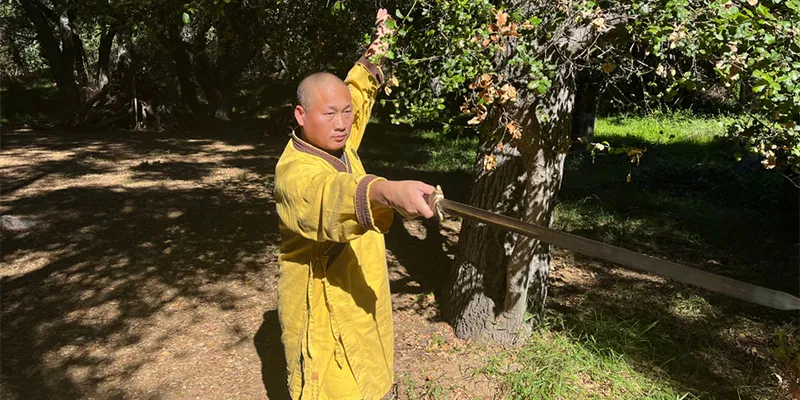
The Jian is a double-edged blade, lighter than the broadsword and designed for piercing gaps in armor. It requires a calm mind and a fluid body.
This is an advanced weapon. Mastery of the Jian is not about hacking; it is about deflection and redirection. Because the blade is thin, blocking a heavy weapon directly would snap it.
Therefore, the practitioner must use footwork to evade and deflect attacks, redirecting the opponent’s force before delivering a fatal thrust. The focus is on the tip of the blade. The movements are intricate, often involving wrist circles and precise stabs to the throat, eyes, or wrists.
Applications in Shaolin Kung Fu Styles:
Damo Jian: A form emphasizing meditative movement and internal power.
Long Xing Jian: Focuses on twisting body movements and rapid, darting strikes.
Spear (Qiang)
The spear, or Qiang, called the “King of All Weapons,” is a long-shafted weapon with a pointed blade tip in Shaolin Kung Fu, known as the “king of weapons” for its superior reach and lethal thrusting capabilities.
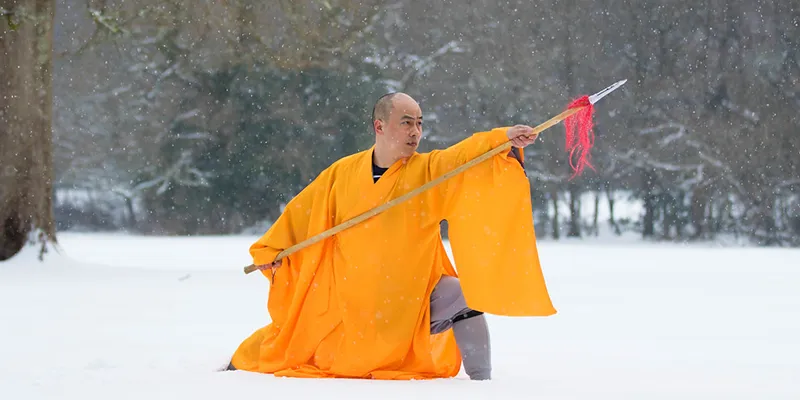
Historically, the spear was the primary weapon of military warfare. In Shaolin, it represents the pinnacle of long-range combat. It consists of a flexible wax wood shaft and a diamond-shaped metal tip, often adorned with red horsehair to blur the tip’s position and stop blood from making the shaft slippery.
The spear moves unpredictably and flexibly. The primary technique is the thrust, which must be generated from the waist and rooted in the legs. The famous maxim for spear training is “Lan, Na, Zha.”
The flexibility of the shaft allows the practitioner to snap the spear, creating a vibration that can disarm opponents or knock aside heavy weapons. While the tip is for killing, the butt of the spear is used for striking in close quarters.
Applications in Shaolin Kung Fu Styles:
Shaolin Thirteen Spear: A classic set containing the thirteen fundamental defensive and offensive spear energies.
Mei Hua Qiang: Focuses on rapid, clustered thrusts resembling a flower.
Three-Section Staff (San Jie Gun)
The three-section staff, San Jie Gun, is a flexible chained weapon in Shaolin Kung Fu, consisting of three connected rods, capable of striking around shields and adapting to various ranges.
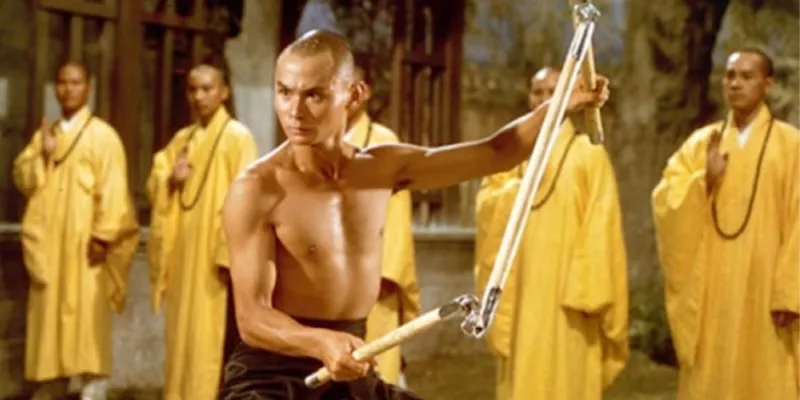
This is one of the most difficult weapons to master. It combines the length of the staff with the flexibility of the chain whip.
The Three-Section Staff is versatile. Fully extended, it acts as a long weapon. Held by the center section, it functions as dual short sticks for close-range boxing. Held by both ends, it can be used to block and trap. Its most dangerous feature is its ability to wrap.
If an opponent blocks a strike, the flexible joints allow the hitting end to fold over the block and strike the target behind it. It requires high coordination; a mistake can easily result in the practitioner striking themselves.
Applications in Shaolin Kung Fu Styles:
Shaolin San Jie Gun: The core form teaching the folding, spinning, and extension methods.
Chain Whip (Jiu Jie Bian)
The Chain Whip, or Jiu Jie Bian, consists of nine metal sections linked together with a handle and a heavy dart at the tip. It is a soft and hidden weapon, relying on rotational inertia and speed and used for long-range whipping attacks.
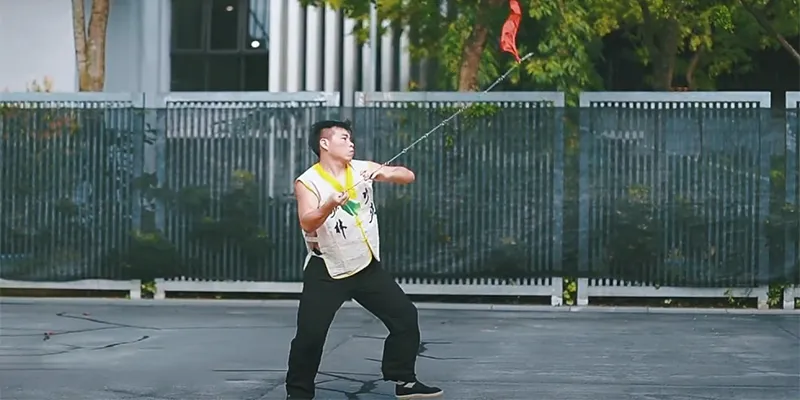
The chain whip typically consists of nine metal sections linked together with a handle and a heavy dart at the tip. It is easily concealed in a sleeve or belt, making it a surprise weapon.
The chain whip must be kept in constant circular motion; if it stops, it becomes useless. The practitioner uses the joints of the body—elbows, neck, knees, and ankles—as pivot points to accelerate the whip and change its direction.
It is primarily a mid-range weapon used to strike the head or wrap around limbs to trip or disarm. The visual display is dazzling, often used to intimidate, but the strike of the tip carries enough kinetic energy to fracture bone.
Applications in Shaolin Kung Fu Styles:
Solo Chain Whip: Performance and combat sets focusing on wrapping and shooting techniques.
Double Chain Whip: An advanced variation using a whip in each hand.
Monk’s Spade (Yue Ya Chan)
The Monk’s Spade, or Yue Ya Chan, is a distinctive Shaolin weapon with a spade on one end and a crescent blade on the other, originally a tool for traveling monks to bury the dead and clear paths.
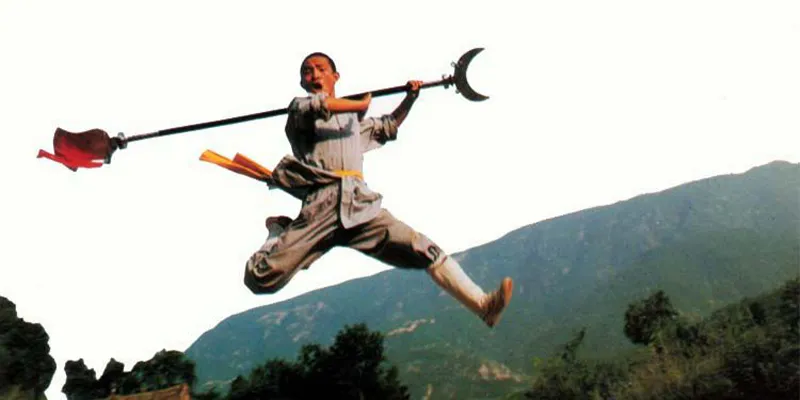
This weapon is synonymous with the character Lu Zhishen from The Water Margin. It is a heavy weapon, often weighing over 50 pounds in traditional practice, designed to build immense physical power.
The monk’s spade is a weapon of momentum and geometry. The spade end is used for digging and undercutting, while the crescent moon end is used to hook the neck or limbs.
Because of its weight, it cannot be manipulated with the wrist like a spear; the movement must come from the core and the turning of the waist. It acts as a defensive wall. The wide blades make it excellent for blocking projectiles and crowd control.
Applications in Shaolin Kung Fu Styles:
Shaolin Chan: Forms that emphasize low stances, heavy rooting, and wide, clearing movements.
Tiger Hook Swords (Shuang Gou)
Double hooks, Shuang Gou, are paired curved blades in Shaolin Kung Fu, designed for hooking, slashing, and trapping. Exotic dual weapons featuring a hooked tip, a sharpened guard, and a spear point, designed for disarming and maiming.
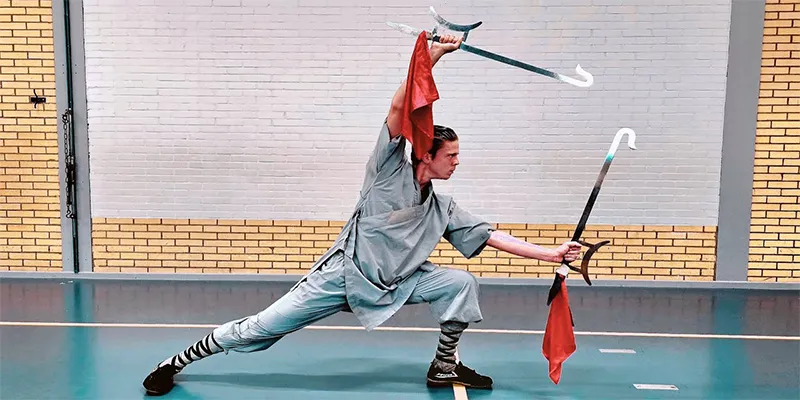
These are typically used as a pair. They appear intimidating and are purely martial weapons, with no agricultural origin.
The Tiger Hooks has four damaging components: the tip for stabbing, the hook for catching weapons, the crescent guard for slashing, and the sword blade for cutting. This weapon is linking the two hooks together. This suddenly doubles the practitioner’s reach, allowing them to swing the outer sword like a flexible meteor hammer to cut a distant opponent.
Applications in Shaolin Kung Fu Styles:
Mei Hua Shuang Gou: A set designed to fight against long weapons like the spear by trapping the shaft in the hooks.
Damo Cane (Damo Guai)
A T-shaped crutch-like weapon associated with Bodhidharma, emphasizing humility and the ability to turn a support tool into a devastating defensive instrument.
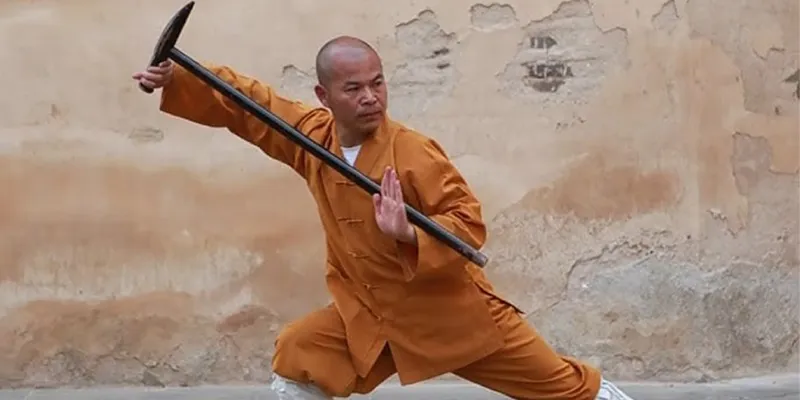
Legend has it that Bodhidharma used a cane to aid his travel to the Shaolin Temple. This weapon symbolizes the monk’s nonaggressive nature—it is a walking aid first and a weapon second.
The cane is a short-range weapon primarily used for locking, hooking, and striking pressure points. The perpendicular handle allows for high-leverage blocks and can be used to hook an opponent’s leg for a takedown. The shaft is used to strike, while the tip is used to poke. It is highly effective in close quarters where long weapons are disadvantaged.
Applications in Shaolin Kung Fu Styles:
Damo Cane Forms: Specific sets that mimic the hobbling walk of an elderly monk to lure opponents in before striking with sudden speed.
Pu Dao
A lighter infantry variant of the Guan Dao, combining the leverage of a staff with the cutting power of a broadsword.
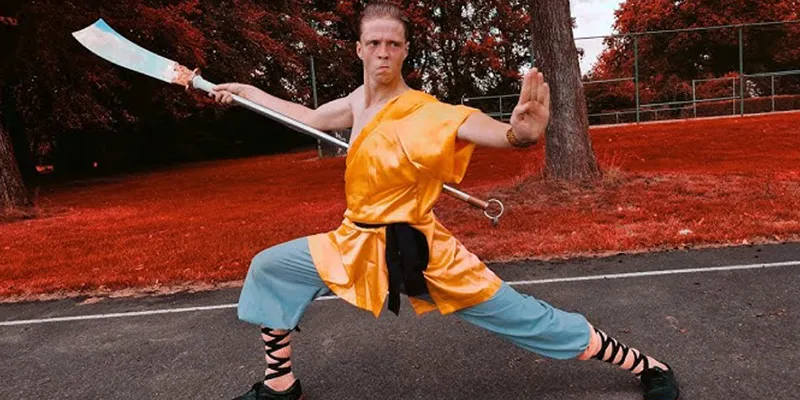
Often called the “Horse Cutter,” the Pu Dao consists of a broad, heavy blade attached to a medium-length wooden staff (shorter than a spear but longer than a sword).
The Pu Dao is a weapon of war. It is designed to cut through armor and, as the name suggests, cut the legs of horses on the battlefield. It utilizes the “slashing” energy of the saber but with the increased leverage of the staff.
The practitioner uses the weight of the blade to generate centrifugal force. Movements are large, circular, and continuous. It is excellent for fighting multiple opponents, as the heavy blade can clear a wide radius.
Applications in Shaolin Kung Fu Styles:
Shaolin Pu Dao: Focuses on waist rotation, heavy chopping, and low-stance sweeping attacks.