Adult Kung Fu Training for Your Goals
The greatest regret before joining a martial arts class is not choosing the wrong uniform or starting as a beginner. It is entering a program without knowing what kind of practice you truly seek. Adult Kung Fu Training can mean fitness, self defense, traditional forms, quiet internal practice, cultural study, or a disciplined combination of all these paths. Each aim asks for a different teaching method, pace, and relationship with the instructor.
At SJF Kung Fu School, we encourage adults to begin with honest reflection. A strong body is valuable, but traditional Chinese martial arts also ask for attention, patience, respect, and Wu De, the martial virtue that guides conduct in training and daily life. The right school should help you build skill without asking you to become someone else.

Before attending a trial class, identify your main goal, ask how the instructor teaches beginners, and observe whether the training environment supports steady practice. A school may offer many subjects, yet the best choice is the one with a clear path that suits your present condition and your reason for studying.
Start with the outcome you want from practice
Adults often arrive with several goals at once. You may want better mobility, practical self defense, stress relief, a deeper connection with Chinese culture, or time away from routine. These aims can work together, but one should lead your decision. When the primary goal is clear, you can judge whether the class structure and instructor approach are suitable.
Choose a primary goal before choosing a style
- Fitness and mobility: Choose a class that includes stance work, basic movement, coordinated forms, stretching, and gradual conditioning. This suits adults who want regular physical activity without making combat their main focus. It may not suit someone seeking frequent sparring practice.
- Self defense: Look for controlled partner practice, distance awareness, balance disruption, practical movement, and clear safety rules. San Da training, Qin Na, and Ge Dou can support this goal. Self defense study requires patience and responsible practice; it is not a promise of instant skill.
- Traditional Kung Fu study: Choose a school that explains forms, body mechanics, lineage, martial ethics, and the purpose behind techniques. This fits students who value long term learning and cultural depth. It requires consistent repetition rather than quick visible results.
- Internal practice and calm focus: Tai Chi, Qi Gong, Zhan Zhuang, and meditation may suit adults seeking posture awareness, breathing discipline, and a quieter mind. This path can be physically demanding in subtle ways, especially when learning correct alignment.
- Cultural immersion: Consider a school in China with a training setting connected to martial history. SJF Kung Fu School is located near the Shaolin Temple, with more than 30 cultural and historical attractions nearby. This is suitable for students who want their practice to include place, history, and daily training life.
A useful rule is simple: do not judge a class only by how difficult it looks. Judge it by whether the difficulty serves your purpose. Fast kicking drills may be excellent for conditioning, while quiet standing practice may be more appropriate for learning structure, breathing, and mental steadiness.
Compare class formats teaching styles and progression paths
When comparing adult kung fu classes, ask not only which style is offered but how that style is taught. The same movement can be taught as exercise, combat application, traditional form, or meditative practice. Each approach has value when it matches the student’s purpose.
| Primary goal |
Suitable class format |
Teaching style to seek |
Likely progression path |
Best fit and limits |
| Fitness and coordination |
Regular group basics, forms, stretching, stance practice |
Clear demonstrations, manageable repetition, posture correction |
Foundational stances, hand forms, footwork, longer routines |
Fits adults wanting discipline and movement. It may not provide extensive partner defense practice. |
| Practical self defense |
Partner drills, controlled contact, movement practice |
Safety focused instruction with practical applications |
Guard, distance, striking basics, escapes, controlled exchanges |
Fits students who want applied skills. It requires calm decision making and regular partner work. |
| Traditional practice |
Forms, applications, weapons, cultural study |
Lineage based instruction and explanation of purpose |
Basics, forms, applications, weapon foundations, deeper refinement |
Fits long term students. Progress is often gradual and repetition is central. |
| Tai Chi and internal training |
Slow forms, standing practice, breathing, quiet attention |
Detailed alignment guidance and patient correction |
Zhan Zhuang, foundational movement, form sections, weapons where appropriate |
Fits adults seeking body awareness and calm focus. It is not passive exercise. |
| Short cultural immersion |
Daily intensive practice with selected subjects |
Adaptable instruction based on level and available time |
Fundamentals, a focused style, cultural visits, independent practice habits |
Fits travelers with limited time. It introduces a path but cannot replace long term repetition. |
For adults comparing Shaolin kung fu for adults, a broad curriculum can be helpful only if the school can guide you toward a sensible starting point. At SJF Kung Fu School, training includes nine distinct martial arts styles: Shaolin Quan, San Da, Qin Na, Tai Chi, Qi Gong, Zhan Zhuang, Ge Dou, Chinese Weapon, and Meditation. A wide offering matters because a student interested in combat movement may need a different emphasis from a student seeking Chen style Tai Chi and standing practice.
Master Shen Jiangfei is a descendant of Liuhe Quan and the 11th generation inheritor of Chen style Tai Chi, recognized as the original and oldest of the five primary family styles. This background is especially relevant for students who want teaching rooted in traditional transmission rather than only fitness routines.
Assess the instructor the training space and the learning culture
Knowing how to choose a kung fu school begins with observing what happens in the room. Watch a class if possible. Do students receive corrections? Are beginners treated with patience? Is partner work supervised? Does the teacher explain why a stance, breath, or hand position matters?
A respectful school does not remove challenge. It gives challenge a proper place. In traditional practice, humility is not weakness. It allows a beginner to accept correction and allows an experienced student to return to the basics with a clear mind.
What to check during a trial class
- Ask about beginner progression. A suitable kung fu school for beginners should explain what a new adult practices first, rather than placing every student into advanced routines immediately.
- Observe correction methods. Good correction is specific. An instructor may adjust foot direction, hip position, shoulder tension, or breathing rhythm. Vague encouragement alone does not teach body mechanics.
- Check safety in partner work. Controlled practice should include boundaries, supervision, and appropriate intensity. This matters particularly in San Da, Qin Na, and Ge Dou practice.
- Look for a clean, usable training environment. SJF Kung Fu School has a 200 square meter indoor training center with mats, wooden dummies, traditional weapons, and a meditation hall. Indoor space allows year round practice regardless of weather.
- Ask about class size and access. Regular classes at SJF Kung Fu School have no minimum enrollment requirement. Group bookings require at least two students. This can help solo learners who do not want to delay their plans while waiting for a group.
- Listen for cultural context. A teacher should be able to explain the difference between performance, combat application, health practice, discipline, and meditation without making unrealistic claims.
When considering what to look for in an adult kung fu class, notice whether the school respects your starting point. Adults may carry old injuries, demanding work schedules, family responsibilities, or prior martial arts habits. A good instructor does not ignore these realities. At the same time, the student must remain responsible for communicating limitations and practicing with care.
Match your available time to a realistic training commitment
Time is not merely a scheduling detail. It shapes what you can reasonably learn and retain. A one week course can offer a meaningful first encounter with Kung Fu practice, while several months create more room for refinement, physical adaptation, and deeper understanding of forms.
| Program length |
Suitable purpose |
What to prioritize |
What not to expect |
| One week |
First experience, cultural immersion, focused introduction |
Basic stances, one selected subject, daily practice habits |
Full mastery of a style or a finished self defense system |
| One month |
Focused foundation and meaningful routine |
Posture, conditioning, form sections, selected applications |
Perfect technique without continued practice after departure |
| Three months |
Structured development across body and mind |
Consistency, deeper basics, form refinement, individual weaknesses |
Identical progress for every student |
| Six months or longer |
Serious traditional study and sustained conditioning |
Refinement, broader curriculum, personal practice discipline |
A substitute for lifelong learning |
SJF Kung Fu School offers programs from one week intensive courses to long term training. The sensible choice depends on your aim. A visitor with limited time may benefit from a One Week Kung Fu Course built around foundations and cultural experience. A student seeking a stronger daily routine may prefer a one month Kung Fu Course. For deeper study, a Three Month Kung Fu Course allows more time for repetition and adjustment.
Consider Andrew Williams from the United States, who spent 30 days training Tai Chi, Zhan Zhuang, and Dao Fa with his son. He described the experience as life changing physically, mentally, and spiritually, and plans to return. His example does not mean every student will have the same result. It does show how a focused month, shared with family and supported by regular practice, can become meaningful.
Choose subjects that support one another
Traditional Kung Fu is not a collection of unrelated techniques. Stance work supports striking. Breathing supports steadiness. Forms teach coordination. Partner drills reveal whether posture remains useful under pressure. Meditation can help a student meet difficulty without unnecessary tension.
A balanced adult program may combine one main subject with one supporting practice. This prevents the beginner from scattering attention across too many styles while still allowing the body and mind to develop in connected ways.
- Shaolin Quan with Zhan Zhuang: Suitable for students who want traditional movement and stronger structure. Shaolin Quan training can develop coordinated forms, while standing practice teaches patience and alignment.
- Tai Chi with Qi Gong: Suitable for adults who want measured movement, breathing awareness, and internal practice. You can Learn Tai Chi in China alongside quiet exercises that support posture and attention.
- San Da with Qin Na: Suitable for students interested in practical movement, distance, timing, and controlled close range skills. This combination needs responsible partner practice and does not suit students seeking only gentle exercise.
- Chinese Weapon with forms: Suitable for students who already have basic coordination and want to study timing, range, and traditional movement patterns. Weapon study should begin with safety and instructor guidance.
- Meditation with any physical subject: Suitable for adults who want to develop attention and emotional balance alongside physical training. Meditation does not replace technical practice, yet it can improve the quality of attention brought to practice.
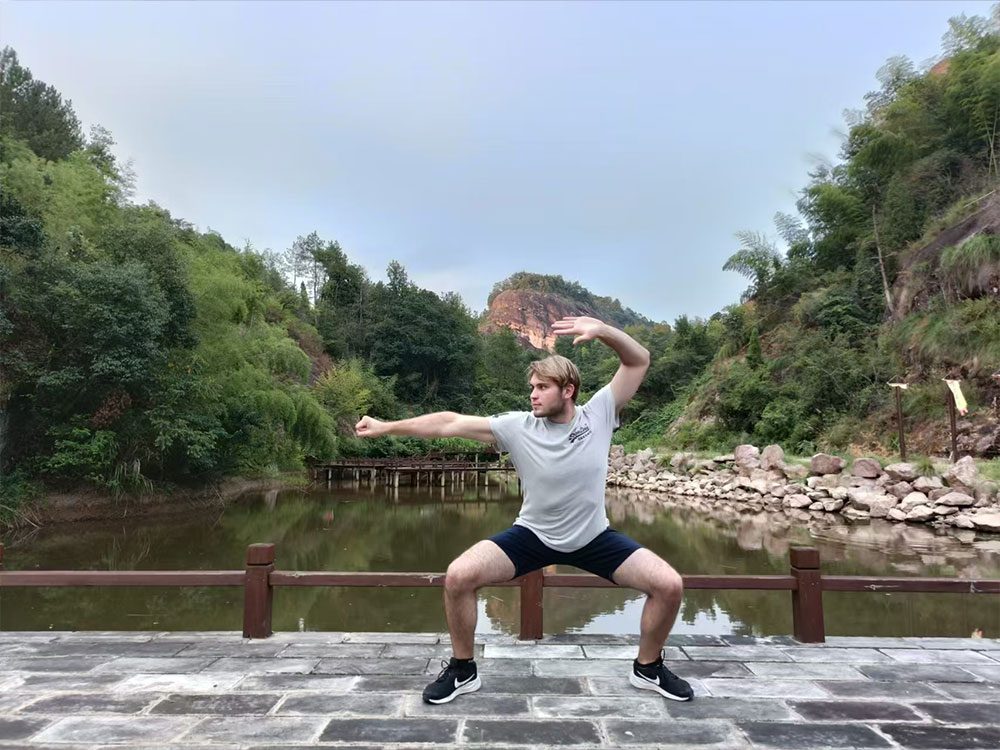
For example, a beginner focused on stress reduction may begin with Tai Chi, Qi Gong, and Zhan Zhuang rather than immediately adding demanding combat drills. An adult who wants to improve confidence in physical encounters may begin with San Da movement and basic Qin Na under close instruction, then add forms to improve coordination. The correct choice is not fixed. It should reflect your health, temperament, available time, and willingness to practice.
Use real student experiences as context rather than promises
Testimonials can reveal what students valued, but they should not be treated as guarantees. Look for details that relate to your own priorities: teacher care, training focus, accommodation, cultural setting, or the ability to adapt instruction.
Klaes Risbjerg Simonsen from Denmark completed a 30 day Tai Chi, Zhan Zhuang, and Broadsword course. He chose SJF Kung Fu School because he wanted an authentic and focused experience rather than a tourist focused stay. He felt from the first day that he was in the right place and praised Master Shen for adapting training to his specific needs.
Hayley Noel from the United Kingdom completed a 120 day course in Tai Chi, Zhan Zhuang, Sword, and Broadsword. Her family later expressed gratitude that she had enjoyed her time in China. This case may be relevant to adults considering a longer stay, but it does not mean that every student needs four months to benefit. The lesson is that duration should match intention.
SJF Kung Fu School has trained more than 3,000 students worldwide since its establishment in 2009. That experience matters, yet your own decision should still rest on a direct conversation about your goals, level, and preferred pace of study.
Prepare thoughtful questions before your first class
The best first conversation is clear and respectful. You do not need martial arts vocabulary. You only need to describe what you hope to gain and what concerns you may have.
- Which subjects are most suitable for my main goal?
- How are beginners introduced to stance work, forms, and partner practice?
- How does the instructor adjust training for age, fitness level, or prior experience?
- Can I focus on Tai Chi, Shaolin Quan, San Da, or another selected subject?
- What does a normal training day look like for a short course or longer stay?
- How are Wu De, respect, and cultural understanding practiced in class?
- Which program length gives me enough time for my intended outcome?
The right Adult Kung Fu Training program should leave you with more than fatigue after class. It should give you a clearer posture, steadier attention, deeper respect for practice, and a method you can continue carrying into daily life.
If you are seeking traditional Chinese martial arts with sincere guidance, contact SJF Kung Fu School to discuss the training path that best fits your goals.



 WhatsApp