Budget to Learn Kung Fu in China for 3 Months
Most students who plan to learn Kung Fu in China budget for tuition and then discover, around week six, that they forgot everything else: the visa paperwork, the insurance period, the transfer from the station, the weekend trip to a temple. A three month stay rewards the person who counts every line before booking. This guide breaks a stay like our Three-Month Course into cost lines you can check one by one, and explains the training reasons behind them.
We do not print one fixed total here. The real number depends on your home country, your travel dates, your room arrangement, and the styles you choose. What follows is a method. The school confirms tuition and what is bundled in a written quote, and you fill in the rest yourself.
Why Three Months Is Different from a Short Visit
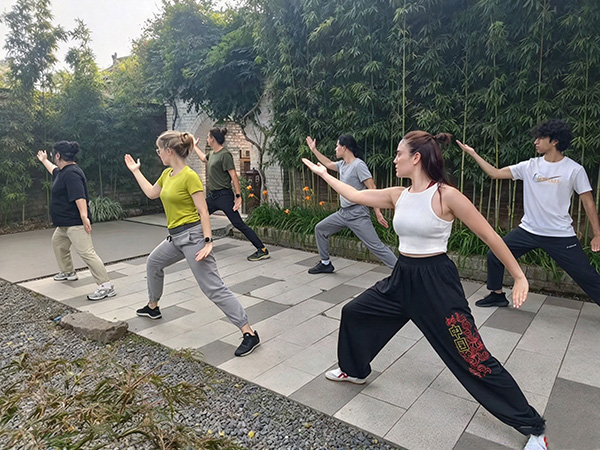
In the old teaching, a stance is not learned. It is settled into. Master Shen Jiangfei is a descendant of Liuhe Quan and the 11th generation inheritor of Chen style Tai Chi, the original and oldest of the five primary family styles. He teaches that the body must first be emptied of habits before it can hold new ones.
That is why the first weeks of Tai Chi feel humble. You learn to stand, to breathe low, to turn from the waist instead of the shoulders. In Zhan Zhuang, the standing practice of holding a posture like a tree, the legs tremble within minutes. Over weeks the trembling becomes steadiness. Thirteen weeks gives that process room to happen.
Where this does not apply: if you have only seven days, a one week course is a real taste of the practice, not a smaller version of three months. Pamela Paes Ezawa from Brazil and Othmane Echaouki and his wife from France both completed seven day Chen style Tai Chi courses and valued the setting and the care. They did not expect mastery in a week, and neither should you.
The All-In Three-Month Budget Formula
Use this formula and fill every letter before you decide. A blank letter is a risk, not a zero.
Total = T + L + M + V + I + R + P + B
| Line | What it covers | Status | How to pin it down |
|---|
| T: Tuition | Daily training in your chosen styles for about 13 weeks | Unknown until quoted | Request a written quote for the three month program |
| L: Lodging | Your room for the full stay | Unknown until quoted | Ask whether lodging is bundled, shared or private |
| M: Meals | Daily food | Unknown until quoted | Ask which meals are included and what you buy yourself |
| V: Visa | Application fees and documents | Estimated by you | Check your nearest Chinese embassy or consulate page; fees vary by nationality and visa type |
| I: Insurance | Medical and travel cover for 90 days or more | Estimated by you | Get an insurer quote and confirm martial arts training is not excluded |
| R: Transfers | Airport to school, the return, local rides | Estimated by you | Ask the school about pickup and typical routes |
| P: Personal spending | Laundry, snacks, phone, weekend visits | Estimated by you | Pick a weekly figure and multiply by 13 |
| B: Buffer | Anything unplanned | Your own rule | A common planning habit is 10% of the other lines; this is a suggestion, not a school figure |
Confirmed facts you can build on
The school offers short and long programs, from one week intensives to extended training, including a three month course.
Regular classes have no minimum enrollment. Group bookings need at least 2 students.
Training takes place in a 200㎡ indoor center, so weather does not cancel practice.
Students in our cases praised the accommodation and food. Austin Erkl from the USA did so after a 30 day stay.
Estimated costs you must research yourself
Visa fees, which depend on your passport.
Insurance for the length of your stay.
Transfers and personal spending, which depend on your habits.
Unknown costs to ask about directly
The tuition figure for your styles and dates.
Whether lodging and meals sit inside tuition or beside it.
What support documents the school can provide for your visa application.
"Confirmed" here means a fact about the program, not a price. If you want the unknown lines turned into numbers, ask SJF Kung Fu School for a written quote. Include your arrival month, the styles you want, and whether you travel alone or with a companion.
Where to Spend and Where to Save
Spend on training-focused lodging
Conclusion: choose the room that keeps you close to the training hall over the nicer room that sits farther away. Reasoning: Pamela praised the training-focused accommodation, and Klaes Risbjerg Simonsen from Denmark chose us because he wanted a focused experience, not a touristy resort. Fits: solo students who need quick rest between sessions. Limits: if you have specific sleep, diet, or health needs, raise them before booking. Do not assume they can be met.
Spend on insurance that matches the practice
Conclusion: read the exclusions before you pay. Reasoning: training in Zhan Zhuang, San Da, or joint locks puts load on knees, wrists, and shoulders, and some policies treat martial arts as a special activity. Fits: any stay beyond a few weeks. Limits: a cheaper policy is fine only if it clearly covers training and the full 90 days.
Save on early purchases and extras
Conclusion: hold back on gear and souvenirs until you arrive and ask what you actually need. Reasoning: Austin admitted he did not love the training at first. After he adjusted, he had a great time. A student still adjusting is the one most likely to overbuy. Limits: keep money aside for the 30 plus cultural and historical sites near the Shaolin Temple. Seeing them is part of the education.
A worked example: scaling the formula
Hayley Noel from the UK completed a 120 day course in Tai Chi, Zhan Zhuang, Sword, and Broadsword. That is about four months, not three. If you plan a stay like hers, multiply the monthly lines (lodging, meals) by four and the weekly personal line by roughly 17. Her family wrote to Master Shen that they had been worried when she flew out, but she loved it so much and has had an awesome time. She plans to return soon. A longer stay costs more in every line, so recalculate instead of stretching a three month total.

Common Budgeting Mistakes
Comparing tuition only. One program may bundle lodging and meals while another does not. Compare the whole formula, never one letter.
Treating an estimate as a fact. Your insurance figure and weekly spending are guesses until you have a quote or a habit to measure.
Insuring for the wrong dates. A policy that ends on day 60 leaves a month uncovered.
Skipping the buffer. A cold week, a missed connection, or one extra weekend away can use it up.
Budgeting for a resort. Klaes wanted focus, and from his first day felt he was in the right place. A stay built around early mornings and repetition needs a different kind of spending plan.
Not asking about changes. If you might shorten or extend, ask how that affects the quote before you pay.
What the Money Buys Beyond the Line Items
Numbers measure cost. They do not measure what you carry home. Traditional martial arts are taught through Wu De, the martial virtues of humility, respect, restraint, and perseverance. A student learns them by sweeping the floor, waiting a turn, and repeating a movement a hundred times without applause.
Practices such as Qi Gong teach you to feel breath and internal energy move through a stance. Shaolin Quan carries the discipline of the temple tradition into the body. Meditation, in the Zen spirit, asks you to stop chasing results.
Andrew Williams from the USA trained 30 days in Tai Chi, Zhan Zhuang, and Dao Fa with his son. He called it life changing, strengthening him physically, mentally, and spiritually, and plans to return next year. Klaes praised the Shifu for being highly qualified and adapting training to his needs. Such care cannot be priced as a line item, yet it shapes how much three months will give you.
Step by Step: Turn This Guide into a Quote Request
Decide your stay length and two or three styles, for example Chen style Tai Chi, Zhan Zhuang, and a weapon form.
Research V, I, and R from official and insurer sources, and write each down as an estimate.
Send the school your arrival month, styles, solo or pair booking, and any health notes.
Ask five direct questions: the tuition amount, the lodging type, which meals are included, whether pickup is offered, and what visa support documents the school can provide.
Put the replies into T, L, and M, then set a weekly figure for P and multiply by 13.
Add B at your chosen percentage and compare the final total with your savings.
If the total feels heavy, shorten the plan instead of cutting insurance or your buffer.
Your Next Step Toward the Training Hall
If you want to learn Kung Fu in China, you do not have to settle every question today. Many students start with 30 days. Andrew, Austin, and Klaes all began that way, so it is a sensible first test of whether the training suits you. You can read about our 30 Day Kung Fu Course and then decide whether three months is right.
When you are ready, use the contact details on the school's website to request a written quote for the three month program. Send us your styles and your arrival month. Master Shen and the team welcome sincere seekers of traditional Chinese martial arts, and we are glad to answer your questions with patience.




 WhatsApp