Build Chinese Weapon Training Control Through Staff Basics
How can a new student begin Chinese Weapon Training without rushing into fast spins, long forms, or unsafe movements? Start with one clear goal: keep the staff connected to your stance, hands, breath, and attention. At Chinese Weapon classes at SJF Kung Fu School, students first learn to feel where the staff is moving before they try to make it move quickly.
A staff is simple in appearance, yet it reveals many habits. If the feet are unstable, the staff will pull the body off balance. If both hands grip too tightly, the shoulders rise and the movement becomes stiff. If the eyes follow the tip without awareness of the rear end, control is incomplete. The early work is quiet, but it has purpose. It develops Wu De, the martial virtue of patience, self-discipline, respect, and responsibility.
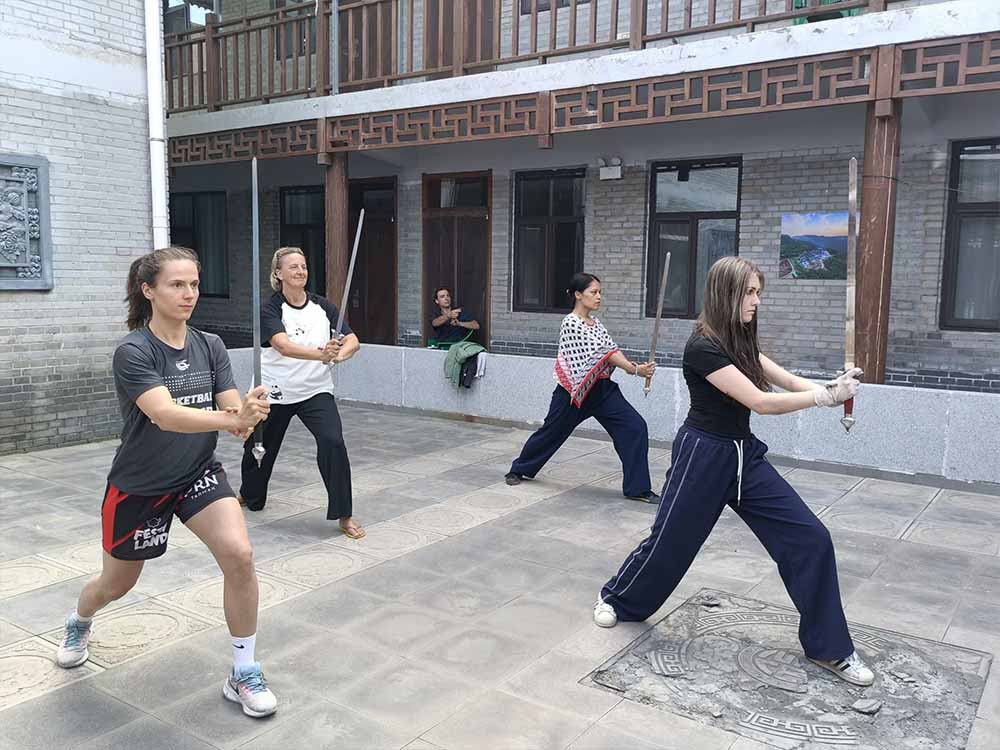
Prepare the body and space before lifting the staff
The correct starting condition is not strength or prior martial arts experience. It is a calm body, enough clear space to move safely, and a willingness to repeat simple actions. This fits adults, young learners, and returning martial artists who need to rebuild control before studying forms.
For Chinese staff training, use an instructor-provided staff whenever possible. A beginner should not select a staff based only on appearance or copied online demonstrations. The tool must be suitable for the student’s height, coordination, and current physical condition. These details are best checked in person by an instructor.
Starting requirements for the first practice
Clear practice area: Stand where the staff can move in front, behind, and to each side without striking people, walls, furniture, or hanging objects.
Stable footwear: Use shoes that do not slide easily, or practice barefoot on a suitable training surface if instructed.
Relaxed shoulders: Before holding the staff, raise and lower the shoulders once. If they remain tense, pause and reset.
Quiet attention: Put phones aside. A staff changes direction quickly, so divided attention creates avoidable errors.
Teacher supervision: Practice new motions slowly with an instructor when available, especially changes from one side of the body to the other.
The staff should be treated as an extension of the body, not as a separate object to swing. This principle also appears in Zhan Zhuang practice, where still posture teaches students to notice weight, alignment, and unnecessary tension before movement begins.
Do not begin by copying advanced spins from videos. Those movements may look impressive, but they demand timing, spatial awareness, and a stable base. The first task is smaller: hold the staff without locking the arms, step without crossing the feet, and stop the staff where you intend.
Use stance, hand changes, and slow direction drills before forms
The most useful beginner sequence is action-based. First establish the stance. Then learn the two-hand grip changes. Only after that should the student practice slow changes of direction. This order prevents the common loss of control that occurs when a student attempts a complex form before understanding where the staff’s two ends are traveling.
| Training stage | Action to perform | Checkpoint for control | Why it comes before forms | Common reason it fails |
|---|
| Stance foundation | Stand with knees soft, feet grounded, and weight balanced before moving the staff. | You can turn your head left and right without wobbling or shifting the feet. | A stable lower body prevents the staff from pulling the torso out of position. | The student bends forward, locks the knees, or stands too narrowly. |
| Two-hand grip changes | Slide and reposition one hand at a time while the other hand keeps the staff supported. | The staff does not drop, jerk, or swing outside the intended path. | Hand changes teach responsibility for both ends of the weapon. | Both hands release or move at once without control. |
| Slow direction drills | Guide the staff from front to side, side to rear, then return along the same route. | You can stop at each position without leaning or holding your breath. | Slow turns expose errors before speed hides them. | The student watches only the front tip and forgets the rear end. |
| Short linked pattern | Connect stance, grip change, and direction change in a small repeated sequence. | Each movement begins and ends in balance. | A form becomes meaningful only when its parts remain under control. | The student memorizes the order but loses posture and tempo. |
This progression suits a beginner who wants a structured entry into Shaolin stick training. It also suits an experienced martial artist who has trained empty-hand methods but has not yet learned to manage the distance and weight of a staff. It does not replace personal coaching for fast, partner, or striking practice. Those activities require closer observation and a suitable training setting.
At SJF Kung Fu School, Master Shen Jiangfei teaches within the lineages of Liuhe Quan and Chen-style Tai Chi. As an 11th-generation Chen-style Tai Chi inheritor and a descendant of Liuhe Quan, he places body alignment and deliberate direction ahead of hurried performance. That teaching approach helps students understand that stillness is not the opposite of martial skill. It is the foundation of control.
Practice four staff basics in a repeatable first session
The following sequence gives new students a defined first session. Move slowly enough that you can stop at any point. Speed is not the measure of success. Clear posture and deliberate stopping are better signs.
1. Find the centered standing position
Stand upright with the feet comfortably apart and the knees slightly bent.
Hold the staff in front of the body with two hands, keeping the elbows soft rather than pushed straight.
Look forward, not downward at the hands.
Breathe naturally for several breaths without moving the staff.
Notice whether one shoulder is higher or whether one hand is squeezing harder.
Success check: The staff remains quiet while your breathing stays even. Recovery: If the shoulders rise, lower the elbows slightly and reduce the grip pressure. Do not correct tension by forcing the staff downward.
2. Learn how to hold a Chinese staff with active but relaxed hands
Students asking how to hold a Chinese staff often focus only on hand placement. Placement matters, but pressure matters too. One hand guides while the other supports and adjusts. Both hands should remain awake, yet neither should grip as if trying to crush the staff.
Hold the staff with both palms closed around it, keeping the wrists in a natural line.
Move the staff a short distance forward, then bring it back to center.
Keep the elbows close enough to protect the body, without pressing them tightly against the ribs.
Pause at center before repeating.
Switch the leading hand only after the staff has stopped.
Success check: The staff travels in a controlled line and returns without bouncing. Recovery: If the staff jerks when changing hands, make the movement smaller. The likely error is that both hands are trying to lead at the same moment.
3. Perform the front, side, and rear direction drill
This is one of the most useful kung fu staff drills for learning spatial awareness. Begin with slow arcs. The purpose is not to strike the air. The purpose is to know where each end of the staff is going.
From the centered position, guide the front end toward one side of the body.
Turn the waist a small amount while keeping the feet grounded.
Pause before the staff reaches its farthest intended point.
Return to center using the same path.
Repeat to the other side.
Only after both sides feel controlled, guide the staff behind the body under supervision.
Success check: Your head stays level, your feet remain stable, and the rear end does not swing unpredictably. Recovery: If the rear end comes too close to the leg or shoulder, shorten the arc and slow the waist turn. Do not solve this by moving faster.

4. Link the motions without adding speed
When stance, grip, and direction changes are clear, combine them: stand at center, move to one side, return to center, change the leading hand, move to the other side, and return again. Practice this as one continuous pattern, but include a brief moment of stillness at each center position.
This pause has martial value. It teaches the body to finish one action before beginning another. In traditional practice, a form is not merely a remembered sequence. It is a record of timing, posture, intention, and change.
Correct common staff control mistakes before they become habits
Early corrections save time. A student does not need dozens of new movements when one basic error is disturbing every movement. Use the list below as a self-check after each short practice period.
Looking only at the front end: This causes the rear end to drift. Keep broad awareness of the whole staff, especially during turns.
Holding the breath during motion: Breath holding often raises the shoulders and stiffens the wrists. Exhale naturally as the staff changes direction.
Turning only with the arms: The staff then feels heavy and disconnected. Let a small waist turn support the arm movement while the feet remain grounded.
Changing hands too early: This creates a loose, unstable transition. Stop at center first, then move one hand with purpose.
Practicing too close to obstacles: The body begins to hesitate, and the motion becomes distorted. Create more clear space before repeating the drill.
Chasing speed: Fast motion can hide poor alignment. Return to slow direction drills until every stop is balanced.
A controlled staff should not make the student feel rushed. It should make the student more aware. This is why foundational work can support other studies such as Shaolin Quan, where stable stances and coordinated waist movement remain central even without a weapon.
Verify control before progressing to a staff form
Before learning a longer pattern, test whether the basic task is complete. A student is ready to add a simple form only when the staff can be moved through the practiced paths without losing posture, breath, or awareness of both ends.
Use this readiness checklist
You can stand with the staff at center without tightening the shoulders.
You can change the leading hand one at a time without dropping or jolting the staff.
You can guide the staff to each side and return through the same path.
You can stop the staff at a chosen point without stepping unexpectedly.
You can repeat the sequence on both sides, even if one side remains less comfortable.
You can explain where the rear end of the staff travels during each turn.
If one of these checks fails, do not add more movements. Return to the stage that caused the problem. For example, if the staff feels uncontrolled during a hand change, the solution is not another form. Repeat the centered grip transition at a slower pace until the staff remains quiet.
Structured practice also allows people with different schedules to begin at an appropriate level. SJF Kung Fu School offers programs from a one-week intensive course to extended study, without a minimum enrollment requirement for regular classes. Students who want time for repeated basics before adding forms may consider a one month Kung Fu Course, while shorter stays can focus on a carefully supervised introduction.
Learn control as part of traditional practice
Staff work becomes deeper when it is not separated from character and daily discipline. A student may begin with a practical wish to learn movement, improve coordination, or experience Chinese martial culture. Over time, the staff can also teach restraint. The body learns that power without direction is wasteful, and movement without awareness is incomplete.
Master Shen has taught more than 3,000 students worldwide, including students who arrived with different levels of physical training and different reasons for studying. Andrew Williams from the United States spent 30 days practicing Tai Chi, Zhan Zhuang, and Dao Fa with his son. He described the experience as life-changing for his physical, mental, and spiritual development, and planned to return the following year. His experience does not promise the same result for every student. It does show what can happen when regular practice, teacher guidance, and patient attention are given time.
The school’s 200 square meter indoor training center allows practice throughout the year, regardless of weather. That consistency matters for beginner weapon training drills, because repetition in a stable setting helps the student notice small improvements rather than starting over after long interruptions.
When your stance is stable, your hands can change without panic, and you can guide the staff slowly in every direction, you have completed the first meaningful step. From there, forms become more than choreography. They become a method for refining body, mind, and conduct.
Contact SJF Kung Fu School to discuss a respectful, structured staff training plan with our instructors.



 WhatsApp