Build Taijiquan Skills With Push-Hands Basics
You have practiced the solo form for a year and your frame looks tidy. Then a partner rests a forearm on yours and leans. What happens? For most people the shoulders rise, the breath stops and the legs stiffen. The gap between a clean solo form and a calm response under pressure is where Taijiquan asks for partner training. Push hands, called tuishou in Chinese, closes that gap with light contact, slow circles and honest feedback.
This article is for practitioners who already know a form and want to understand the partner side. We look at what push hands trains, give you five beginner drills with checkpoints and failure causes, and explain how we approach this work at SJF Kung Fu School.

Why a Solo Form Is Only Half the Conversation
Every posture in a solo form carries an imagined partner. When Chen style Tai Chi names a movement "Lazy About Tying Coat" or "Buddha's Warrior Attendant Pounds Mortar", the body is answering a push, a grab or a strike that is not there. Without a real person you cannot test whether the answer works. Your balance may feel perfect simply because nothing disturbs it.
Master Shen Jiangfei is the 11th-generation inheritor of Chen style Tai Chi, the oldest of the five family styles. In that lineage the form and the partner work are two views of one practice. The form builds the structure, and push hands shows you where the structure is false.
| Aspect | Solo form practice | Push hands |
|---|
| Source of feedback | Your own sensation and a teacher's eye | A partner's pressure, felt immediately |
| What it builds | Structure, flow, breath, coordination | Sensitivity, timing, balance under load, yielding |
| Main blind spot | Hidden tension and false balance go unnoticed | Needs a calm partner and a controlled pace |
| Best used for | Building the frame | Testing and refining the frame |
Partner work also tests Wu De, martial virtue. Someone who wins every round by shoving has missed the point. Humility, restraint and care for your partner's joints are part of the technique, not decoration. Taijiquan has always been taught as a way of shaping character as well as movement.
What Push Hands Trains: Listening, Rooting and Yielding
The central skill is ting jin, "listening energy". You learn to read a partner's intention through the skin of your forearm before it becomes a push. The old Taiji classics say that four ounces can deflect a thousand pounds. That is not magic. It is timing, leverage and a body that does not resist where resistance is easy to exploit.
Yielding depends on a root. If your legs cannot receive force and send it into the ground, you will either collapse or brace with the arms. This is why we pair partner drills with Zhan Zhuang standing practice. Holding a still posture teaches the legs to carry weight while the shoulders and chest let go. The reasoning is simple: relaxed legs that are strong enough let the upper body stay soft.
In yin and yang terms, when your partner is full you become empty, and when they empty you fill. A beginner experiences this as a feeling of "sticking" to the partner's arm without gripping it.
Where this does not apply: push hands is not sparring or self-defense training. It develops the sensitivity that combat skills depend on, but striking, locking and throwing need their own practice. If you want those applications, San Da and Qin Na are the right companions.
Beginner Push-Hands Drills to Build Sensitivity, Balance and Yielding
Choose a partner of similar size and a calm temperament. Keep contact light, and treat 10 to 20 minutes per session as plenty at the start. Slow work teaches more than fast work. Go through the steps in order and do not move on until the checkpoint feels reliable.
Stand and root for three to five minutes. Take a shoulder-width stance with your weight evenly split, knees softly bent over the toes, and shoulders sinking.
Checkpoint: you could lift either foot without first shifting your weight.
Common failure: locked knees and a lifted chest, usually from rushing past the standing.
Single hand circles. Stand with the same-side foot forward. Touch wrists with your partner and trace a slow, upright circle together. Neither person pushes.
Checkpoint: the contact pressure stays about as light as a hand resting on a table.
Common failure: pressing, or breaking contact and chasing it, because you are trying to control the circle instead of listening to it.
Receive with peng. Your partner presses gently on your forearm. Round the arm like an inflated tube and let the force run down through your rear leg.
Checkpoint: you feel the pressure arrive in your back heel, not in the elbow or shoulder.
Common failure: a stiff elbow bracing against the push. The arm is doing the legs' job.
Yield with the waist. As the pressure comes in, turn from the waist so the incoming line slides past you. The hands follow the turn.
Checkpoint: your hands never move before your waist does.
Common failure: turning only the arm, or leaning back and losing your center. Both leave you off balance.
Double hand fixed-step circles. Practice the four phases, peng (ward off), lu (roll back), ji (press) and an (push), in one continuous slow circle. Swap roles every two or three minutes.
Checkpoint: the spine stays upright, the eyes stay level, and the breath keeps flowing.
Common failure: speeding up and competing. Once both partners want to win, listening stops.
A realistic rhythm for a student who already knows a form is three short partner sessions a week, with the form and standing practice on the other days. Stop immediately if a knee or wrist complains. People with knee problems should keep the stance high and the steps small.
If you would like a teacher to watch these steps in person, you can learn Tai Chi in China with us and bring your questions straight to the training floor.
Common Push-Hands Mistakes and How to Correct Them
| Mistake | What it looks like | Correction |
|---|
| Using local force | Shoulders rise, arms push | Return to step 1, sink the shoulders, and move from the waist |
| Disconnecting | Hands slip off, or you grab on | Slow the circle until contact feels constant and soft |
| Leaning | Head or chest travels ahead of the feet | Keep the crown of the head over the hips |
| Rushing | Speed climbs after a few minutes | Set a count: four seconds per circle |
| Treating it as a contest | Pushing the partner off balance | Aim to find your partner's tension, not to win |
A typical case. Picture a practitioner whose Chen form is smooth, but whose partner always finds a hard spot at the elbow. The fix is rarely more strength. We would ask them to hold a standing posture for a few minutes, then repeat step 3 until the pressure is felt in the heel. Within a few sessions the elbow usually softens, because the legs have started to share the load. This is a general teaching pattern, not a promise of a fixed timeline. Bodies vary.
Training Life Near the Shaolin Temple
Sensitivity is hard to build between busy days. It grows when practice becomes the rhythm of your life. Our school sits near the Shaolin Temple, with more than 30 cultural and historical sites within reach. The 200㎡ indoor hall lets us train every season, whatever the weather, on mats with wooden dummies and traditional weapons close at hand.
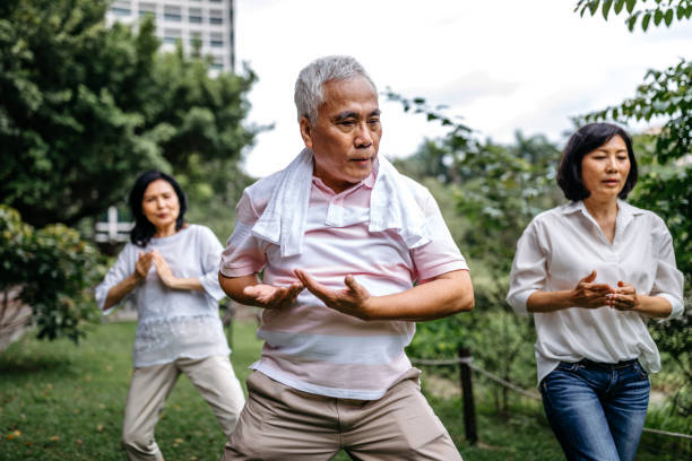
Students who have trained with Master Shen describe the atmosphere in their own words. These are their experiences of Tai Chi training in general, not specific claims about push hands:
Klaes Risbjerg Simonsen from Denmark trained for 30 days in Tai Chi, Zhan Zhuang and Broadsword. He wanted a focused experience, not a touristy resort, and felt he was in the right place from the first day. He praised the Shifu for adapting the training to his needs.
Andrew Williams from the USA trained Tai Chi, Zhan Zhuang and Dao Fa for 30 days with his son. He called it a life-changing experience that strengthened him physically, mentally and spiritually, and he plans to return.
Austin Erkl, also from the USA, admitted he did not love the 30-day Tai Chi and Sword course at first. After adjusting, he said: "The master is a great guy that cares for his students. I made some lifelong memories here and will cherish my time."
Master Shen has taught more than 3,000 students from around the world. Each arrives with a different body and background, so the drills above are always adjusted to the person in front of him.
How Push Hands Connects to the Rest of the Training
Push hands does not stand alone. These practices each strengthen one part of what it asks of you:
| Practice | What it adds to partner work |
|---|
| Zhan Zhuang | A stable root and relaxed shoulders |
| Qi Gong | Breath coordination and body awareness |
| Meditation | A quiet mind that notices tension early |
| Qin Na | Understanding joints, angles and controlled contact |
The Zen idea of "empty cup" fits this work well. A mind full of the wish to win has no room to listen. A mind that is still can feel a partner's weight shift a moment earlier than it otherwise would.
Come and Practice Push Hands With Us
Reading about listening energy helps, but the body only learns it through contact and patient correction. If you already know a solo form and want to understand the partner side of Taijiquan, we would be glad to hear from you. Tell us about your experience, any injuries and what you hope to understand, and we will suggest a suitable way to begin.
You are welcome to join us at SJF Kung Fu School, as a student or as a guest who wants to learn how this old art is practiced in its home country.




 WhatsApp