Chinese Weapon Training and Body Mechanics Explained
Why would a martial artist spend months holding a wooden pole when the goal is better punches, steadier stances, and cleaner Tai Chi? The short answer is that a weapon amplifies every small flaw in your structure. Chinese weapon training takes the way you stand, turn, and release force and shows it back to you through the tip of a staff, spear, or sword. If you are curious about the traditional Chinese weapons taught at our school, this article explains what each one does to the body and why it matters before you pick a class.
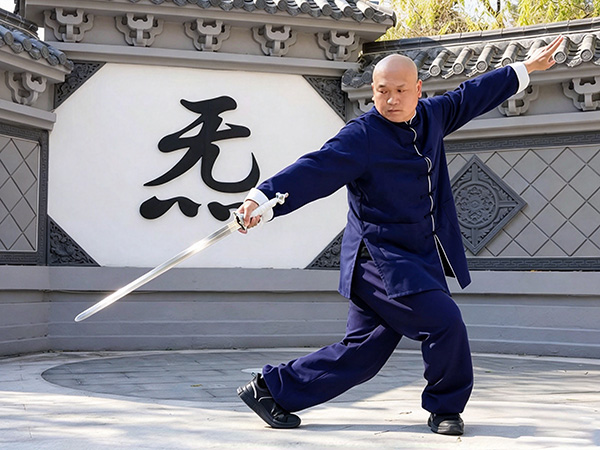
What a Weapon Shows That Empty Hands Hide
In empty-hand practice, a stiff shoulder or a collapsed hip can hide inside a fast punch. Put two meters of wood in your hands and the same fault shows up at once. The tip wobbles, the staff drags, the spear misses its line. The weapon works as a long, honest mirror.
Our teachers describe three things a weapon changes:
Reach becomes a skill. Force has to travel from the ground, through the legs and waist, then out past the fingers. Chinese martial arts weapons teach that path because a short cut through the arms fails visibly.
Feedback gets faster. A sword that whistles in the wrong place or a staff that bounces off your forearm tells you what is wrong without any explanation.
Timing gets slower to learn but deeper. A longer object takes longer to start, stop, and redirect. You learn to move before the moment arrives.
Master Shen Jiangfei, founder of SJF Kung Fu School, is an 11th-generation inheritor of Chen-style Tai Chi and a descendant of Liuhe Quan. In both lineages, weapons are not a separate hobby. They are another way to study the same waist, the same root, and the same relaxed power.
Four Body Mechanics Every Weapon Trains
Different weapons stress different parts of the body, but four mechanics appear again and again. Each has a practical effect and a trade-off.
Waist-led rotation. Turning from the hips and lower back moves the weapon with the whole torso. The effect is power that does not tire the shoulders. The trade-off is that beginners often need weeks of stance work before the waist moves without the arms taking over.
Grip and release. Holding too tightly blocks the force that travels along the shaft or blade. Loosening the grip trains the forearms and fingers to act as a tuned connector. The limit is that a loose grip with no structure behind it just drops the weapon.
Stacked alignment. Head, spine, hips, and weight-bearing leg must stay organized while the arms extend. This carries straight into stance quality. It also demands joint patience, and tight hips or ankles may need extra preparation.
Rhythm and breath. A weapon cannot be rushed through a sequence without losing its path. You learn to gather, release, and recover with the breath. The trade-off is that rhythm cannot be forced; it comes from repeated, relaxed practice.
These mechanics interact. A looser grip only helps when the waist is driving. A strong waist only transfers when the spine is aligned. That is why we usually ask students to fix the foundation before adding speed. This is also why the standing practice of Zhan Zhuang pairs well with weapons. Holding a still posture builds the root that every weapon later asks you to spend.
Staff, Spear, and Straight Sword Compared by Lever Action, Alignment, and Timing
An old saying lists the characters of the main weapons: the saber is like a tiger, the sword like a phoenix, the spear like a swimming dragon, and the staff like a whirlwind. Those images point to real differences in grip and movement. The table below summarizes how three common weapons train the body in typical traditional forms. Details vary by lineage and teacher, so treat it as a map and not a rulebook.
| Feature | Staff (Gun) | Spear (Qiang) | Straight Sword (Jian) |
|---|
| Grip | Both hands apart, sliding along the shaft | Rear hand steers and pushes, front hand slides as a guide | One hand, light hold; the free hand forms sword fingers |
| Lever action | Long lever; rear hand acts as pivot, front hand directs; waist rotation drives it | Longest lever; force travels in a line from rear leg through hip to the tip | Short lever; the wrist and fingers steer the tip with fine control |
| Alignment demand | Level shoulders and a stacked spine while both arms work | Tip, front hand, navel, and rear foot kept on one line | A soft chain from shoulder to elbow to wrist; blade angle follows the forearm |
| Timing pattern | Continuous and rolling, with quick changes of end and direction | Withdraw and launch; the classic circle, block, and thrust sequence | Light and flowing, moving between slow control and quick flicks |
| Stance demand | Frequent changes between bow, empty, and rest stances | Deep, stable bow stance with a firm rear leg | Narrow, high balance, often on one leg |
| Transfers to empty hand | Waist-driven striking, two-sided coordination | Straight-line power, linear punching, rooted pushing | Wrist sensitivity, relaxed arms, balance, Tai Chi flow |
Read across the rows and you can see how Chinese weapon body mechanics divide up. Staff and spear training both build long-lever power, but in different shapes: the staff rolls and circles, the spear drives straight. The sword goes the other way and trades length for finesse. Neither is "better." A higher demand on stance does not make the spear superior to the sword. It only means the spear exposes a different weakness.
A caution: these descriptions compare traditional forms. A short, modern performance routine may emphasize different movements, and a particular student's body may favor one weapon over another.
How Do Weapons Improve Kung Fu Beyond the Weapon Itself?
The honest answer is "it depends on what you carry across." Weapons help empty-hand skill when the body learns the underlying principle rather than the choreography.
Staff to striking. The rolling waist of the staff supports the whirling hands in Shaolin Quan and the rotational power used in San Da.
Spear to forward drive. The line from rear foot to tip trains the same pushing path used in a straight punch or a rooted shove.
Sword to sensitivity. Light grip and wrist control carry into the soft, connected hands of Tai Chi, which is why many of our students start with a sword after learning the basic forms. If you want to study that connection directly, you can learn Tai Chi in China at our school.
The limits matter too. Weapons do not repair a missing foundation. If a student cannot hold a stable bow stance, the spear will teach frustration, not mechanics. And a weapon class does not replace partner work such as grappling or striking contact. It supports those skills; it does not stand in for them.
Common Mistakes That Slow Beginners
These are the errors we correct most often when someone first picks up a staff, spear, or sword:
Swinging from the arms. The shoulders tire and the tip drifts. Fix it by starting every movement from a small waist turn with the weapon almost still.
Gripping like a hammer. A white-knuckle grip blocks the force that should travel along the weapon. Hold just firmly enough to control it.
Chasing speed too early. Fast, sloppy repetitions record faults into the body. Slow practice shows where the line breaks.
Treating the weapon as decoration. Flourishes without structure look pretty and teach little. Ask what the foot, hip, and spine are doing at each pose.
Skipping standing practice. Weak legs make every long lever heavier. A few minutes of posture holding before class pays back quickly.
You can check your own progress with three simple questions. Does the tip stop where you meant it to stop? Can you feel your feet during the move? Can you breathe evenly through the whole sequence? If the answer to any is no, the issue is usually in the foundation and not the weapon.
What Students at SJF Kung Fu School Have Experienced
Lineage and theory only go so far. Our students' own words show how weapons sit inside a wider course of study.
Klaes Risbjerg Simonsen (Denmark) completed 30 days of Tai Chi, Zhan Zhuang, and Broadsword. He wanted a focused experience and not a touristy resort, and he said he felt he was in the right place from the first day. He grew physically and spiritually, and he praised the Shifu for adapting the training to his specific needs.
Hayley Noel (UK) trained for 120 days in Tai Chi, Zhan Zhuang, Sword, and Broadsword. Her family wrote to Master Shen: "We were really worried when she flew out that way to China, but she loved it so much. She has had an awesome time, and we are so grateful to you."
Andrew Williams (USA) spent 30 days with his son on Tai Chi, Zhan Zhuang, and Dao Fa. He called it a life-changing experience that strengthened him physically, mentally, and spiritually.
Austin Erkl (USA) completed 30 days of Tai Chi and Sword. He admitted he did not love it at first, but after adjusting he enjoyed it, and he said: "The master is a great guy that cares for his students."
Notice the pattern. Each of them combined a weapon with Tai Chi or Zhan Zhuang. That pairing is intentional, since the standing and the form give the weapon a body worth carrying it. Our 200㎡ indoor training center keeps this practice going in any weather, and the school sits near the Shaolin Temple, so a day of drills can be followed by walks through the surrounding cultural sites. For those who want to see how daily practice is arranged, our Kung Fu Training Course page shows how a stay is structured.
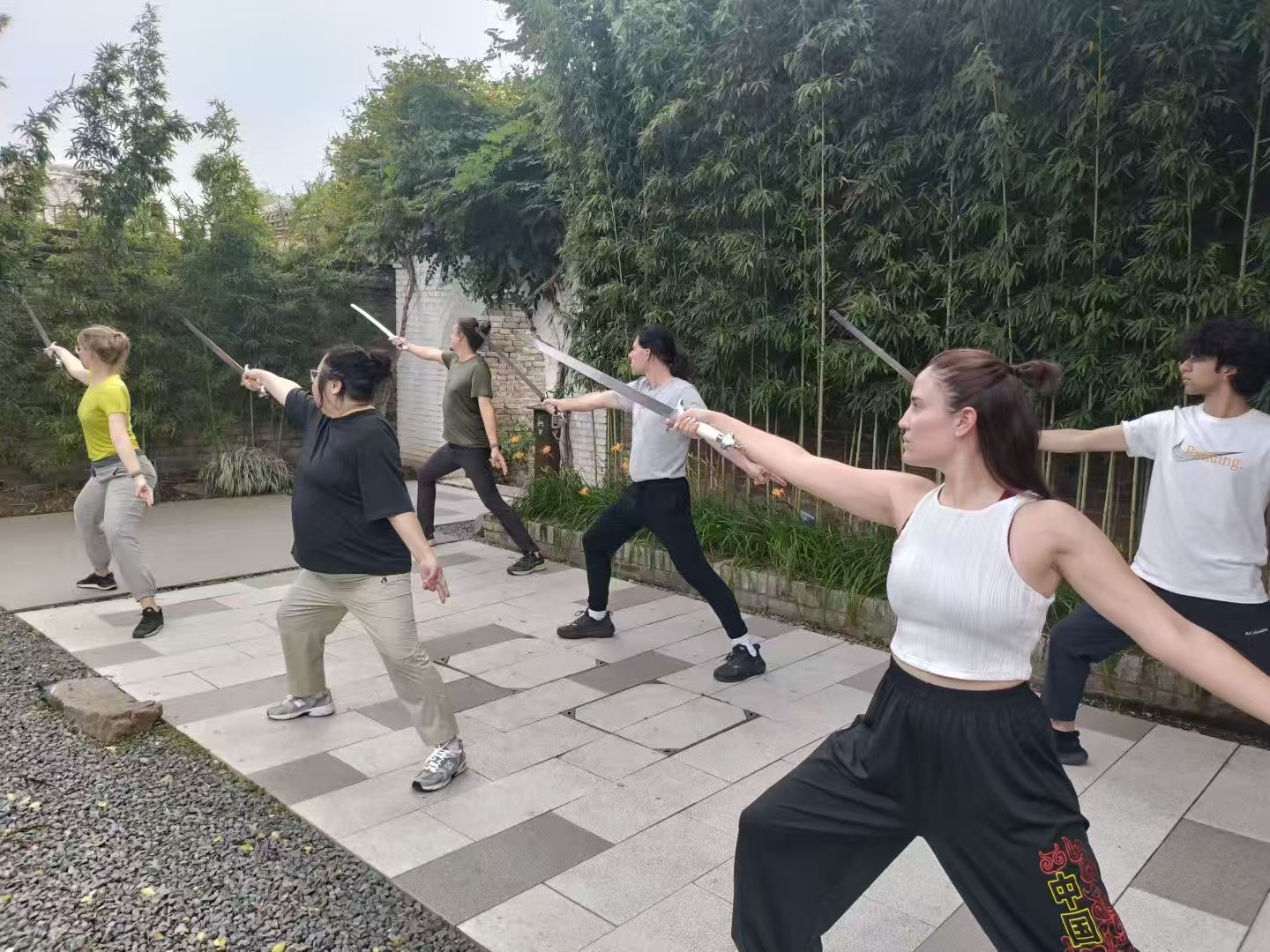
Choosing a First Weapon: A Simple Sequence
If you are still in the research stage, this order keeps the decision practical.
Name your base. Write down your current empty-hand practice, such as Tai Chi, striking, or none.
Match the base to a weapon's demand. Soft, flowing practice tends to suit the sword. Striking-oriented practice tends to suit the staff. A student who enjoys linear drills and strong stance work may find the spear rewarding.
Check your joints. Tight hips or sore knees make deep spear stances harder. Tell your teacher so the work can be adjusted.
Plan the time. Short stays suit one weapon and a few basic movements. Longer stays allow a second weapon and a deeper form.
Talk to the teacher before you book. A conversation about your background helps more than a general description of a course.
As an illustrative case, imagine a student with two years of Tai Chi who wants more clarity in the forearms. A sword paired with Zhan Zhuang would likely be the natural start. Someone with a San Da background might instead begin with the staff to refine waist rotation. These are examples, not rules, and Master Shen tailors the plan to the person in front of him.
Come and Practice With Us
If this has sparked a question about your own body and a weapon, we would be glad to hear it. You can read about the 30 Day Kung Fu Course to see how a month of weapon and empty-hand study fits together, or visit SJF Kung Fu School and send us a message about your experience, goals, and the weapon you are curious about. We welcome sincere learners from every country and will gladly suggest a starting point.



 WhatsApp