Chinese Weapon Training and When Heavy Weapons Fit
When is a student ready to lift a guandao or a metal staff? Most pages say that heavier weapons build strength and usually follow basic forms, then stop there. They rarely describe what readiness looks like in the body. In Chinese Weapon Training, the order of learning matters as much as the weapon itself. The heavy end of the rack is a place you arrive at, not a place you start. Here is what we watch for at SJF Kung Fu School, where students approach traditional Chinese weapons only after the body has learned to stand, turn, and breathe.

What the Traditional Order Is Protecting
Scope first. What follows comes from the way Master Shen Jiangfei teaches, from his Chen-style Tai Chi and Liuhe Quan lineage, and from the students who have trained with us. It is not a survey of every school. A handful of student stories cannot prove an industry trend, and we do not present them that way.
In Chinese martial thinking, a weapon is a longer arm, not a separate tool. If the arm is not yet coordinated with the waist and legs, a longer arm only magnifies the confusion. This is why teachers often say the hands follow the body and the weapon follows the hands. Wu De, the martial virtues, begins with humility. Wanting the heaviest blade on the first day usually reflects ego more than readiness.
It helps to separate what is observed from what is interpreted:
- Observed in published guidance: heavier weapons are commonly described as strength-building tools that come after basic forms and applications.
- Observed in our teaching: standing practice and empty-hand forms come first, and lighter weapons come before heavy Chinese weapons.
- Interpretation, not proof: the order exists mainly to protect joints and keep form clean. That is plausible and matches the physics, but we have no controlled data comparing early and late starters.
Strength, Joint Control, and Form Readiness: Where the Boundaries Sit
This is the question most guides skip. Strength is only one of three signals, and it is often the least reliable. The table below shows how we read each signal before a student moves toward guandao training or metal staff kung fu. These are teaching heuristics from an instructor's eye, not a numeric pass mark.
| Signal |
Suggests readiness when… |
Suggests it is premature when… |
Scaled option meanwhile |
| Leg and trunk strength |
The stance stays steady while the hands move, and weight shifts without hopping or bracing. |
Knees drift inward or heels lift when the hands carry load. |
Longer Zhan Zhuang holds; slow stance transitions with empty hands. |
| Grip and forearm strength |
The grip stays firm but relaxed through a full routine on a light staff. |
Knuckles whiten, fingers tire first, and the weapon drifts off its line. |
Wooden staff rounds; sword and broadsword forms. |
| Wrist, elbow, shoulder control |
The student can stop a movement exactly where intended, with the wrist aligned to the forearm. |
The weapon overshoots, elbows lock at the end of strikes, shoulders hike toward the ears. |
Slow-motion practice with shorter ranges of motion. |
| Waist-driven power |
Movement begins in the legs and waist and travels outward. |
Power comes from the arms alone. |
Chen-style Tai Chi coiling work with empty hands. |
| Form readiness |
The empty-hand form runs in sequence with clear transitions, and a light weapon pattern flows without pausing to think. |
The student is still recalling the next move or confusing the order. |
Repeat the form; return to basic Shaolin Quan patterns. |
| Space and safety awareness |
The student tracks both ends of the shaft and keeps distance from others. |
The back end of the weapon is forgotten and needs constant reminders. |
Marked practice zones; one student at a time. |
Limits of this table
- It does not apply evenly to everyone. A student with years of prior martial arts or weapon work may cross several rows quickly, but still needs an in-person look before a heavy weapon is placed in their hands.
- Strength can mislead. A strong lifter can still fail the joint control row, because the problem is stopping and redirecting momentum, not producing force.
- It is not a diagnosis. Pain or injury belongs with a qualified doctor, not a training chart.
Why Heavy Weapons Are Placed Later, and Other Explanations
The documented driver is mechanical. A guandao carries its blade far from the hands, so every spin and cut multiplies torque at the wrist and demands precise grip changes and waist drive. Metal staff kung fu asks the shoulders and wrists to absorb momentum, and a metal shaft forgives a late stop far less than a wooden one. Weight at a distance is physics, not folklore.
Plausible alternative explanations deserve a fair hearing:
- Teaching sequence. The order may exist partly because it is easier to teach one skill at a time, not only because heavy tools are dangerous.
- "Heavy" is partly about length and balance. A long, tip-weighted weapon can feel heavier than its mass suggests.
- Scaled starts may work. Some teachers may introduce lighter versions of heavy forms early with good results. We have no evidence either way and make no claim about other schools.
What would change our view? Documented outcomes for students who began heavy weapons early, compared with those who waited, would be the clearest evidence. Until then, we rely on the mechanics and on what we see on the training floor.
A Practical Progression Before Guandao or Metal Staff
Here is the order we follow, with the reasoning for each step:
- Stand first. Zhan Zhuang teaches the legs to bear weight and the shoulders to let go. It fits every beginner, but it does not replace form work.
- Learn empty-hand movement. Tai Chi builds waist-led coordination. Basic Shaolin Quan builds clean transitions.
- Add a light weapon. A wooden staff, sword, or broadsword shows whether the hands obey the body.
- Slow the pace. Repeat patterns in slow motion until stops land where intended. Speed comes last.
- Approach the heavy weapon under supervision. A teacher watches grip, wrist alignment, and footing in person. If the signs slip, the student steps back a level without shame.
Student stories show how this plays out, with a caveat. Hayley Noel from the UK trained for 120 days in Tai Chi, Zhan Zhuang, Sword, and Broadsword. Klaes Risbjerg Simonsen from Denmark spent 30 days on Tai Chi, Zhan Zhuang, and Broadsword. He said the Shifu adapted the training to his specific needs. Austin Erkl from the USA took 30 days of Tai Chi and Sword and admitted he did not love it at first, then found his rhythm. None of these is a guandao case, and a few stories do not establish a rule. They show our programs pairing standing practice and Tai Chi with lighter bladed weapons, and students valuing a teacher who adjusted to them.
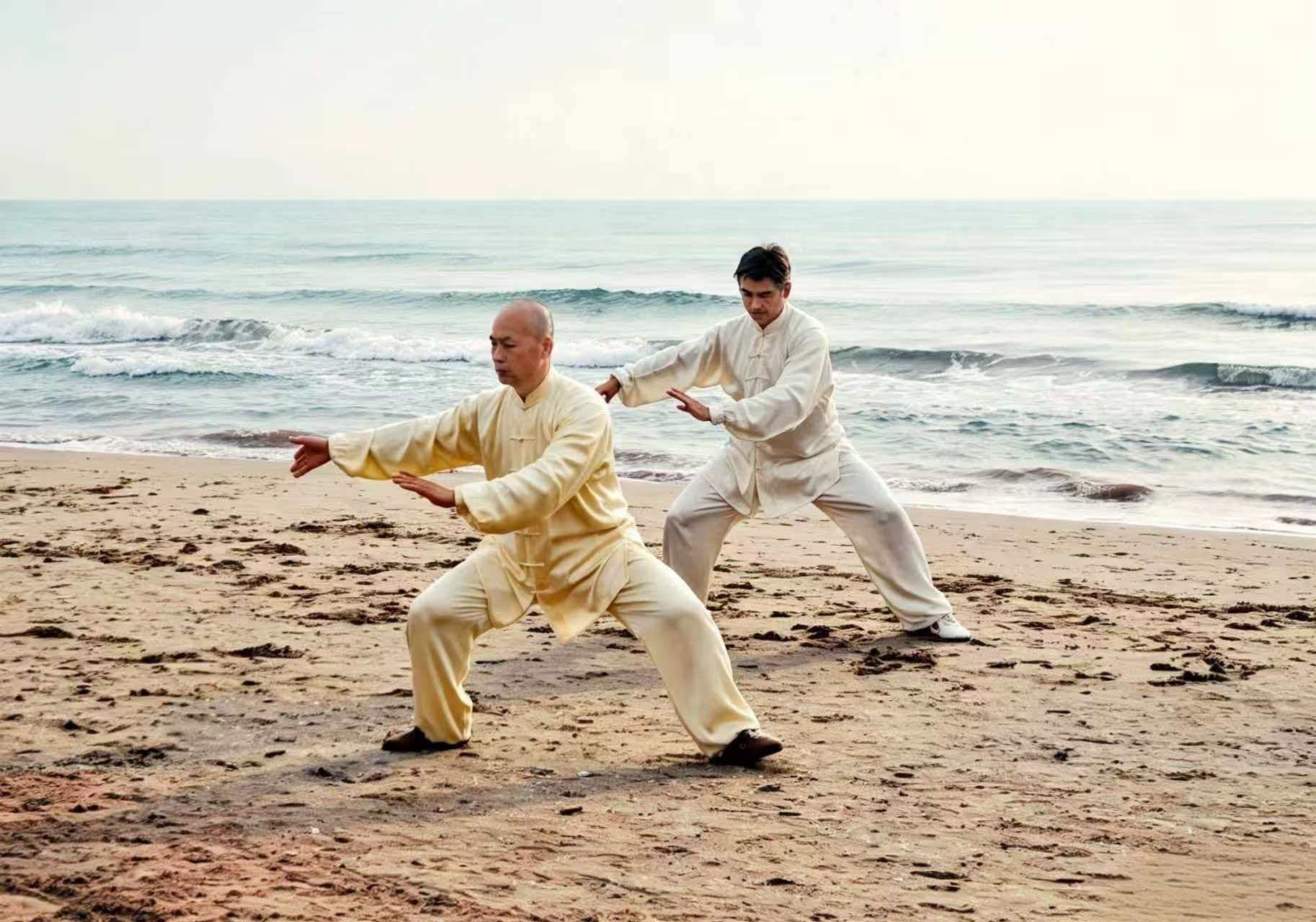
Our 200㎡ indoor training center keeps this progression going in any weather. Weapon drills need clear space and steady footing, and practice should not depend on the sky. Students who want enough time for the full sequence may find a Long Term Kung Fu Course a natural fit.
When to Start Weapon Training: A Checklist and Common Mistakes
There is no universal calendar for when to start weapon training. Use these Chinese weapons training prerequisites as questions, and answer them honestly:
- Can I hold a standing posture with relaxed shoulders and jaw for the whole session?
- Can I run my empty-hand form in order without prompts?
- Can I stop a light staff exactly at the target, again and again?
- Am I free of ongoing wrist, elbow, shoulder, knee, or lower back pain?
- Is there a qualified teacher who can watch me in person?
- Do I understand the etiquette and respect that come with carrying a weapon?
If any answer is no, the decision affects your next step: stay with the lighter practice until it becomes a yes. Common mistakes tend to cluster in the same places:
- Choosing by appearance. A guandao looks impressive, but looks say nothing about readiness.
- Treating gym strength as readiness. Lifting numbers do not measure wrist alignment or stopping control.
- Skipping slow practice. Speed hides errors that slow work exposes.
- Training heavy alone from a video. Nobody is there to catch a drifting wrist or a lost back end.
- Ignoring early joint pain. Soreness that sharpens or lingers is a signal to stop, not push through.
Open Questions and Your Next Step
We cannot say how many weeks any one student needs before a heavy weapon is appropriate. It depends on prior training, body, and how steadily the signals above appear. Pamela Paes Ezawa from Brazil, after a 7-day Chen-style Tai Chi course, remembered the traditional training environment and the welcoming Shifu and community more than any milestone. The best signal is a teacher who knows you, watches you, and is willing to say "not yet." Setting up the chance to be watched is the practical response.
If you want to see where you stand, we would be glad to hear from you. Begin with the 30 Day Kung Fu Course to build the foundation, or write to us through the website to ask about your own background and goals. Genuine seekers of traditional Chinese martial arts are always welcome at our school near the Shaolin Temple.



 WhatsApp