How a China Kung Fu School Teaches Forms and Sparring
How should forms, conditioning, partner practice, and sparring fit together when a beginner starts Chinese martial arts training? This is one of the most useful questions to ask before choosing a Chinese Kung Fu School. Forms can teach structure and coordination, while sparring tests timing, distance, calmness, and decision making under pressure. Neither replaces the other.
At SJF Kung Fu School, training is approached as a connected practice. Students may work on Shaolin Quan, Tai Chi, Qi Gong, Zhan Zhuang, San Da, Qin Na, Ge Dou, Chinese weapons, and meditation, yet each subject has a different purpose. A beginner does not need to prove toughness on the first day. The first task is learning how to stand, move, breathe, and pay attention.
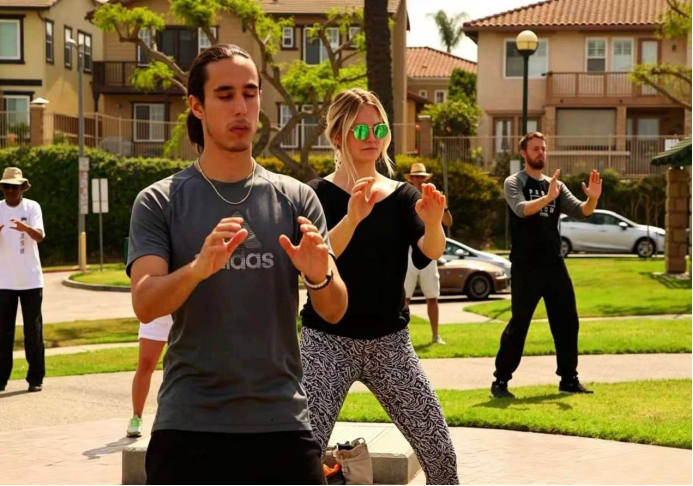
The direct answer is simple: forms build the body method, while sparring reveals whether that method can be adapted to another person. Good training does not treat forms as performance alone, nor does it rush students into uncontrolled exchanges. It develops a foundation, introduces contact in measured steps, then gives students room to apply what they can do safely and thoughtfully.
Forms Teach Body Method Before They Teach Combat
Kung Fu forms are arranged sequences of stances, footwork, hand methods, changes of direction, breathing patterns, and intent. They give a student repeated practice without needing a partner for every repetition. This is especially useful for international beginners who may arrive with energy and enthusiasm but little experience in Chinese martial body mechanics.
The first benefit is structural. A low stance is not valuable merely because it looks demanding. It asks the legs to support the body while the spine remains organized and the hips can still change direction. A punch is not only an arm action. The feet press into the floor, the waist turns, the shoulder stays connected, and the hand arrives without losing balance.
For students interested in northern martial methods, Shaolin Quan training can introduce clear movements, stances, kicking patterns, and coordinated whole body power. The conclusion is not that every student should begin with a long set. A shorter sequence or selected movements is often better for a new student because it leaves time to correct posture. Long forms suit students who already retain positions well and can practice independently between classes.
What forms can and cannot prove
What forms can develop: balance, mobility, coordination, stance endurance, body alignment, memory, breath awareness, and attention to technical detail.
What forms can suggest: where a strike, block, throw, lock, or change of angle may be applied with a partner.
What forms cannot prove by themselves: whether a student can judge range, respond to an unpredictable attack, remain composed during contact, or adapt when the first movement fails.
This limit matters. A student who performs a sequence with precision may still need partner work before understanding timing. On the other hand, a student who only spars may develop habits that lack posture, control, and variety. The most useful approach is to let each method correct the weakness of the other.
Forms also have a quieter side. In Tai Chi practice, slow movement makes tension easier to notice. When the shoulders rise, the breath becomes hurried, or the knees collapse inward, a slow sequence exposes the issue. This suits students seeking health practice, concentration, and detailed body awareness. It is less suited to someone expecting immediate high intensity fighting exchanges in every lesson.
How Beginners Progress Through Forms Conditioning Partner Drills and Sparring
For beginners, the order of training affects both learning and safety. Forms, body conditioning, partner drills, and sparring are not competing departments. They are stages that interact. The table below compares what each element changes in practice and where its limits appear.
| Training element | Main beginner purpose | Practical effect | Best time to add it | Limit when used alone |
|---|
| Forms | Learn posture, footwork, coordination, and sequence | Builds repeatable movement patterns and awareness of body alignment | From the first lessons, with corrections kept simple | Does not provide live timing or resistance |
| Conditioning | Prepare legs, stance, mobility, and general work capacity | Helps students maintain positions and move with less loss of posture | From the first lessons, adjusted to individual condition | Fitness alone does not teach distance or tactical choice |
| Partner drills | Learn distance, contact, angle, and controlled response | Connects a movement from a form to a changing human target | After basic positions can be repeated safely | Predictable drills can become automatic if never varied |
| Sparring | Test decision making under agreed rules and live movement | Shows whether technique can be selected, timed, and controlled | When students can protect themselves and respect training rules | Too much too early can replace learning with flinching or rushing |
The practical conclusion: beginners should begin all four areas in some form, but not at the same intensity. A first week may include stance work, simple movements, light conditioning, and a cooperative two person drill. That does not mean hard sparring is required in the first week. The appropriate level depends on prior experience, physical condition, confidence around contact, and the course focus.
For example, a student attending a short intensive course with no martial background may benefit more from structured movement and controlled drills than from repeated free exchanges. A student who has already trained boxing, kickboxing, wrestling, or another contact art may enter sparring preparation sooner, but still benefits from learning the stance and distance rules of the new system.

Why Conditioning Changes the Quality of Forms and Sparring
Conditioning is often misunderstood as punishment or as a separate fitness class. In Chinese martial arts, its first purpose is functional: helping the body hold useful positions and repeat them without unnecessary tension. Standing practice, leg work, mobility, controlled kicking, footwork, and basic strength work can all support martial movement.
Zhan Zhuang practice is one example. Standing still with attention can reveal whether the feet grip the floor, whether the knees track safely, whether the pelvis is stable, and whether the shoulders are doing too much work. It may appear quiet, but the work is demanding when done with care.
The interaction between conditioning and forms is direct. If the legs tire immediately, a student may shorten the stance and lose the intended line of movement. If the hips are restricted, kicks and turns may become forced. If breathing becomes rushed, the hands often become tense. Better conditioning gives forms a more stable base, but the trade off is that fatigue can reduce technical quality when training volume rises too quickly.
The interaction between conditioning and sparring is equally direct. In a moving exchange, a student needs enough leg endurance to maintain distance and enough calmness to avoid holding the breath. Yet conditioning should not become an excuse for careless contact. A fit beginner can still lack control, while a less fit beginner may have strong awareness and learn technical timing quickly.
A practical beginner session sequence
Begin with joint preparation, simple stepping, and breath awareness.
Practice one or two stance positions with clear alignment cues.
Repeat selected movements from a form at a manageable pace.
Add controlled partner entries, distance steps, or simple responses.
Use a brief conditioning segment that does not destroy posture.
Finish with calm breathing, mobility work, or meditation to observe tension and recovery.
This sequence fits a beginner because it moves from self control to interaction. It does not apply unchanged to every class. A student in a focused San Da training session may spend more time on footwork, pads, defensive movement, and sparring preparation. A Tai Chi student may spend more time refining weight shifts, relaxation, and partner sensitivity.
Partner Drills Bridge the Gap Between a Form and a Live Exchange
Partner drills answer the question that forms raise: “What is this movement for when another person is present?” A single hand technique can become a strike, a deflection, a grip release, an entry, or a control position depending on distance and direction. The drill narrows the possibilities so the student can learn one relationship at a time.
In a beginner drill, one partner may step forward with an agreed attack while the other practices angle, guard position, and a selected response. The attack is known. The speed is controlled. Both people can stop and correct details. This format is not meant to imitate a full confrontation. Its purpose is to teach contact without confusion.
As skills improve, the drill can change one condition at a time:
Change the starting distance so students must judge range.
Change the side of the attack to prevent memorized responses.
Add footwork before contact rather than beginning in a fixed stance.
Allow the attacker to choose between two agreed options.
Reduce predictability while maintaining control and respect.
This progression is valuable because it avoids a common misunderstanding: a form application is not a promise that one movement will always succeed. Distance, timing, size difference, balance, intent, and the partner’s response all change the result. A useful drill teaches students to notice these conditions rather than treating the sequence as a fixed answer.
Students interested in grips, controls, and close range responses can study Qin Na training. The conclusion for a beginner is to focus on positioning, balance, and cooperative practice before trying to apply force. A lock or control depends on angle and control of the partner’s structure. It is not suitable for careless repetition or resistance beyond the level agreed for training.
When Sparring Should Begin and What It Should Look Like
Sparring is a training conversation with live movement. It asks whether a student can make choices when the partner is moving, reacting, and creating uncertainty. It should have stated rules, agreed intensity, appropriate supervision, and a clear purpose. Sparring without purpose often becomes a contest of speed or aggression. Sparring with structure can teach humility, restraint, and awareness.
For a beginner, progression usually makes more sense than a sudden leap into open rounds. A useful path may look like this:
| Stage | Training condition | What the student learns | When to move forward |
|---|
| Distance practice | No contact or limited target work | Guard, movement, range, and stopping control | When posture remains stable while moving |
| Restricted exchange | Agreed attacks and agreed responses | Reading simple cues without panic | When both partners can work safely and calmly |
| Limited choice sparring | Small set of permitted attacks and defenses | Timing, adaptation, and controlled initiative | When control is maintained at a moderate pace |
| Open sparring | Rules and intensity agreed in advance | Decision making under greater uncertainty | Only when technical control and mutual respect are clear |
Open sparring is not the only marker of progress. A person studying Tai Chi for health, meditation, or internal body method may prefer sensitivity work and fixed partner exercises. A student preparing for San Da may need more regular contact practice. The right balance follows the student’s aim, not a single idea of what Kung Fu training must look like.
What Prospective Students Should Ask Before Choosing a Program
Before enrolling, ask how the school connects solo work to partner work. The answer tells you more than a list of styles. At SJF Kung Fu School, Master Shen Jiangfei is a descendant of Liuhe Quan and the eleventh generation inheritor of Chen style Tai Chi. This background matters for students who want instruction that treats stance, breathing, intent, and martial application as connected subjects rather than isolated exercises.
The school also has a 200 square meter indoor training center, allowing practice throughout the year regardless of weather. This is especially relevant for short term visitors: a limited training period benefits from consistent class conditions instead of relying on outdoor weather.
Use this checklist when comparing a one week visit with a longer stay:
Ask about beginner entry: Can the instructor adjust intensity for someone without previous martial arts training?
Ask about class balance: How much time goes to forms, conditioning, partner drills, and sparring preparation?
Ask about contact rules: What type of contact is expected, and how are students matched by experience?
Ask about corrections: Will instructors explain posture, footwork, breathing, and application rather than only asking students to copy movements?
Ask about course duration: Is the goal a cultural introduction, a focused intensive period, or a longer practice routine?
Ask about personal aims: Do you want health practice, martial skill, discipline, cultural study, or a blend of these aims?
Course length changes what can reasonably be absorbed. A short stay can introduce basic forms, stance work, partner exercises, and the rhythm of school life. A longer stay gives more time for corrections, repetition, conditioning, and a gradual sparring progression. Andrew Williams from the United States spent 30 days training Tai Chi, Zhan Zhuang, and Dao Fa with his son. He described the period as life changing physically, mentally, and spiritually, and planned to return the following year. His example does not predict the same result for every visitor, but it shows what sustained daily practice can mean for a family willing to train with patience.
For students seeking a fuller period of practice, the one month Kung Fu Course provides more time to connect forms, conditioning, partner work, and personal reflection. We welcome sincere students who wish to study Chinese martial arts with respect and steady attention.




 WhatsApp