How to Choose an International Kung Fu School for Your Goals
Choosing where to train in Chinese martial arts is one of the most significant decisions you will make on your path. The wrong choice can lead to a superficial, tourist-level experience that wastes your time and investment. The right one, however, offers a life-changing opportunity for deep physical, mental, and spiritual growth. Before committing to a program, it is vital to look beyond glossy photos and consider the core elements that define a truly great international kung fu school: the instructor's lineage, the logistical support for overseas students, and the environment in which you will train.
At our Chinese Kung Fu School, we believe that authentic training is a bond built on trust and a shared commitment to the art. This guide will help you understand what to look for, ensuring your efforts are invested in a place that honors tradition and supports your personal development.
Evaluating an Instructor’s Lineage and Teaching Philosophy
In traditional Chinese martial arts, an instructor's lineage is not about prestige; it is the direct channel through which knowledge has been preserved and passed down for centuries. A verifiable lineage ensures that the techniques, principles, and internal cultivation methods you learn are pure and undiluted. It is the difference between learning a dance and mastering a deep-rooted system of self-development.
As the founder of SJF Kung Fu School, my own path is defined by this principle. I am a descendant of Liuhe Quan and the 11th-generation inheritor of Chen-style Tai Chi, the original and oldest of the five primary family styles. This direct transmission from my masters to me, and from me to my students, is the foundation of everything we do. It ensures that every student receives instruction that is true to the art's origins.
When you evaluate a potential school, use this checklist to look deeper into the master's qualifications and approach.
Verifiable Lineage: Does the instructor clearly state their lineage? Can it be traced back through recognized masters? A genuine teacher is proud of their heritage and transparent about their training history.
Teaching Experience: How long have they been teaching international students? A long history, such as our experience training over 3,000 students from around the world, demonstrates a proven ability to adapt traditional methods for modern learners from diverse backgrounds.
Philosophical Depth: Does the curriculum emphasize martial virtue (武德, Wǔ Dé), internal cultivation, and philosophy, or does it focus only on physical application? True mastery combines mind, body, and spirit.
Breadth of Knowledge: Does the school offer a range of styles? While specialization is good, exposure to different arts deepens your understanding of core principles. We offer training in 9 distinct styles, including Shaolin Quan, San Da, and Qi Gong, providing a complete martial education.
Key Logistical Factors for International Students: A Comparison
For students traveling from abroad, practical considerations like accommodation, language, and visa support are just as important as the quality of the training. A school that understands the needs of international students removes barriers, allowing you to focus completely on your practice. Neglecting these details can lead to unnecessary stress and a disrupted experience.
Different types of schools offer vastly different living and learning conditions. The table below compares common school models to help you identify the environment that best suits your needs.
| Factor | Typical Tourist-Focused School | Remote Mountain Monastery | SJF Kung Fu School (Our Approach) |
|---|
| Destination & Immersion | Located in major cities with high tourist traffic. Cultural interaction can be superficial. | Highly isolated with minimal interaction outside the monastery walls. Deep but narrow immersion. | Situated near the historic Shaolin Temple with access to 30+ cultural sites for balanced, meaningful immersion. |
| Teaching Language | English is spoken, but instruction may lack depth or nuance. | Primarily Chinese, requiring a translator or prior language skills. | All classes are taught in clear English by certified Shaolin instructors to ensure complete understanding. |
| Accommodation | Students often stay in off-site hotels or generic dormitories, separate from the training community. | Extremely basic, spartan facilities, often with shared rooms and limited amenities. | Clean, comfortable, and training-focused accommodation is provided on-site to foster community and focus. |
| Visa Support | Often limited assistance, leaving students to manage the process alone. | Visa processes can be complex or unofficial, posing a risk for long-term students. | We provide official invitation letters and clear guidance to simplify the visa application process. |
| Weekly Training Load | Lighter schedule, typically 15-20 hours per week, more akin to a holiday activity. | Extremely intense and rigid, often exceeding 40 hours per week with little personal time. | Flexible and structured programs with around 30-35 hours of training per week, balancing rigorous practice with adequate rest. |
The Training Environment: Facility, Community, and Culture
The space where you train and the people you train with shape your experience. A dedicated, well-equipped facility enables consistent practice, while a supportive community provides encouragement and camaraderie. Look for a school that nurtures a positive culture focused on mutual respect and shared growth.
Our 200㎡ indoor training center ensures that your progress is never hindered by rain, snow, or extreme heat. This year-round facility, equipped with training mats, wooden dummies, and traditional weapons, provides a professional space for dedicated practice. However, the environment is about more than the physical space. It is about the feeling of belonging.
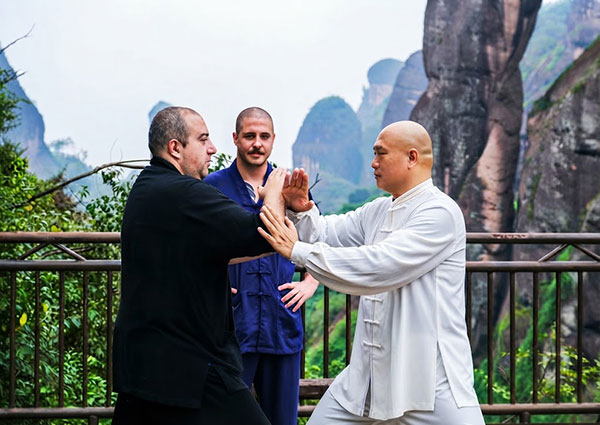
This is something our students often mention. Pamela Paes Ezawa from Brazil highlighted the "welcoming Shifu and community" and the "authentic, traditional training environment" during her stay. Similarly, Austin Erkl from the USA noted, "The master is a great guy that cares for his students. I made some lifelong memories here and will cherish my time." This sense of care and community is intentional. As Othmane Echaouki from France shared, "Thank you, Shifu, for taking such good care of all the students. It made us feel we were in the best conditions."
Defining Your Path: Matching a Program to Your Personal Goals
There is no single "best" program—only the program that is best for you. Your personal goals, available time, and current skill level should guide your choice. A quality school will offer flexible options to accommodate different needs, from short-term immersions to long-term discipleship.
Consider which of these paths aligns with your aspirations:
The Curious Explorer (1-4 Weeks): If you want an introduction to genuine Kung Fu and a rich cultural experience without a long-term commitment, a short, intensive program is ideal. These courses are designed to give you a strong taste of different styles and the training lifestyle. A program like our Kung Fu Camp provides a perfect blend of training and cultural exploration.
The Dedicated Practitioner (1-6 Months): If you are serious about building a solid foundation or have previous martial arts experience, a medium-term program allows for substantial skill development. This duration is enough to gain proficiency in the fundamentals of a style and begin to understand its internal aspects. Andrew Williams from the USA found his 30-day course to be a "life-changing experience that strengthened him physically, mentally, and spiritually."
The Lifelong Learner (6+ Months): For those committed to deep mastery, a long-term program is essential. This path is about more than learning techniques; it is about immersing yourself in the art and philosophy under the direct guidance of a master. Hayley Noel from the UK completed a 120-day course and, according to her family, "loved it so much." This level of commitment fosters profound transformation, as experienced by students who choose our Long Term Kung Fu Course.
Klaes Risbjerg Simonsen from Denmark, who trained for 30 days, chose our school because he wanted an "authentic and focused experience—not a touristy resort." From day one, he felt he was in the right place, praising the highly qualified Shifu who adapted the training to his specific needs. This personalized approach is what makes a program truly effective, regardless of its length.
Choosing an international kung fu school is the first step on a rewarding path. By carefully considering the instructor's lineage, the school's environment, and your own personal goals, you can ensure that step is taken in the right direction.
If you are ready to learn authentic Chinese martial arts in a supportive and traditional environment, we invite you to explore our programs. Contact us to discuss your training goals and find the right path for you.



 WhatsApp