How Traditional Chinese Kung Fu Differs by Style
How can one martial art tradition contain powerful strikes, slow circular movements, standing meditation, throws, joint controls, weapons, and quiet seated practice? The answer is that Traditional Chinese Kung Fu is not one fixed system. It is a broad family of methods shaped by different lineages, training purposes, body mechanics, and cultural settings.
For a beginner, the useful question is not simply “Which style is best?” It is: “What does each style ask my body and mind to practise every day?” At SJF Kung Fu School, students can encounter connected disciplines rather than treating each one as an isolated label. Shaolin forms, Tai Chi, partner practice, weapons, breathing work, and meditation can each reveal a different part of Chinese martial culture.
The direct answer is simple. Some styles place greater emphasis on long range striking and fast footwork. Others develop close range control, balance disruption, structure, sensitivity, or mental stillness. Most complete training paths combine several qualities over time. A style differs not only by the techniques it contains, but by how it trains timing, posture, breath, attention, and conduct.
Style differences begin with purpose rather than appearance
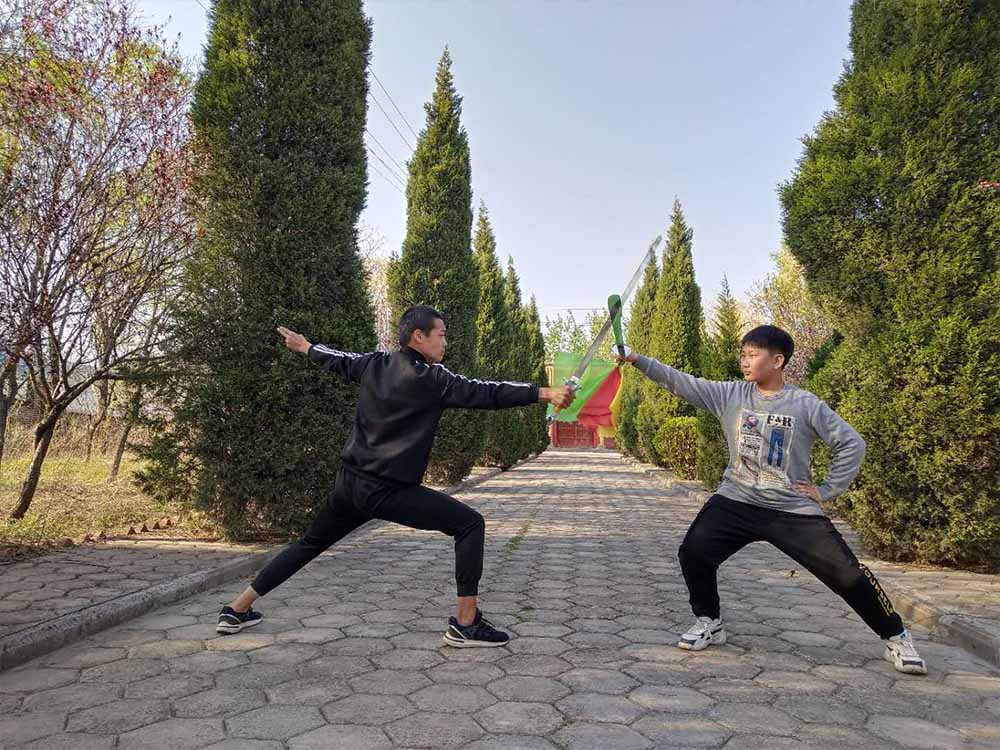
A low stance, a sword form, or a slow movement may look impressive, but appearance alone does not explain a system. To understand a style, first identify its main training purpose. That purpose determines what receives repeated attention.
Long range striking: Systems with extended punches, kicks, and agile footwork teach distance recognition. They suit learners who want to improve coordination, mobility, and clear striking lines. They do not replace close range gripping or throwing practice.
Close range control: Grappling and joint control methods teach how to manage an opponent after contact has been made. They suit students interested in restraint, balance breaking, and practical hand placement. They require careful partner work and cannot be understood from solo movement alone.
Internal structure: Tai Chi and standing practices examine alignment, relaxation, whole body connection, and controlled weight transfer. They suit learners who can work patiently with slow repetition. Slow practice by itself does not automatically create fighting skill; it must be linked with intention and, where appropriate, partner feedback.
Conditioning and resilience: Repeated stances, forms, kicking drills, and controlled impact work build usable strength and endurance. This suits students prepared for regular physical practice. The limit is recovery: training quality declines when posture collapses through fatigue.
Mental discipline: Meditation and breath focused work help a student notice tension, attention drift, and emotional reaction. They support martial training but are not substitutes for technical instruction.
This is why a famous style name is an incomplete basis for selection. Two students may both say they study Kung Fu while one spends the morning refining a horse stance and punch, and the other spends it learning how weight moves through the feet during slow circles.
Comparison of training method range conditioning forms and partner work
The matrix below compares major style families and training areas commonly associated with Chinese martial arts. These categories overlap. A school may teach a form with applications, or use standing practice to support striking. Still, the comparison shows what each area usually places first.
| Style family or method | Primary training method | Typical range | Conditioning focus | Forms role | Partner work role |
|---|
| Shaolin Quan | Stances, punches, kicks, coordinated combinations | Mostly medium to long range | Leg strength, flexibility, speed, endurance | Builds movement vocabulary, rhythm, and power expression | Tests distance, timing, and application |
| Chen style Tai Chi | Slow form, spiralling mechanics, weight transfer, controlled release | Close to medium range | Postural alignment, leg support, relaxed connection | Trains continuity, balance, and body unity | Develops sensitivity, listening, and structure under pressure |
| San Da | Striking combinations, kicking, takedown entries, controlled sparring | Medium range into clinch range | Cardiovascular fitness, reactions, impact tolerance | Usually secondary to drills and live practice | Central for timing, defence, and tactical decisions |
| Qin Na | Grips, controls, joint angles, escapes, positional response | Close range | Hand placement, posture, balance, controlled pressure | May preserve technical sequences and principles | Essential because pressure and alignment must be felt |
| Ge Dou | Practical combat movement, combinations, defensive responses | Changes from long range to close range | Footwork, composure, whole body coordination | Supports technical memory where included | Important for adapting techniques to movement |
| Zhan Zhuang | Standing postures with sustained attention | Not range based | Structural endurance, breathing awareness, stillness | Not form based | Indirect; supports body awareness before contact practice |
| Chinese Weapon practice | Footwork, grip, coordination, weapon specific patterns | Determined by the weapon | Wrist control, stance stability, spatial awareness | Central for safe handling and traditional sequences | Introduced progressively with safety and distance control |
The practical consequence is clear. A student seeking a demanding striking base may begin with Shaolin Quan, while someone interested in contact timing may be drawn toward San Da training. A student who wants to examine posture, balance, and calm attention may find a better first foundation in Learn Tai Chi.
None of these choices needs to become permanent. A long range striker can benefit from close range control. A Tai Chi student can benefit from understanding distance. The trade off is training time: trying to study every method deeply in a short period can leave each one underdeveloped.
Range changes what a technique must solve
Range is one of the clearest technical differences between styles. It describes how close practitioners are when a method is intended to work. Range affects stance length, hand position, visual attention, and reaction time.
At long range, the main problems are entry, exit, and angle. A kicking or striking method must teach the practitioner how to cover distance without overreaching. The body needs stable legs, but it also needs mobility. A stance that is too low may build strength during training yet become slow if used without adjustment in movement.
At medium range, hands and feet can both reach. This is often where striking combinations, defensive movement, and tactical changes happen quickly. San Da work is useful here because it asks students to read rhythm rather than repeat a fixed sequence. Its limit is that controlled sparring needs suitable supervision and progressive intensity. Beginners should first learn safe posture, basic guards, and controlled responses.
At close range, contact changes everything. Grips, shoulder position, elbow control, and balance become more important than extended kicking lines. Qin Na techniques show why small details matter: a hand placement that appears correct may fail if the practitioner loses their own balance or applies force in the wrong direction.
A common misunderstanding is that close range methods are only about hand strength. In fact, they depend on the entire body. Feet establish position, the hips organise direction, the spine maintains alignment, and the hands guide the final control. For this reason, partner work should be cooperative at first. Speed and resistance can increase only after both people understand the intended path of the technique.
Forms teach patterns but cannot replace feedback
Forms are remembered sequences of movements. In many traditional systems, they preserve footwork, postures, power patterns, directional changes, and cultural teaching methods. They are not merely performances.
In Shaolin oriented practice, a form may train clear lines, changes of level, explosive coordination, and transitions between stance positions. In Chen style Tai Chi, the form can train slow weight shifts, circular pathways, and connected movement through the body. In weapon practice, forms teach where the weapon travels in relation to the practitioner’s own body and space.
The value of forms depends on how they are practised. Use the following procedure to make form work useful:
Learn the route of the movement slowly and accurately.
Identify the stance, direction, and hand or weapon position at each key point.
Ask what range the movement suggests and what it might protect or control.
Repeat with relaxed breathing rather than unnecessary tension.
Practise an adapted partner drill when the movement has a safe application.
Return to the form with better understanding of distance and timing.
The limit is important: no solo sequence can fully teach reaction to an unpredictable partner. A form develops the practitioner’s own movement. Partner drills reveal whether that movement can keep structure when another person changes angle, pressure, or timing.

Internal practice changes the quality of movement
Internal practice is often misunderstood as something separate from martial skill. In traditional training, it can be a method for refining how the body organises force, attention, and breath. It is not a shortcut and does not depend on dramatic claims.
Zhan Zhuang is standing practice. A student holds a defined posture, notices tension, and learns to remain stable without becoming rigid. The immediate effect is often simple: the student becomes more aware of where weight is placed and where the shoulders, hips, or knees are misaligned. Over time, this awareness can support better stances, quieter balance, and steadier breathing.
Qi Gong practice uses breathing, attention, and coordinated movement. It suits students who need a calmer pace alongside physical training. Its limit is that breathing work should not be forced. Strained breath usually creates more tension, not less.
Chen style Tai Chi carries these lessons into motion. Its slow passages ask the student to shift weight without losing the central axis. Its faster releases show that softness does not mean collapse. A relaxed body still needs clear structure. This is one reason Master Shen Jiangfei’s lineage matters in context: he is a descendant of Liuhe Quan and an eleventh generation inheritor of Chen style Tai Chi. Lineage does not remove the need for daily practice, but it gives students a defined teaching connection through which to study the material carefully.
Choose a first discipline by training conditions
Beginners often choose by watching a short video or by selecting the most familiar name. A better choice comes from matching your present condition to the training method. Use this checklist before deciding where to begin.
Choose Shaolin forms if you enjoy active movement, stances, kicks, and visible physical challenge. This fits a student ready for regular mobility and leg conditioning. It may not be the best first focus for someone recovering from a condition that limits repeated low stances.
Choose Chen style Tai Chi if you want to study balance, body connection, and controlled movement in detail. This fits patient learners willing to repeat small adjustments. It will feel incomplete if your only goal is immediate high intensity sparring.
Choose San Da if you want to understand distance, timing, and controlled exchange with a partner. This fits students comfortable with athletic drills. It should be approached progressively rather than treated as an instant test of toughness.
Choose Qin Na if close range control and technical detail interest you. This fits careful learners who value partner sensitivity. It does not work well when practiced carelessly or with excessive force.
Choose Zhan Zhuang and Qi Gong if posture, breathing, and concentration need attention. These methods fit almost any wider training path. They should support, rather than replace, movement training when martial ability is the goal.
Choose weapon practice after establishing basic posture and coordination. This fits students interested in cultural forms and precise spatial control. Safe instruction matters because range and momentum change with each weapon.
A real example shows how goals can combine. Andrew Williams from the United States trained Tai Chi, Zhan Zhuang, and Dao Fa with his son for 30 days. He described the experience as life changing physically, mentally, and spiritually, and planned to return. This does not mean every student will have the same result. It does show that a structured combination of movement, standing practice, and weapon work can suit a learner seeking more than one training quality.
Verify what a school means by a style name
Style names are broad. Before joining a course, ask what the daily practice actually includes. This is more useful than asking whether a school teaches the “best” system.
How much time is given to forms, conditioning, partner drills, and quiet practice?
Is instruction adapted for beginners, returning practitioners, and experienced martial artists?
Which skills are taught through solo repetition, and which are taught with a partner?
How are stance depth, flexibility, and training intensity adjusted for the individual?
Are weapons introduced after basic body control, or immediately?
Who teaches the material, and what lineage or qualification is stated clearly?
SJF Kung Fu School is a registered Kung Fu school with certified Shaolin Kung Fu instructors, and its indoor training centre covers 200 square metres for practice throughout the year. These details matter because a beginner needs consistent space, clear supervision, and enough time to understand the difference between copying a movement and training its purpose.
For short focused study, a One Week Kung Fu Course can help a beginner experience several training methods before committing to a longer path. For more sustained practice, students may consider how daily repetition changes posture, endurance, and attention over a month or longer.
Traditional Chinese Kung Fu becomes clearer when you stop asking which style is superior and begin asking what each method is designed to cultivate. Striking develops one kind of decisiveness. Standing practice develops another. Forms preserve patterns. Partner work tests them. Together, they reflect the martial virtue of patience, respect, restraint, and disciplined effort.
Explore the one month Kung Fu Course to discuss a suitable starting discipline with SJF Kung Fu School.




 WhatsApp