Tai Chi Quan Eight Energies Through Partner Work
You have practised the form for months. Your Ward Off looks round, your Push looks smooth, and then a partner leans on your forearm and the movement you trusted falls apart. Where was the energy supposed to be? Partner training in Tai Chi Quan answers that question, and it is one of the main reasons students choose to Learn Tai Chi in China instead of studying only from videos.
At SJF Kung Fu School, Master Shen Jiangfei is the 11th generation inheritor of Chen style Tai Chi and a descendant of Liuhe Quan. He teaches the eight energies the way the old masters passed them on: through hands that touch, listen and answer. This article explains what those energies are, where they sit inside the solo form, and how to train them with a partner step by step.
Why the Solo Form Keeps the Eight Energies Hidden
A Tai Chi form is a written record in motion. Each posture stores a martial idea, but the idea is compressed. Without resistance, the body can only guess at it. The classical term is Ba Jin, the eight energies: Peng, Lü, Ji, An, Cai, Lie, Zhou and Kao. The first four are the cardinal energies. The last four are the corner energies. Together with five steps, they make up the Thirteen Postures that the whole art grows from.
Alone, you can make a posture look correct and still miss the point. A partner supplies what the form lacks: weight, direction and intention. When someone pushes, your Peng either holds or collapses. There is nothing to argue about. This is why Tai Chi martial applications are learned in pairs, and why the practice carries a quiet ethic. In the Wu De tradition, touching hands is a conversation of respect, not a contest. You are not there to defeat your partner. You are there to understand yourself through them.
Where this does not apply: if you cannot yet hold a stable stance or remember the sequence, partner work turns into wrestling. Spend time on the solo form and standing practice first.
The Eight Energies and Where They Sit in the Form
The table below links each energy to a feeling, a classic posture where it is easiest to find, and a simple test with a partner. Treat the postures as starting points. In Chen style Tai Chi, energies blend and change inside a single movement.
| Energy | Meaning | Where to find it | Partner test |
|---|
| Peng | Ward off, an expanding and elastic quality | Ward Off posture | Partner presses your forearm slowly. Can you stay springy without bracing? |
| Lü | Rollback, yielding and leading | Rollback posture | Partner pushes. Can you redirect the force past your hip without leaning? |
| Ji | Press, a forward squeeze | Press posture | Does the force come from your legs and back, or only from your arms? |
| An | Push, a sinking and forward release | Push posture | Does your partner feel weight settling through them, or a shove? |
| Cai | Pluck, a downward pull | Transitions where one hand grips and draws down | Can you pull a wrist down while your own root stays still? |
| Lie | Split, a spiralling separation | Parting Wild Horse's Mane | Can your two arms move in opposite directions and still stay connected? |
| Zhou | Elbow, close range energy | Elbow movements in the Chen sequences | At close range, can you stay relaxed and avoid tensing the shoulder? |
| Kao | Shoulder or back strike, whole body contact | Back Fold Strike | Does the movement start in the legs and waist, or only in the shoulder? |
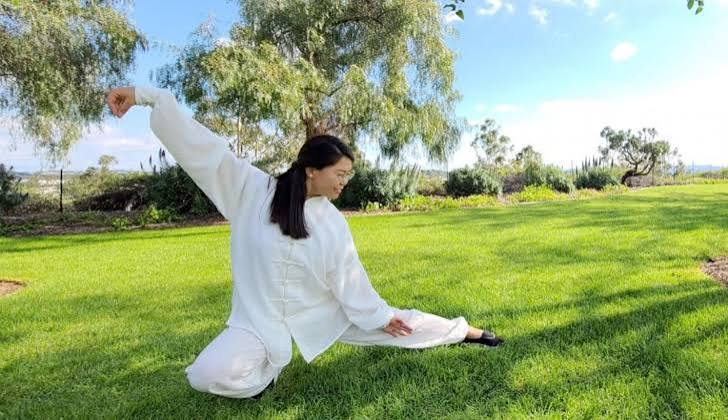
The Cai, Lie, Zhou and Kao rows overlap with other arts we teach. Cai and Lie share ideas with Qin Na techniques, where controlling a joint depends on the same sensitivity. A student who feels Cai clearly usually finds Qin Na easier to learn.
How Partner Sensitivity Drills Reveal the Eight Core Energies
This is the practical part. These six steps follow the order we use in class. Each has a checkpoint to confirm you are on track and the usual reason it fails. Move slowly. A drill done at 30 percent speed teaches more than one done at full speed with tension.
| Step | What to do | Checkpoint | Why it usually fails |
|---|
| 1. Single hand contact | Stand facing a partner and touch wrists. Circle slowly for five minutes without trying to move them. | Shoulders drop, contact stays light, and you can feel where your partner's weight sits. | Gripping the wrist, holding the breath, or watching the hands instead of feeling them. |
| 2. Peng and Lü | One partner presses gently. The other expands to meet the force (Peng), then yields and leads it away (Lü). Swap roles. | The pressed arm feels elastic, not stiff. The yielding turn comes from the waist. | Bracing the arm to resist, which kills Peng. Or retreating by leaning back, which breaks Lü. |
| 3. Ji and An | Join hands on your partner's forearm for Ji. Then release a sinking, forward push for An, stopping before they lose balance. | Your rear leg feels the force travel up. Your partner feels pressure that settles rather than jolts. | Pushing with the shoulders, rising onto the toes, or leaning forward past the front knee. |
| 4. Cai and Lie | Take your partner's wrist and draw it down and slightly back (Cai). Then separate the arms in opposite directions (Lie). | Your root stays still while your hands move. Your upper and lower body stay connected. | Pulling with the arm alone, or twisting the waist so far that the stance gets narrow. |
| 5. Zhou and Kao | At close range, practise the elbow and shoulder contacts at very low force on a mat. The attacker gives light resistance only. | The whole body moves as one piece and the contact point does not tense. | Adding speed too early, or striking with the joint instead of with the body behind it. |
| 6. Return to the form | Perform the solo form at slow speed. Name the energy in each posture and imagine the partner's hands. | Postures that felt empty now have direction and a clear point of contact. | Rushing the form, or treating the drills and the form as separate subjects. |
Who this fits: students who know the basic solo movements and want to understand what the movements are for. Where it does not fit: anyone with a recent shoulder, wrist or knee injury. Tell your instructor beforehand so the drills can be changed.
If you want to try these steps with a teacher beside you, the one month Kung Fu course gives enough time to take every step with a partner and correct the common failures.
Common Mistakes in Push Hands Practice
Push hands practice looks simple, which is why the same errors repeat. Here are the ones we correct most often in our training hall:
Trying to win. The moment you want to win, your shoulders rise and your root disappears. Wu De, the martial virtue of restraint, is a practical rule here as well as a moral one.
Memorising names instead of feelings. Knowing the word "Peng" means little until your forearm feels it. Ask your partner what they feel in your contact.
Skipping standing practice. A weak root makes every energy fall apart. Many students find that Zhan Zhuang training improves their drills within a few weeks, because it teaches the legs to carry weight without tension.
Training the corner energies too fast. Cai, Lie, Zhou and Kao carry more risk. Keep them slow, and use soft mats.
Practising only with the same partner. You get used to one person's habits. Rotate partners whenever you can.
Ignoring breath and mind. A held breath makes the body rigid. Short Meditation classes help students settle the attention before touching hands.
What Students Found When They Trained With Master Shen
Students come from many countries, and their experiences show what partner work and a teacher's attention can change.
Klaes Risbjerg Simonsen from Denmark trained for 30 days in Tai Chi, Zhan Zhuang and Broadsword. He wanted a focused experience, not a touristy resort, and said that from the first day he felt he was in the right place. He grew both physically and spiritually. He also noted that his Shifu was highly qualified and adapted the training to his specific needs.
Andrew Williams from the USA spent 30 days training Tai Chi, Zhan Zhuang and Dao Fa with his son. He called it a life-changing experience that strengthened him physically, mentally and spiritually, and he plans to return. Austin Erkl, also from the USA, admitted he did not love the 30-day Tai Chi and Sword course at first. After adjusting, he said: "The master is a great guy that cares for his students. I made some lifelong memories here and will cherish my time."
Pamela Paes Ezawa from Brazil completed a 7-day Chen style Tai Chi course. She valued the traditional training environment, the Taoist heartland location, the training-focused accommodation, and the welcoming Shifu and community. Even a single week gave her a clear introduction to how the style is taught.
Our 200㎡ indoor training center means partner drills continue in any weather, on mats, with wooden dummies and traditional weapons nearby. The school stands close to the Shaolin Temple, so after training you can walk into a landscape of old temples and history that has shaped these arts for centuries. For students who already train with traditional Chinese weapons, the same sensitivity carries over to the sword and broadsword.
A Checklist Before You Start Partner Work
Use this list to judge whether your solo practice is ready for contact. If you answer "no" to more than two items, return to the form and standing practice for a few more weeks.
Can you perform the complete form slowly without stopping to remember the order?
Can you hold a stance for several minutes without your shoulders rising?
Can you describe what Peng, Lü, Ji and An each feel like in your own body?
Do you have a teacher or experienced partner who can correct your contact?
Do you have a safe, padded space to practise?
Are you willing to lose a drill in order to learn from it?
Bring Your Form to a Partner in China
The eight energies cannot be fully learned from a page. They are learned through patient contact, correction and time, in a place where practice is the point of the day. Our students describe it as a quiet setting where a form that was only a shape begins to carry meaning.
If you would like to explore this with Master Shen Jiangfei, you have a few simple ways to start:
Genuine seekers of traditional Chinese martial arts are always welcome. Send us a message and we will be glad to talk.




 WhatsApp