Tai Chi Quan: How Forms Train Balance and Real Defense
Many people see the slow, flowing movements of Tai Chi and wonder, "How can this be a martial art?" The movements appear gentle, almost like a dance. Yet, hidden within these forms is a sophisticated system for cultivating profound balance, structural power, and effective self-defense. The secret is not in the speed, but in the method. As the 11th-generation inheritor of Chen-style Tai Chi, I have guided over 3,000 students to understand that the slow practice is a tool for mastering the body and mind. This path allows you to learn Tai Chi not just as a sequence of moves, but as a deep internal skill.
The goal is to re-educate your body to move with a connection and efficiency that is lost in modern life. The slow, deliberate practice of a Tai Chi Quan form is the laboratory where this transformation happens. It builds a foundation that is stable, responsive, and powerful under pressure.

The Deeper Purpose of Slow Movement in Martial Arts
In our school, we teach that slowness is a discipline. It is a way to magnify your awareness of every small detail in your posture, weight distribution, and alignment. When you move quickly, it is easy to use momentum and muscular tension to cover up underlying weaknesses and imbalances. Slowing down removes this crutch. You are forced to rely on correct structure and a rooted connection to the ground.
This deliberate pace serves several key functions:
Develops Internal Awareness: Moving slowly allows your mind to fully inhabit your body. You can feel precisely where your weight is, which muscles are engaged, and whether your joints are aligned properly. This heightened sensitivity is the first step toward martial control.
Builds Tendon and Ligament Strength: Unlike fast, explosive movements that primarily target large muscle groups, holding and transitioning through deep stances strengthens the connective tissues. This creates a resilient power that is integrated throughout the entire body.
Cultivates Rooting (Gen): The concept of "rooting" is fundamental. It means connecting your body's structure to the ground so that you become stable and immovable, like an old tree. Slow movements train you to "sink" your weight and energy, establishing this powerful foundation in every posture. This is often supplemented by practices like Zhan Zhuang (standing post) to specifically train this skill.
Trains Relaxation (Song): True power in internal arts comes from relaxation, not brute tension. Moving slowly teaches you to release unnecessary tension in the shoulders, chest, and limbs, allowing energy (Qi) and force to flow unimpeded from the ground, through the legs and waist, and out to the hands.
Klaes Risbjerg Simonsen from Denmark came to our school seeking an experience that was not a tourist resort. He wanted focus. He shared that from his first day training Tai Chi, he felt he was in the right place. The slow, focused work allowed him to grow both physically and spiritually, connecting him to the deep purpose of the practice.
A Technical Breakdown of Balance and Defensive Positioning
The graceful appearance of the form hides a precise biomechanical engine. Every weight shift, turn of the waist, and placement of a limb has a direct application for maintaining your balance while disrupting an opponent's. Here is a breakdown of how these components work together to build a strong defensive structure.
| Principle | Technical Execution | Practical Effect on Balance & Defense |
|---|
| Substantial vs. Insubstantial Weight Shifts | Slowly and completely transfer your weight from one leg ("substantial" or full) to the other ("insubstantial" or empty). The empty leg must be light enough to lift without any shift in the upper body. | This trains you to move your center of mass without compromising your structure. In a defensive situation, it allows you to absorb a push by shifting to the back leg or to step nimbly to evade an attack without losing your root. An opponent pushing you finds no solid resistance to push against. |
| Maintaining Structural Alignment | The Baihui point at the crown of the head is gently lifted, while the tailbone sinks. The shoulders are relaxed and aligned over the hips (Kua). Knees are bent and aligned over the feet, never past the toes. | This creates a unified, vertical structure that directs force efficiently into the ground. Poor alignment (e.g., leaning forward, stiff shoulders) creates weak points where your structure can be broken. A properly aligned body can absorb and redirect incoming force without collapsing. |
| Leading with the Dantian (Waist) | All turns and movements originate from the rotation of the waist and hips, not the arms and shoulders. The hands and feet follow the center. | Power generated from the body's core is far greater than from the limbs alone. Defensively, turning from the waist allows you to deflect an incoming strike by redirecting its path, rather than meeting force with force. Your opponent's push is led into emptiness. |
| Mastering Slow Transitions | The focus is not on the start and end postures, but on the continuous, smooth movement between them. Every inch of the transition must be controlled, balanced, and structurally sound. | Combat is dynamic; you are rarely in a perfect static stance. Training the transitions ensures you are balanced and powerful even when in motion. It eliminates moments of weakness between techniques, making your defense continuous and without gaps for an opponent to exploit. |
Common Mistakes to Avoid in Form Practice
As you begin to practice Tai Chi Quan, your progress depends on avoiding common habits that undermine its principles. Correcting these mistakes early is essential for building a proper foundation. Here are some of the most frequent errors I see in new students.
Chasing the Hands: Many beginners focus only on the hand shapes and arm movements. They forget that the hands are merely expressing the power generated by the legs and directed by the waist. Correction: Always initiate movement from your center (Dantian). Feel the turn of your waist guide your arms.
Leaning and Bobbing: Leaning the upper body forward or backward, or bobbing up and down between postures, indicates a loss of root. Your center of gravity becomes unstable and easily manipulated. Correction: Keep your torso upright as if suspended from the crown of your head. Sink into your stances instead of rising out of them.
Stiff or Locked Joints: Locking the knees or elbows creates blockages. It stops the flow of energy and makes the limb a rigid lever that an opponent can easily break or control. Correction: Maintain a slight, relaxed bend in all your joints. Think of your limbs as heavy, pliable, and connected.
Forgetting to Separate Yin and Yang: This refers to failing to fully commit your weight to one leg at a time (the principle of substantial and insubstantial). A "double-weighted" stance (50/50) is static and immobile. Correction: Be deliberate in your weight shifts. Before stepping, ensure one leg is completely "full" and the other is completely "empty."
Shallow Chest Breathing: Holding your breath or breathing with tension in the chest and shoulders is counterproductive. It raises your center of gravity and creates stiffness. Correction: Practice deep, slow abdominal breathing. Allow your breath to sink into your Dantian. The breath should be silent, smooth, and coordinated with the movements.
By paying close attention to these details, your form practice transforms from a simple choreography into a powerful method of self-cultivation.
From Form to Function: Applying Principles in Partner Work
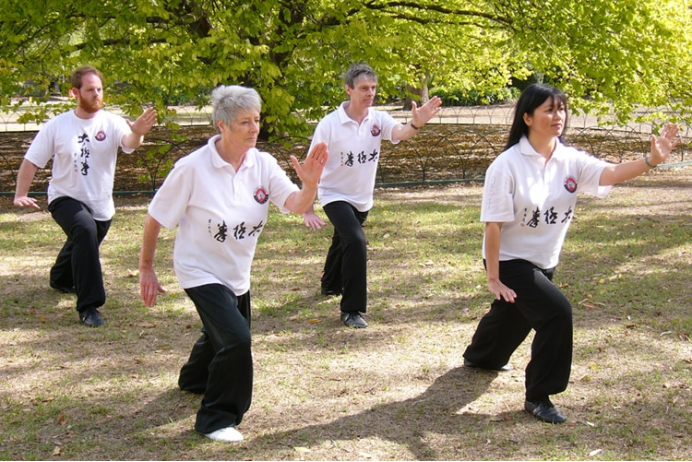
The solo form is only half of the equation. The principles of balance, structure, and sensitivity are truly tested and understood through partner exercises like Push Hands (Tui Shou) and applied in practical combat scenarios like San Da training. The form teaches you the alphabet; partner work teaches you how to form sentences and hold conversations.
In Push Hands, you and a partner maintain contact while executing patterns designed to unbalance each other. Here, you learn "listening energy" (Ting Jin)—the ability to feel your partner's intention through touch. You practice yielding to their force, redirecting it, and finding the moment of emptiness when you can apply your own technique without resistance. The slow, rooted power you developed in the solo form allows you to absorb their push and uproot them with minimal effort.
These same principles provide a superior foundation for San Da (Chinese kickboxing). A Tai Chi practitioner doesn't meet a punch with a rigid block. Instead, they use their rooted stance and waist rotation to deflect the blow, sticking to the opponent's limb to control their balance and create an opening for a counter. The ability to remain calm and centered under pressure, a direct benefit of the form's meditative nature, is perhaps the greatest asset in a fighting context.
Andrew Williams from the USA came to train with his son for 30 days. They practiced Tai Chi and Zhan Zhuang, and he described it as a life-changing experience. He felt it strengthened him physically, mentally, and spiritually. This integration of mind and body is the true gift of the art, and it's why he plans to return.
At SJF Kung Fu School, all our training, from a One Week Kung Fu Course to long-term study, is built on this principle of moving from internal understanding to practical application. Our 200㎡ indoor training center ensures that this essential practice can happen year-round, in any weather, allowing for consistent and focused progress.
If you are ready to explore the deep connection between movement, mind, and martial application, we welcome you to our community. Contact us to discuss how a training program can be shaped to your personal goals.




 WhatsApp