Taiji Meaning, Practice and History Explained
Type Taiji into a search bar and you get three answers that seem unrelated: a black and white swirl from Chinese philosophy, a slow group exercise in a city park, and a fighting art taught in a Henan village. Which one is correct? All three. The confusion comes from treating them as separate subjects when they share one root. At SJF Kung Fu School, new students ask us this every season, so here is a plain explanation from the training hall.
Three Meanings of Taiji and Why They Get Mixed Up
The word is written 太极 and is usually translated as "supreme ultimate." In philosophy, it names the state before yin and yang separate. In daily life, many people use it for a gentle exercise. In martial arts, it is shorthand for Taijiquan, the "supreme ultimate fist." Each use is legitimate. Trouble starts when someone expects the park exercise to behave like a fighting system, or expects a philosophy book to teach the body how to move.
| Meaning |
What it refers to |
Where you meet it |
Its limit |
| Philosophy |
The source from which yin and yang arise; a way of describing change |
Classical texts, temples, calligraphy, the familiar symbol |
Can be studied from books, but it will not teach you body mechanics |
| Health exercise |
Slow, even movement with relaxed breathing |
Parks, community classes, short sequences |
Good for calm and mobility; does not by itself train martial skill |
| Martial art |
Taijiquan, with stance work, spiraling power, and partner practice |
Family lineages and traditional schools |
Needs a qualified teacher and years of repetition |
Our conclusion is simple. If you only want a calm morning routine, the exercise meaning is enough. If you wonder why the movements look the way they do, you need the philosophy and the martial logic behind them. That does not mean you must become a fighter. It means the form makes more sense when you know what it was built to do.
Where Taiji Comes From: A Short Historical Line
The term appears in an appendix to the Yijing (Book of Changes), which says that change contains Taiji and that it produces the two forms. Much later, the Song dynasty scholar Zhou Dunyi wrote his explanation of the Taiji diagram, and that text shaped how the symbol is read today.
The martial lineage is a separate thread. Tradition places its birth in Chen Village, Henan, where Chen Wangting is credited with merging family boxing with breathing and meridian theory in the 17th century. In the 19th century, Yang Luchan learned in that village and carried the art to Beijing. Other family styles grew from there. In 1956, a short public sequence was compiled for general health, which is one reason many people now associate the art with parks rather than with combat.
A caution: dates from the early period rest on family records and oral tradition, and historians still debate details. We teach what our lineage passed down while acknowledging that the record is not perfectly documented.
Our head instructor, Master Shen Jiangfei, is the 11th generation inheritor of Chen style Tai Chi, the original and oldest of the five primary family styles. He is also a descendant of Liuhe Quan. That is why our teaching begins with the older, more martial form of the art.

How Taiji Works in the Body
Chen style looks soft from a distance. Up close, it is a study of the legs, the waist, and the spiral. Power starts from the ground, passes through the legs, is steered by the waist, and reaches the hands. Teachers call the spiral movement "silk reeling." Beginners usually move their arms too much and their waist too little, so the first corrections nearly always concern the middle of the body.
The words "internal energy" cause the most misunderstanding. In the tradition, qi is the term for the energy a practitioner cultivates through posture, breath, and attention. In practice, students describe it as warmth, heaviness in the legs, or a feeling of connection between hand and foot. We do not promise medical effects. What we can say is that trained relaxation is a skill, and it can be seen in how a person stands and moves.
That is why we pair forms with Zhan Zhuang, the standing post. Standing still for several minutes shows you your weak points faster than any form. Legs shake, shoulders rise, breath turns shallow. Breathing and attention work from Qi Gong then gives that stillness a purpose.
A sensible order for the first weeks
- Stand in a basic Zhan Zhuang posture for a few minutes, and learn to release the shoulders.
- Practice shifting weight between the legs without bobbing up and down.
- Learn single-arm silk reeling circles, led by the waist.
- Study the opening movements of the form slowly, with corrections.
- Only then begin partner work, where the structure is tested.
This is a general order, not a rigid script. Klaes Risbjerg Simonsen from Denmark, who trained 30 days in Tai Chi, Zhan Zhuang, and Broadsword, praised his Shifu for adapting the training to his specific needs. Good teaching responds to the person in front of it.
Wu De, Zen, and the Quiet Side of Practice
Chinese martial arts have always put character beside technique. Wu De, the martial virtues, covers humility, respect, restraint, and loyalty. Its first lesson is easy to miss: a skilled person should be the quietest one in the room. In the hall, this appears in small ways. You bow, you listen before you ask, you sweep the mat for the next person.
The Shaolin tradition has long been tied to Chan (Zen) thinking, while Taiji draws more on Daoist ideas of balance and change. The two are not identical, and we do not pretend they are. They meet in stillness, which is why we teach Meditation alongside the physical forms. Ten minutes of sitting often makes the next hour of movement noticeably more focused.
FAQ: Taiji, Taijiquan, and Tai Chi Questions Answered
| Term |
Meaning |
Typical use |
| Taiji |
"Supreme ultimate," the philosophical concept |
Philosophy, and shorthand for the art |
| Taijiquan |
"Supreme ultimate fist," the martial art |
Lineages, competitions, traditional schools |
| Tai Chi |
An older English spelling of the same characters |
Everyday English, class names, public settings |
Is Taiji the same thing as Tai Chi?
Mostly, yes. They are two romanizations of the same Chinese characters. "Taiji" follows the modern pinyin system, and "Tai Chi" follows an older system. The difference is in spelling, not in the art. What does differ is the school: two classes both called Tai Chi may teach very different things.
Is Taijiquan only for older people?
No. The slow pace suits older bodies, but the art includes low stances, sudden power release, and partner pressure that younger students find demanding. Our limit is honest: beginners with knee or back problems should tell the teacher at the start so stances can be adjusted.
Is it a real martial art or only exercise?
It is both, depending on how it is taught. The movements have fighting applications, and partner drills show them. Still, a short course will not make anyone a fighter. For combat-oriented skills we teach Qin Na (joint locks) separately.
Can Taiji cure illness?
We cannot promise that, and no responsible teacher should. Many students report feeling calmer and steadier. If you have a medical condition, talk to your doctor before you begin.
Do I need to understand the philosophy first?
No. Most people learn the ideas through the body, and the reading follows later. Pamela Paes Ezawa from Brazil completed a 7 day Chen style course and said what stayed with her was the traditional training environment and the welcoming community, not a lecture.
Common Mistakes When Starting Taiji
- Copying videos without correction. Video shows the shape but not the weight, and wrong weight settles into the body quickly. A teacher fixes this in minutes.
- Rushing to learn the whole form. A long sequence on weak legs is empty choreography. Stance work first, form second.
- Confusing relaxed with limp. Real relaxation keeps the structure while the muscles let go. Collapse is not softness.
- Skipping standing practice. It looks dull, but it builds the root that the form borrows from.
- Judging too early. Austin Erkl from the USA admitted he did not love his 30 day Tai Chi and Sword course at first. After adjusting, he had a great time and said he made lifelong memories. The first week is often the least comfortable one.
These mistakes do not apply equally to everyone. An experienced martial artist may struggle with the opposite problem: using too much force. Either way, the correction comes from slow repetition under a teacher's eye.
Training Life Near the Shaolin Temple
Our school stands near the Shaolin Temple, with more than 30 cultural and historical sites within reach. Practice is simple and quiet. Mornings begin with standing and forms, and the 200 square meter indoor hall keeps training steady regardless of weather. Klaes chose SJF Kung Fu School because he wanted a focused experience, not a touristy resort, and from the first day he felt he was in the right place.
Others stayed longer. Andrew Williams from the USA trained 30 days in Tai Chi, Zhan Zhuang, and Dao Fa with his son and called it life-changing, physically, mentally, and spiritually. Hayley Noel from the UK completed 120 days of Tai Chi, Zhan Zhuang, Sword, and Broadsword. Her family wrote to Master Shen that she had loved it, and she plans to return. Some of our Chinese Kung Fu School students have trained with us for a week and some for months, and more than 3000 students have studied with Master Shen over the years.
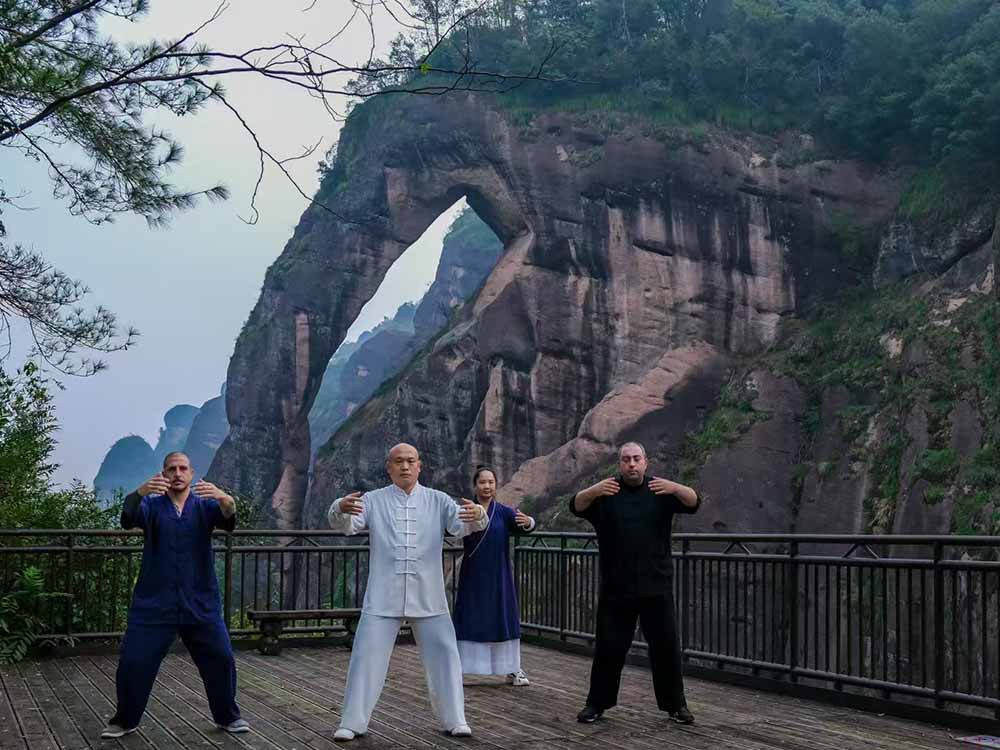
If this kind of practice interests you, the next step can be small. You can read about Learn Tai Chi in China to see how we teach the art, or choose a length that fits your schedule: the One Week Kung Fu Course for a first taste, or the 30 Day Kung Fu Course for deeper study.
View the One Month Kung Fu Course
Not sure which program suits you? Send a message through our website with your experience and goals, and Master Shen's team will reply with a suggested path. Questions about Taiji, even small ones, are always welcome.




 WhatsApp