Traditional Chinese Kung Fu vs Wushu: What's the Difference?
Many people ask: are Kung Fu and Wushu the same? While often used interchangeably in the West, these terms represent different concepts within the vast world of Chinese martial arts. Understanding their distinctions is the first step for anyone seeking to learn authentic skills, whether for health, self-defense, or personal development. At SJF Kung Fu School, we focus on the time-honored practices that form the foundation of these arts.
The confusion is understandable. In Mandarin, "Wushu" (武术) literally translates to "martial art." "Kung Fu" (功夫), on the other hand, means "skill achieved through hard work and time." You can have good Kung Fu in cooking, calligraphy, or any other discipline. Historically, Chinese people referred to their fighting systems as Wushu. However, as these arts spread globally, the term Kung Fu became the popular name for Traditional Chinese Kung Fu. Today, the term Wushu is more commonly associated with a specific, modern, performance-based sport.
What Is the Real Meaning of Kung Fu?
At its heart, Kung Fu is about more than fighting. It is a process of self-mastery achieved through persistent, dedicated practice. It is the refinement of body, mind, and spirit. This principle is the foundation of our teaching, passed down through a direct lineage. As the Head Instructor and founder, I, Shen Jiangfei, am a descendant of Liuhe Quan and the 11th-generation inheritor of Chen-style Tai Chi, the oldest of the five primary family styles. My purpose is not just to teach techniques, but to guide students on this path of development.
The "skill through hard work" applies to every aspect of training:
Physical Conditioning: Building strength, flexibility, and stamina through rigorous drills.
Technical Proficiency: Mastering the precise movements of forms, strikes, and blocks.
Mental Focus: Developing concentration, discipline, and a calm mind through practices like Meditation and Zhan Zhuang.
Spiritual Growth: Understanding the philosophy and virtues (Wu De) that underpin the martial arts.
This approach has guided over 3,000 students from around the world who have trained with us. A student from Denmark, Klaes Risbjerg Simonsen, chose our school because he wanted an authentic, focused experience—not a tourist resort. He found that from the first day, the training helped him grow significantly, both physically and spiritually, because the Shifu was highly qualified and adapted the training to his specific needs.

Clarifying the Terms: Kung Fu, Wushu, Sanda, and Traditional Systems
To make an informed decision about your training, you must understand the key differences between the major categories of Chinese martial arts practiced today. The primary distinction lies between traditional systems focused on practical application and self-cultivation, and modern sport Wushu designed for performance and competition.
This table breaks down the main differences between these two paths.
| Aspect | Traditional Kung Fu (e.g., Shaolin Quan, Tai Chi) | Modern Sport Wushu (Taolu) |
|---|
| Primary Goal | Practical combat effectiveness, health, self-cultivation, and character development. | Aesthetic performance, acrobatic demonstration, and competition points. |
| Training Focus | Repetitive practice of foundational stances, power generation, combat applications (fighting), and internal energy. | Flexibility, high kicks, aerial maneuvers, and standardized routines for competition. Movements are often exaggerated for visual appeal. |
| Application | Rooted in historical combat scenarios. Every movement has a purpose for self-defense, grappling, or striking. | Primarily for demonstration. Combat applications are secondary or non-existent in performance routines. |
| Forms (Taolu) | Forms are libraries of combat techniques, designed to be practical and efficient. The appearance is secondary to the function. | Forms are choreographed routines judged on criteria like difficulty, speed, and artistic expression, similar to gymnastics floor routines. |
| Pacing & Rhythm | Varies by style. Can be slow and deliberate (Tai Chi) or explosive and direct (Shaolin Quan), but always linked to breath and intent. | Often fast-paced and dynamic, with an emphasis on creating a visually exciting performance. |
Where Do Sanda and Ge Dou Fit In?
Sanda (散打), or Sanshou, is a modern Chinese combat sport. It is the practical application component that grew alongside modern Wushu. Think of it as Chinese kickboxing that also includes wrestling, throws, and takedowns. While it is a sport with rules, its techniques are derived from traditional combat systems.
Sanda: A competitive sport focused on full-contact fighting within a rule set. It is an excellent way to pressure-test skills.
Ge Dou (格斗): A broader term for "combat" or "fighting." It can refer to free fighting in a training context that is less structured than a Sanda competition.
At our school, we teach both San Da and Ge Dou to ensure students can apply the techniques they learn from traditional forms in a dynamic, real-world context.
Choosing Your Path: A Checklist for Prospective Students
What are your personal goals? Answering this question is the key to finding the right martial art and school for you. Use this checklist to clarify your intentions.
I want to improve my physical health, reduce stress, and cultivate internal energy.
Your focus should be on internal arts. Our programs in Learn Tai Chi, Qi Gong, and Zhan Zhuang are designed for this purpose. Andrew Williams from the USA found his 30-day training in these arts to be a "life-changing experience" that strengthened him physically, mentally, and spiritually.
I am primarily interested in practical self-defense and combat skills.
Look for schools that emphasize application and sparring. Our curriculum includes San Da, Qin Na (joint locks and grappling), and Ge Dou, which directly translate traditional techniques into effective fighting ability.
I am seeking a deep cultural experience and a disciplined lifestyle.
Your best fit is an immersive program at a school with a strong lineage. Hayley Noel from the UK spent 120 days with us and had an "awesome time." Her family was grateful for the supportive environment we provided. This kind of experience is found in Long Term Kung Fu Training.
I want to learn beautiful, acrobatic forms for performance.
Your path is modern sport Wushu. While we appreciate its athleticism, our school does not focus on this. Our forms are for combat and cultivation, not performance points.
I have a limited amount of time but want an intensive introduction.
Many schools, including ours, offer short-term programs. Pamela Paes Ezawa from Brazil completed a 7-day course and loved the authentic environment and welcoming community. A One Week Kung Fu Course can be a powerful introduction.
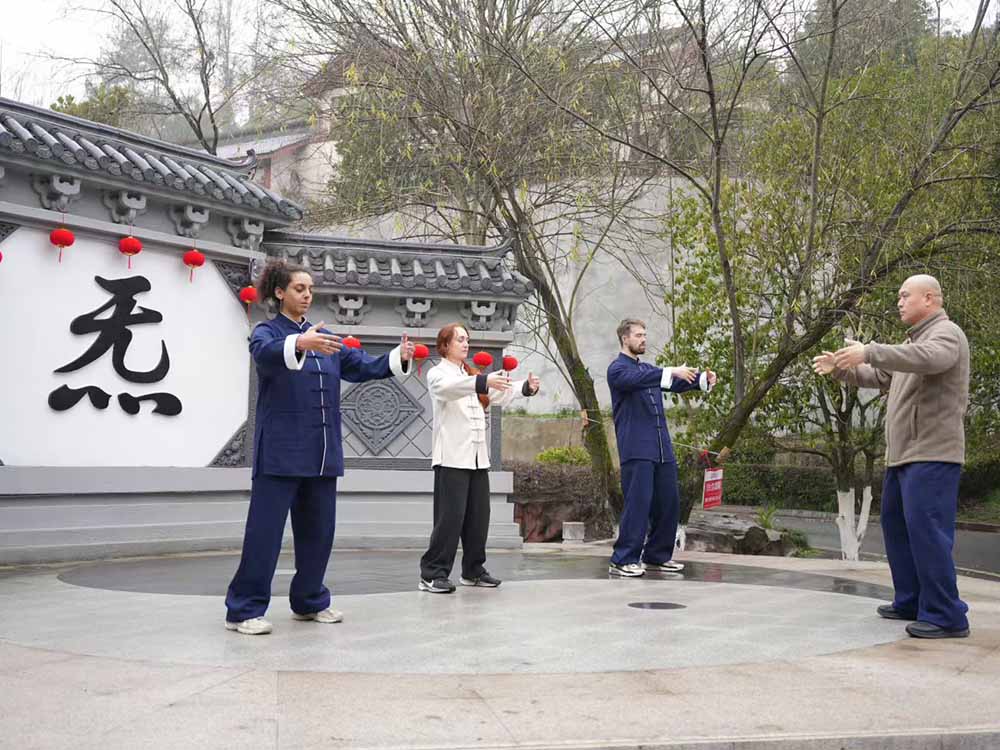
The SJF Kung Fu School Approach to Martial Arts Training
Our philosophy is simple: we teach traditional Chinese martial arts as a complete system for developing the whole person. We are not a sport-focused academy or a tourist attraction. We are a community dedicated to preserving and passing on these valuable skills in an environment built for serious training.
Our curriculum covers 9 distinct martial arts styles, allowing students to explore a wide range of traditional practices. This includes internal arts like Tai Chi and Qi Gong, external styles like Shaolin Quan, and practical combat systems like San Da and Qin Na. This breadth ensures a well-rounded martial education.
Training takes place in our 200㎡ indoor training center, equipped with mats, wooden dummies, and traditional weapons. This facility allows for dedicated practice year-round, regardless of the weather, ensuring consistent progress. For many students, like Austin Erkl from the USA, the combination of a great master, good accommodation, and a focused environment creates "lifelong memories." He noted, "The master is a great guy that cares for his students," a sentiment shared by many who train here.
Whether you are a complete beginner or an experienced martial artist, our flexible programs are designed to meet you at your level and help you achieve your goals. The journey is challenging, but the rewards—in skill, health, and personal growth—are immense.
If you are ready to explore the path of traditional martial arts, we invite you to learn more about our one month Kung Fu Course and see if our school is the right place for your journey.



 WhatsApp