Understanding Silk Reeling in Chen Style Tai Chi
Many people ask, "What makes the movements in Chen Style Tai Chi so distinct?" The answer lies in a core principle known as Chan Si Jin, or silk-reeling energy. This is not merely a poetic description; it is the fundamental physical and energetic mechanic that defines the art. Unlike martial arts that rely on isolated muscular force, this practice cultivates a unified power that spirals through the body, connecting the ground to the fingertips. Understanding this concept is the first step toward genuine progress.
At SJF Kung Fu School, we teach that Chan Si Jin is the living expression of Yin and Yang theory within the body. It is the continuous, spiraling motion that generates, stores, and releases internal energy (Jin). As the 11th-generation inheritor of Chen-style Tai Chi, I, Shen Jiangfei, have dedicated my life to preserving and transmitting this authentic method to over 3,000 students. It is a profound practice that integrates mind, body, and breath into a single, powerful whole.
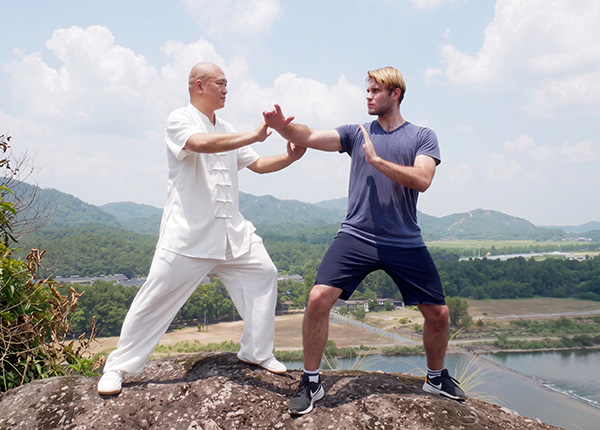
The Mechanics of Chan Si Jin: Connecting Foot, Waist, and Hand
To truly understand what is silk reeling in tai chi, one must look beyond the surface movements. It is a sophisticated system of biomechanics where every part of the body is interconnected through spiraling pathways. Force is not generated by the arms or legs alone; it is initiated from the ground, directed by the waist, and expressed through the limbs. When this connection is correct, even a small, subtle movement can contain immense power. Let's break down this kinetic chain.
The Foot (The Root): All power begins from the connection to the ground. The feet must be firmly rooted, yet alive and sensitive. As you shift your weight, pressure changes across the sole of the foot (the "bubbling well" or Yongquan point). This action initiates the first twist, a spiral force that travels up through the ankle and knee. Proper Chen tai chi body alignment starts here. Without a stable root, any subsequent movement is empty.
The Legs and Kua (The Engine): The spiral from the foot continues up the leg and into the Kua (the inguinal crease area). The opening and closing of the Kua acts like a powerful hinge, amplifying and directing the energy. The legs should feel like coiled springs, sinking and expanding to generate force. This is a critical component of Chen Taijiquan basics.
The Waist and Dantian (The Commander): The waist is the central axis for all movement. The Dantian, an area roughly three finger-widths below the navel, is considered the body's center of gravity and energy. The spiraling force from the legs is received and directed by the Dantian. Every turn of the waist governs the movement of the upper body, ensuring the entire torso moves as a single, coordinated unit. If the waist does not turn, the connection is broken.
The Spine and Back (The Transmitter): The spine acts as a conduit, allowing the energy directed by the waist to flow upward. It should move like a dragon, with each vertebra articulating to transmit the spiral force smoothly into the upper back, shoulders, and arms. A stiff spine will block this transmission.
-
The Arms and Hands (The Expression): The hands are the final expression of the silk-reeling power, but they never move in isolation. The spiral travels from the shoulder, through the elbow, to the wrist and fingers. The arms and hands feel as if they are moving through a dense medium like water or air, maintaining a continuous, connected tension. The power that arrives at the fingertips is the culmination of the entire body's coordinated effort, rooted in the feet.
When these components work in harmony, the body moves with a unique, powerful grace. This is the goal of all Chan Si Jin training: to transform fragmented actions into a unified, whole-body force.
Common Mistakes in Silk Reeling Training
For beginners and even some experienced practitioners, developing Chan Si Jin can be challenging. The body's habitual tendency is to use localized muscle groups, which is the opposite of the Tai Chi principle. Recognizing common errors is the first step to correcting them. Here is a checklist of pitfalls to avoid during your practice.
| Common Mistake | Why It Happens | How to Correct It |
|---|
| Moving the Arms Independently | The practitioner uses shoulder and arm muscles to create movement, disconnecting the upper body from the waist and legs. The power is superficial. | Focus on initiating every arm movement from the Dantian and the turn of the waist. The arms should feel as if they are being moved by the torso, not on their own. |
| Stiff or Locked Joints | Tension in the shoulders, elbows, hips, or knees breaks the flow of energy. Locked joints create blockages in the kinetic chain. | Practice "Song" (relaxing/sinking). Consciously release tension in the joints, allowing them to remain open and flexible throughout the movement. Exercises to learn Zhan Zhuang in China are essential for this. |
| Using Brute Muscular Strength (Li) | Relying on external strength (Li) instead of cultivating internal energy (Jin). The movement looks forced and lacks the characteristic spiraling quality. | Slow down. Focus on the feeling of connection and internal rotation rather than speed or power. The goal is efficiency, not effort. Let the structure and mechanics do the work. |
| Poor Rooting | The feet are unstable, the weight is not properly sunk, or the connection to the ground is weak. Power cannot be drawn from the earth. | Spend more time on foundational stance training. Feel the weight sink through the feet. Practice shifting weight slowly and deliberately, maintaining balance and connection at all times. |
Developing Silk Reeling Power Through Foundational Practices
Cultivating Chan Si Jin is a gradual process that requires dedicated practice of foundational exercises. It is not something learned simply by mimicking the external shape of a form. At our school, we emphasize the traditional methods that build this skill from the inside out.
The journey often begins with Zhan Zhuang (Standing Pile), a seemingly static practice that is in fact intensely dynamic internally. By holding specific postures, students learn to relax, sink their weight, and establish a strong root. This practice builds the structural integrity and internal awareness necessary for Chen style tai chi silk reeling. It teaches the body to release unnecessary tension and align itself correctly with gravity, creating the foundation upon which all other skills are built.
From there, we introduce basic, repetitive silk-reeling drills. These exercises isolate the spiraling motions in different parts of the body—single-hand reeling, double-hand reeling, and stepping drills. This focused training allows the student to concentrate on the specific mechanics of the waist-driven movement without the complexity of a long form. It rewires the neuromuscular pathways, teaching the body a new way of coordinated movement. Only when these foundational skills are established does the student progress to learning the full forms (Taolu).
Practicing the forms integrates these principles into a continuous, flowing sequence. Each posture becomes a test of the student's ability to maintain connection, root, and spiraling energy. This is where the lineage and guidance of a qualified instructor become so important. My training as a Liuhe Quan descendant and inheritor of the Chen family lineage ensures that students learn these methods correctly, preserving the art’s true essence.
An Authentic Path to Physical and Spiritual Growth
Learning these deep principles requires an environment dedicated to authentic practice. Many students come to China seeking more than just a tourist experience; they are looking for a genuine connection to the art and its culture. Klaes Risbjerg Simonsen from Denmark chose our school for this very reason. He wanted an authentic and focused experience, and from day one, he felt he was in the right place, growing immensely both physically and spiritually.
This journey of transformation is a common theme among our students. Andrew Williams from the USA, who spent 30 days here with his son, described his training as a life-changing experience that strengthened him on every level. He plans to return next year. This depth of experience is nurtured by our environment—from our 200㎡ indoor training center that allows for year-round practice to our location near more than 30 cultural and historical attractions.
The community and the guidance of the Shifu are just as important as the techniques themselves. Austin Erkl from the USA noted, "The master is a great guy that cares for his students." Pamela Paes Ezawa from Brazil loved the welcoming community and the traditional training environment. This supportive atmosphere allows students, like Hayley Noel from the UK who completed a 120-day course, to fully immerse themselves and thrive. Her family was initially worried but was overjoyed to see how much she loved the experience.
The principles of silk reeling are more than just a martial technique; they are a way of understanding balance, connection, and the flow of energy in all aspects of life. To truly Learn Tai Chi in China is to embark on a path of self-discovery.
If you wish to explore the profound principles of traditional Chinese martial arts, we invite you to learn more about the training programs at our Chinese Kung Fu School.




 WhatsApp