Wang Zongyue's "Treatise on Tai Chi" – A Complete Guide
Why Is the "Treatise on Tai Chi" Worth Reading Again and Again?
Wang Zongyue's Treatise on Tai Chi contains just over three hundred Chinese characters, yet it is regarded as one of the highest classics of Tai Chi theory. It does not discuss specific techniques or forms. Instead, it starts with the concepts of "Tai Chi," "yin-yang," and "movement-stillness" to explain the fundamental principles of force generation, combat strategy, and the progression of training in Tai Chi.
Whether you are a beginner or a practitioner with years of experience, if you cannot grasp the Treatise on Tai Chi, much of your practice is likely to remain at a superficial, external level. Only when you truly understand it can you comprehend what "understanding jin" really means, what it means to "surrender yourself to follow the opponent," and why Tai Chi is not about comparing raw strength or speed.
This article is structured in four parts—original text, vernacular translation, in-depth analysis, and frequently asked questions—to help you systematically understand this classic work.

The Original Text of Wang Zongyue's "Treatise on Tai Chi" (Classical Chinese)
太极者,无极而生,动静之机,阴阳之母也。动之则分,静之则合。无过不及,随曲就伸。人刚我柔谓之走,我顺人背谓之粘。动急则急应,动缓则缓随。虽变化万端,而理唯一贯。由着熟而渐悟懂劲,由懂劲而阶及神明。然非用力之久,不能豁然贯通焉。
虚领顶劲,气沉丹田,不偏不倚,忽隐忽现。左重则左虚,右重则右杳。仰之则弥高,俯之则弥深。进之则愈长,退之则愈促。一羽不能加,蝇虫不能落。人不知我,我独知人。英雄所向无敌,盖皆由此而及也。
斯技旁门甚多,虽势有区别,概不外壮欺弱、慢让快耳。有力打无力,手慢让手快,是皆先天自然之能,非关学力而有为也。察四两拨千斤之句,显非力胜;观耄耋能御众之形,快何能为。
立如平准,活似车轮。偏沉则随,双重则滞。每见数年纯功,不能运化者,率皆自为人制,双重之病未悟耳。欲避此病,须知阴阳。粘即是走,走即是粘。阴不离阳,阳不离阴,阴阳相济,方为懂劲。懂劲后愈练愈精,默识揣摩,渐至从心所欲。
本是舍己从人,多误舍近求远。所谓差之毫厘,谬以千里,学者不可不详辨焉。是为论。
Vernacular Translation and In-Depth Analysis (Section by Section)
1. Taiji, Movement-Stillness, and Yin-Yang: The Fundamental Principles of Tai Chi
Original Text:
太极者,无极而生,动静之机,阴阳之母也。动之则分,静之则合。无过不及,随曲就伸。
Vernacular Translation:
Taiji is born of Wuji (the boundless void). It is the crux of movement and stillness, and the mother of yin and yang. In motion, it differentiates; in stillness, it reunites. Neither exceed nor fall short—follow the bend and extend with the curve.
In-Depth Analysis:
This passage establishes the philosophical foundation of Tai Chi. Taiji is not mysticism—it is a state of "balanced change." Applied to practice, it means the body should be neither stiff nor limp; movements should adapt to the opponent's bends and extensions—neither resisting forcefully nor disengaging completely.
"Neither exceed nor fall short" (wu guo bu ji) is an extremely important principle in Tai Chi. Exert too much force, and you leave yourself open to being borrowed against; exert too little, and you will be overwhelmed by the opponent. The ideal state is just right—enough to neutralize the opponent while keeping your own center of gravity intact.

2. Yielding and Adhering: The Core Dynamic of Tai Chi Combat
Original Text:
人刚我柔谓之走,我顺人背谓之粘。动急则急应,动缓则缓随。
Vernacular Translation:
When the opponent is hard and I am soft, that is called "yielding" (zou). When I am in accord and the opponent is at a disadvantage, that is called "adhering" (zhan). If the opponent moves quickly, I respond quickly; if the opponent moves slowly, I follow slowly.
In-Depth Analysis:
"Yielding" (zou) is not fleeing—it is neutralizing. "Adhering" (zhan) is not clinging stubbornly—it is controlling. Yielding and adhering are two sides of the same coin: within yielding there is adhering, and within adhering there is yielding.
Many people mistakenly believe that Tai Chi is only practiced slowly and cannot be fast. But Wang Zongyue makes it clear: if the opponent is fast, I respond fast; if the opponent is slow, I follow slowly. Tai Chi is not about comparing speed—it is about training "listening jin" and responsiveness. The real key is to neither resist nor disengage, but to adapt continuously to the opponent's changes.
3. From "Familiarity with Forms" to "Understanding Jin" to "Divine Clarity"
Original Text:
虽变化万端,而理唯一贯。由着熟而渐悟懂劲,由懂劲而阶及神明。然非用力之久,不能豁然贯通焉。
Vernacular Translation:
Though the variations are endless, the principle remains consistent. From familiarity with forms, one gradually comes to understand jin. From understanding jin, one advances step by step toward the realm of divine clarity. Yet without long and devoted practice, one cannot suddenly achieve full penetration.
In-Depth Analysis:
This outlines the three stages of Tai Chi training:
Familiarity with forms (zhao shu): First, practice the forms until they become embedded in muscle memory.
Understanding jin (dong jin): Through push-hands and partner drills, learn to listen, neutralize, and issue force. Understand the shifting of solid and empty in force dynamics.
Divine clarity (shen ming): Skill becomes internalized. Response becomes spontaneous and correct without conscious thought.
Wang Zongyue emphasizes "long and devoted practice" (yong li zhi jiu), reminding us that Tai Chi offers no shortcuts. It does not rely on brute force, but it does require sustained accumulation over time. The saying "four ounces can deflect a thousand pounds" describes an ability that emerges only after years of dedicated training.

Lightly Suspended Head-Top, Sunk Qi, and Highly Sensitive Listening Jin
Original Text:
虚领顶劲,气沉丹田,不偏不倚,忽隐忽现。左重则左虚,右重则右杳。仰之则弥高,俯之则弥深。进之则愈长,退之则愈促。一羽不能加,蝇虫不能落。人不知我,我独知人。
Vernacular Translation:
Suspend the head-top lightly, sink the qi to the dantian. Be neither leaning nor tilting; appear and disappear unpredictably. If pressure comes on the left, empty the left; if on the right, vanish the right. When the opponent rises, I appear higher; when he lowers, I appear deeper. When he advances, I seem longer; when he retreats, I seem more pressing. Not even a feather can be added; not even a fly or insect can alight. The opponent does not know me, but I alone know the opponent.
In-Depth Analysis:
This passage is often misunderstood as mysticism. In fact, "not even a feather can be added; not even a fly or insect can alight" is a vivid description of extreme sensitivity in listening jin. It does not mean that flies literally cannot land on the body—it means that the point of contact is so light and responsive that the slightest pressure from the opponent is immediately sensed and neutralized.
"Lightly suspend the head-top, sink the qi to the dantian" is the most fundamental postural requirement in Tai Chi. The head feels as if suspended from above, naturally straightening the spine; the breath sinks, stabilizing the center of gravity. The two actions create an upward-downward stretch, allowing the body to be both relaxed and stable.
"If pressure comes on the left, empty the left; if on the right, vanish the right" is the principle of neutralizing in practice: when the opponent attacks my left side, I relax and empty that side, causing the opponent to lose their target. The same applies to the right. In this way, the opponent cannot locate my center of gravity, while I can clearly sense theirs.

Four Ounces Deflect a Thousand Pounds: Victory Through Skill, Not Strength
Original Text:
斯技旁门甚多,虽势有区别,概不外壮欺弱、慢让快耳。有力打无力,手慢让手快,是皆先天自然之能,非关学力而有为也。察四两拨千斤之句,显非力胜;观耄耋能御众之形,快何能为。
Vernacular Translation:
There are many offshoots of this skill. Though their postures differ, they are generally no more than the strong bullying the weak and the slow yielding to the fast. The strong beating the weak and the slow losing to the fast—these are merely innate natural abilities and have nothing to do with learned skill. Observe the saying "four ounces can deflect a thousand pounds"—clearly it is not strength that prevails. And watch an elderly person fend off many—what use is speed?
In-Depth Analysis:
This passage directly refutes the notion that superior strength and speed are what Tai Chi pursues. Wang Zongyue considers these to be inborn traits, not what Tai Chi training aims to develop.
"Four ounces can deflect a thousand pounds" is not mythology—it works through leverage, center of gravity, timing, and structural alignment. For example, when an opponent pushes toward me, instead of resisting head-on, I follow their force and redirect it, causing them to lose their balance. In this way, a small amount of force can disrupt a much greater force.
The image of "an elderly person fending off many" does not mean that an old person can actually defeat a group of young fighters. Rather, it means that Tai Chi training enables a person—even when aging and losing muscular strength—to still possess defensive and neutralizing capabilities. Because Tai Chi does not rely on muscle power, but on listening jin and structural integrity.

The Fault of Double-Weighting: The Key Reason Many Practitioners Fail to Progress
Original Text:
立如平准,活似车轮。偏沉则随,双重则滞。每见数年纯功,不能运化者,率皆自为人制,双重之病未悟耳。
Vernacular Translation:
Stand like a balance scale; move like a rolling wheel. Sink on one side and you follow; double-weight and you stagnate. One often sees those with years of dedicated practice who still cannot neutralize or issue force—they are usually controlled by others, having not yet understood the fault of double-weighting.
In-Depth Analysis:
"Double-weighting" (shuang zhong) is an extremely important term in Tai Chi theory. In simple terms, double-weighting means failing to distinguish between solid and empty, resulting in stagnant and rigid force.
Common manifestations include:
Both legs bearing weight equally, with no clear distinction of center of gravity;
When the opponent applies force, meeting it with equal opposing force;
A stiff body that cannot turn or rotate fluidly;
In push-hands, both parties lock into a deadlock, reducing the exchange to a contest of brute strength.
Wang Zongyue points out that many people who have practiced Tai Chi for years are still easily controlled by opponents in real contact—the root cause is that they have not understood the fault of double-weighting. To avoid this fault, one must understand yin-yang transformation, which is the shifting between solid and empty.

The Key to Understanding Jin: The Mutual Complementation of Yin and Yang
Original Text:
欲避此病,须知阴阳。粘即是走,走即是粘。阴不离阳,阳不离阴,阴阳相济,方为懂劲。懂劲后愈练愈精,默识揣摩,渐至从心所欲。
Vernacular Translation:
To avoid this fault, one must understand yin and yang. Adhering is yielding; yielding is adhering. Yin does not leave yang, yang does not leave yin. When yin and yang mutually complement each other, that is understanding jin. After understanding jin, the more you practice, the more refined you become. Through silent recognition and careful pondering, you gradually reach the point of following your heart's desire.
In-Depth Analysis:
This passage defines "understanding jin" (dong jin) with great clarity: it is not some mysterious ability, but the state of "mutual complementation of yin and yang."
What does this mean in practice?
When the opponent advances, I retreat; when the opponent retreats, I advance.
When the opponent is hard, I am soft; when the opponent is soft, I am hard.
Solid on the left, empty on the right; empty in the front, solid in the rear.
Within yielding there is adhering; within adhering there is yielding.
In short, do not lean to one extreme. Being only soft leads to collapse; being only hard leads to rigidity. Only when yin and yang shift continuously can it be called understanding jin.
The phrase "adhering is yielding; yielding is adhering" is extremely important. Many people mistakenly believe that "yielding" means escaping and "adhering" means sticking. In reality, the two cannot be separated. Neutralization and control happen simultaneously—you control while neutralizing, and you neutralize while remaining ready to control.
Surrendering to Follow the Opponent: The Most Easily Misunderstood Principle
Original Text:
本是舍己从人,多误舍近求远。所谓差之毫厘,谬以千里,学者不可不详辨焉。是为论。
Vernacular Translation:
Fundamentally, this is about surrendering yourself to follow the opponent. Many mistakenly seek far when the answer is near. A difference of a hair's breadth leads to an error of a thousand miles—students must examine this carefully. This concludes the treatise.
In-Depth Analysis:
"Surrendering yourself to follow the opponent" (she ji cong ren) is a core principle of Tai Chi, yet it is also one of the most misunderstood.
"Surrendering yourself" does not mean giving up on yourself, nor does it mean standing still and letting someone strike you. It means letting go of subjective brute force, stiffness, and the mentality of resistance. "Following the opponent" does not mean blindly chasing after them—it means following their force to discover their vulnerabilities.
Wang Zongyue specifically warns: "Many mistakenly seek far when the answer is near." This means that many people think "surrendering to follow" requires giving up the nearest point of contact and searching for solutions elsewhere, thereby losing the initiative. In reality, Tai Chi demands that you stay with the point of contact, handle things close at hand, and neither resist nor disengage.
A difference of a hair's breadth leads to an error of a thousand miles. If your understanding is off, your entire practice will go in the wrong direction.
Key Takeaways for Practice
If you want to apply the Treatise on Tai Chi to your daily practice, focus on these five key concepts:
1. Neither exceed nor fall short (wu guo bu ji)
Do not resist forcefully, but do not disengage either. Find the balance point—just right.
2. Yielding and adhering as one (zou zhan yi ti)
Neutralization and control happen simultaneously. Do not treat them as separate actions.
3. Understanding jin (dong jin)
Through push-hands and listening training, discover the state of mutual complementation of yin and yang.
4. Avoid double-weighting (bi mian shuang zhong)
Distinguish clearly between solid and empty. Shift your center of gravity fluidly and avoid rigidity.
5. Surrender to follow the opponent (she ji cong ren)
Let go of subjective brute force. Follow the opponent, but never abandon your own structural advantage.
Frequently Asked Questions (FAQ)
Who was the author of the Treatise on Tai Chi?
The author is attributed to Wang Zongyue, a martial arts theorist of the Qing Dynasty. His exact dates and biography remain a matter of scholarly debate, but the Treatise on Tai Chi is universally recognized as a classic of Tai Chi theory.
What exactly does "double-weighting" mean?
Simply put, double-weighting means failing to distinguish between solid and empty, resulting in stagnant and rigid force. Common examples include meeting the opponent's force with equal opposing force, or having both legs bear weight equally with no clear shifting of the center of gravity.
Can "four ounces deflect a thousand pounds" really be achieved?
Yes—but not through brute strength. It works through leverage, center of gravity, timing, and listening jin. It requires long-term training and cannot be applied after just a few casual lessons.
How do you practice "understanding jin"?
Understanding jin cannot be developed through solo form practice alone. It requires push-hands, partner drills, standing post (zhan zhuang), and relaxation training to gradually refine listening sensitivity. The key is to experience the shifting between solid and empty—"yin does not leave yang, yang does not leave yin."
Conclusion
Wang Zongyue's Treatise on Tai Chi is not merely a text to be read—it is a manual for cultivation. At different stages of practice, readers will gain different insights. Beginners focus on "familiarity with forms," intermediate practitioners seek "understanding jin," and advanced masters realize "divine clarity."
If you are currently practicing Tai Chi, we recommend keeping this original text handy and revisiting it periodically. Many principles will only truly make sense once you have reached a certain level of practice.
From Theory to Practice: Bringing the Treatise to Life
Understanding the theory is the first step. But Tai Chi is ultimately a practice—one that must be felt, refined, and transmitted through direct, hands-on guidance. For those who wish to move beyond the page and into authentic practice, the right teacher and environment make all the difference.
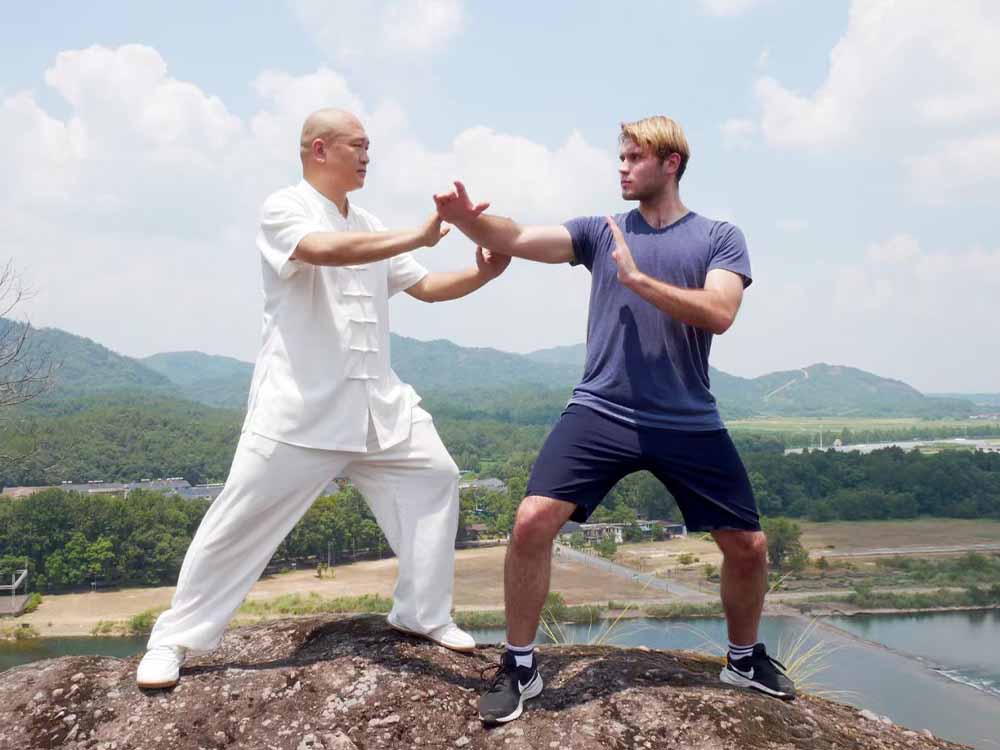
Train Under a Direct Lineage Holder at SJF Kung Fu School
SJF Kung Fu School (Shen Jiangfei Martial Arts Center) offers exactly that opportunity. Located in a tranquil setting surrounded by mountains and rivers in Jincheng City, Shanxi Province, China, the school is a dedicated retreat for international students seeking authentic, immersive training. It bridges the gap between ancient wisdom and modern practice, providing a space where the philosophies discussed in this article come to life through daily, disciplined practice.
At the heart of the school is Master Shen Jiangfei, a direct descendant of Liuhe Quan and the 11th-generation inheritor of Chen-style Tai Chi. Growing up in a martial arts family, Master Shen has dedicated decades to mastering both the powerful, flexible movements of Liuhe Quan and the characteristic strength-softness, spiraling techniques of Chen-style Tai Chi. He brings the core principles of "large joints leading small joints" and "successive connection through each joint" directly to his students, adapting his teaching to individual needs while upholding the highest standards of the art.
The school provides a holistic environment that supports both intensive practice and the mental clarity central to Tai Chi's philosophy. With flexible program durations ranging from one week to five years, it accommodates everyone from short-term retreat seekers to long-term dedicated students. The all-inclusive stay covers training, accommodation, meals, and amenities, allowing students to focus entirely on their practice.
Master Shen has extensive experience teaching international students of all levels, from complete beginners to advanced practitioners. The school's peaceful setting, surrounded by beautiful landscapes and over 30 nearby places of interest, offers an ideal atmosphere for focused training and quiet reflection.
Whether you are a complete beginner or a seasoned practitioner, SJF Kung Fu School offers the ideal environment to deepen your understanding of Chen-style Tai Chi and Chinese martial arts. Join a global community of learners who have come from countries like Germany, the UK, the US, and beyond.
To learn more or to apply for a course, visit https://sjfkungfuschool.com/ or contact the school directly via WhatsApp at +8618635686380.




 WhatsApp