What Makes Taijiquan Different From Tai Chi?
What does Taijiquan mean, and is it different from Tai Chi? Beginners often meet these names in books, class listings, videos, and conversations, then wonder whether they describe separate practices. The short answer is that they are closely connected, but the wording changes the emphasis. “Tai Chi” is commonly used as a broad name for health practice, moving meditation, and slow forms. “Taiji” points toward a Chinese philosophical principle. “Taijiquan” names a martial art built from that principle.
The difference matters when choosing how and why to train. A person seeking calmer breathing, balance, and gentle movement may be well served by a Tai Chi class. A person who also wants body structure, martial applications, footwork, partner practice, and traditional form training should understand what the word “quan” adds.
At SJF Kung Fu School, students study Tai Chi as part of Chinese martial arts training rather than as a sequence of slow movements alone. Master Shen Jiangfei is a descendant of Liuhe Quan and an 11th-generation inheritor of Chen-style Tai Chi. His teaching places breathing, stance, intention, form, and martial purpose in the same practice.

Terminology boundary explaining how the word quan changes Taiji from a philosophical concept into a martial art
The terminology becomes clearer when each word is separated. Taiji refers to the interaction of opposing yet connected qualities: yielding and issuing, opening and closing, rising and sinking, stillness and movement. It is a way of describing balance and change. By itself, it does not name a fighting system, a form, or a training curriculum.
Quan means fist, boxing, or a martial method. When “quan” is added, the term becomes Taijiquan: a Chinese fighting art whose movements are informed by Taiji principles. This boundary is not academic decoration. It changes what a learner should expect in class.
| Term |
What it refers to |
What it affects in practice |
What can go wrong if confused |
| Taiji |
A philosophical principle of balance and transformation |
It guides how students notice weight shift, relaxation, timing, and the relationship between firmness and softness. |
A learner may discuss ideas of balance without developing a repeatable physical method. |
| Tai Chi |
A common English label for several related practices |
It may refer to gentle exercise, forms, health classes, or the martial art itself, depending on the teacher. |
A student may assume every Tai Chi class includes applications, partner work, or martial structure. |
| Taijiquan |
A martial art based on Taiji principles |
Training includes form, stance, alignment, stepping, issuing force, sensitivity, and practical use of movements. |
A learner may move slowly but never learn why a posture protects, redirects, controls, or strikes. |
| Tai Chi Chuan |
An older English spelling of Taijiquan |
It usually points to the same martial art, though class content still depends on the instructor. |
A beginner may search for separate systems when the difference is often spelling and translation. |
Clear conclusion: if your interest is the martial art, look for Taijiquan instruction that explains both the movement and its use. This suits learners who want more than relaxation from their Tai Chi practice. It does not mean every beginner must begin with sparring. Slow form work remains central, but each posture should have a reason.
Why Tai Chi and Taijiquan are often used interchangeably
In everyday English, “Tai Chi” has become the familiar term. It is easier to pronounce, easier to remember, and often used by teachers who focus on health, mobility, breath, or stress reduction. This usage is not necessarily wrong. The confusion begins only when a student assumes that the name alone tells them everything about the training.
Different schools may use the same label while teaching very different material. One class may focus on a short form learned in a community setting. Another may spend significant time on stance work, stepping, silk reeling, partner sensitivity, and applications. Both may call themselves Tai Chi.
For this reason, beginners should ask about practice content rather than relying on a name. The following checklist gives useful questions before joining a class or planning a training period in China.
- Ask whether forms are taught with applications. This is the best question for someone seeking a martial understanding. It may not matter if your only goal is light movement and relaxation.
- Ask how stance training is introduced. Stable legs and aligned hips affect balance, knee safety, and power transfer. Long static holds are not suitable for every new student, especially those managing injury or limited mobility.
- Ask whether partner exercises are optional or required. Partner work helps explain distance, timing, and sensitivity. It may not suit learners who only want solo exercise.
- Ask which family style is taught. Chen style, Yang style, and other systems share principles but use different training methods, pacing, and forms.
- Ask how breathing is taught. For beginners, natural breathing and relaxed alignment should come before forced techniques or dramatic claims about internal energy.
A good early choice is not the one with the most impressive description. It is the one whose training purpose matches your own. If you want martial arts training, choose a class that can show how its forms relate to martial function. If you seek quiet movement and general wellbeing, a gentler Tai Chi course may be the better fit.
How martial purpose changes the way each movement is trained
Taijiquan is often practiced slowly, yet slowness is not the final goal. It is a method for noticing details that fast movement can hide. A slow pace reveals whether the knee follows the direction of the foot, whether the spine remains upright, whether the shoulders rise, and whether weight has actually transferred from one leg to the other.
In martial practice, these details have practical effects. A collapsed knee weakens the base. Raised shoulders interfere with relaxed arm movement. A hand that moves before the waist turns may lose connection with the body. A step placed without control can leave the practitioner unable to change direction.
| Training element |
What it develops |
Practical effect |
Limit for beginners |
| Slow form practice |
Coordination, memory, balance, and body awareness |
Shows where the body breaks alignment during turning, stepping, or shifting weight. |
Slow movement alone does not teach distance or response to another person. |
| Standing meditation |
Postural endurance and calm attention |
Helps students feel leg support, spinal length, and unnecessary tension. |
Postures should be adjusted for injuries and should not be forced through pain. |
| Partner sensitivity |
Listening, timing, and contact awareness |
Shows whether relaxed structure remains when another person applies pressure. |
It requires careful supervision and respectful partners. |
| Application study |
Martial meaning within a form |
Explains how a posture may redirect, control, strike, or protect. |
Applications are taught progressively and should not be treated as fixed answers to every situation. |
| Footwork practice |
Mobility and rooted balance |
Connects hand techniques to stable stepping and changes of angle. |
Deep stances are not a measure of skill for every body type. |
For a new student, the wisest order is simple: first learn alignment, then weight shift, then coordinated movement, and finally the application behind the shape. Trying to imitate martial speed before building these foundations often creates stiffness. Trying to make every movement soft without structure can create collapse. The practice asks for both ease and support.
Standing work has a special place here. Zhan Zhuang practice teaches the student to remain still enough to notice the body honestly. The aim is not to endure discomfort for its own sake. The aim is to find a position where the feet, legs, hips, spine, and arms can work together with less unnecessary effort.

Chen style Tai Chi preserves visible martial training methods
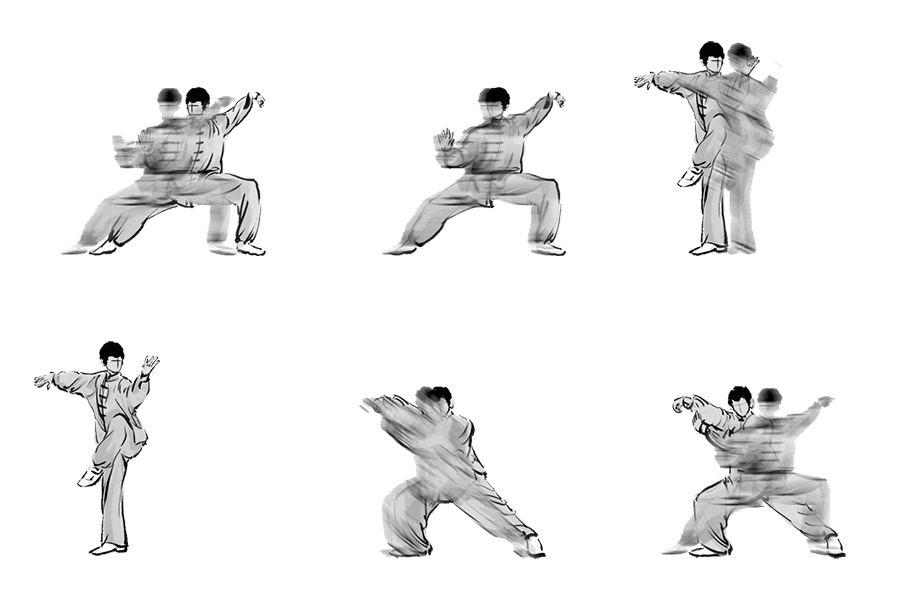
Chen style Tai Chi is often associated with a wider range of pace and expression than many beginners expect. Within its forms, movement may include slow, measured transitions as well as more energetic actions. This variety helps show that Taijiquan is not defined only by moving slowly. It is defined by how the body organizes force, responds to pressure, and maintains balance while changing.
Master Shen Jiangfei’s lineage gives students at SJF Kung Fu School a direct connection to Chen-style Tai Chi and Liuhe Quan. His background includes more than 20 years of teaching and training over 3,000 students worldwide. These facts matter for a beginner because a lineage-based teacher can explain not only the outer sequence, but also why a stance, turn, or hand position is trained in a particular way.
Consider Andrew Williams from the United States, who trained for 30 days with his son in Tai Chi, Zhan Zhuang, and Dao Fa. He described the period as life-changing in physical, mental, and spiritual terms, and planned to return the following year. His experience is personal, not a promised result for every visitor. Still, it illustrates the value of giving practice enough time for the body to settle into a daily rhythm.
For learners considering a longer stay, a one month Kung Fu Course can give more space for this process than a single introductory class. It suits students who want repeated correction and time to absorb forms, standing practice, and cultural study. It may not suit someone who only wants a brief first experience; in that case, a shorter course is a sensible beginning.
Common mistakes when starting Tai Chi or Taijiquan
Most beginner mistakes come from misunderstanding the purpose of practice, not from lack of effort. Correcting them early makes training safer and more rewarding.
- Choosing by name alone. “Tai Chi” may mean health exercise, martial art, or both. Ask what the class actually teaches before enrolling.
- Forcing low stances. Lower is not automatically better. A stance should allow the knees to track safely and the spine to remain supported.
- Holding the breath. Concentration often makes beginners tense their chest and jaw. Return to quiet, natural breathing before adding more detail.
- Chasing invisible sensations. Internal training begins with observable work: posture, balance, relaxation, and attention. Do not make unusual sensations the measure of progress.
- Ignoring martial context. If a movement has no explanation, ask respectfully what it trains. A basic answer is enough at first; advanced applications can wait.
- Learning too many forms at once. One short section practiced carefully is more useful than several sequences learned without stable posture or memory.
The central lesson is patience. Traditional Chinese martial arts are not built through collecting techniques. They are built through regular return to the same essentials: feet on the ground, breath without strain, attention in the body, and respectful conduct toward teachers and training partners. This spirit is part of Wu De, martial virtue. Skill is shaped not only by what the hands can do, but by restraint, humility, and responsibility.
A practical first month for beginners
A beginner does not need to master a complete form immediately. The first month should create a stable base and a clear vocabulary. Use the following structure as a guide when beginning regular classes or planning a focused training period.
- Week one: learn the names and purpose. Understand the difference between Taiji, Tai Chi, and Taijiquan. Practice a neutral standing posture and gentle weight shifts. Stop if you feel sharp pain or joint instability.
- Week two: establish alignment. Work on feet, knees, hips, spine, and relaxed shoulders. Learn a small number of movements rather than rushing through a long form.
- Week three: connect movement to intention. Ask how one or two postures may protect space, redirect force, or control an arm. Keep practice slow enough to retain balance.
- Week four: build a repeatable routine. Combine standing meditation, basic stepping, a short form section, and calm breathing. A modest routine practiced consistently is more useful than occasional overexertion.
Students who wish to place Taijiquan within a broader Chinese martial arts setting can also study Chinese Qi Gong for breath and body awareness, or observe how systems such as Shaolin Quan and San Da train different qualities of movement. Comparison can be helpful, but beginners should keep one primary practice long enough to understand its character.
Choosing the right meaning for your own practice
Use “Tai Chi” when speaking generally about the familiar practice of slow movement, balance, and calm attention. Use “Taiji” when discussing the philosophical principle of changing opposites. Use “Taijiquan” when you mean the martial art: the system of forms, body mechanics, martial application, and self-cultivation shaped by those principles.
None of these terms needs to become a barrier. They are useful because they help you ask better questions. Do you want gentle movement? Do you want a martial art? Do you want both, with time to study the culture that formed them? Your answer should guide the class, teacher, and training schedule you choose.
SJF Kung Fu School welcomes sincere students who wish to study traditional Chinese martial arts with care, discipline, and mutual respect. View the One Week Kung Fu Course to discuss a suitable starting point with the school.




 WhatsApp