Authentic Chinese Kung Fu: What a Trial Day Reveals
Use One Ordinary Training Day to Judge the Right School
Before committing to a week, a month, or a longer stay in China, a visitor may regret judging a school only by photographs, intense training videos, or a list of styles. Authentic Chinese Kung Fu is easier to recognize in an ordinary class: how an instructor corrects a stance, how students work with one another, how safety is handled, and whether practice has a clear purpose.
At SJF Kung Fu School, a trial-day visit can help a prospective student look beyond first impressions. The school supports short and extended study options, from a one-week intensive stay to long-term training. Regular classes do not require a minimum enrollment, while group bookings require at least two students. This makes an individual visit suitable for someone who wants to assess the teaching environment before choosing a larger commitment.
A single day cannot show every part of a martial arts school. It cannot prove how a student will feel after three months, nor can it replace consistent practice. It can, however, answer practical questions: Is instruction attentive? Is the training suited to my current condition? Do traditional forms, partner work, conditioning, and quiet practice have a sensible place in the schedule?

Arrive with a clear purpose
A useful trial day begins with one simple decision: what do you need to learn first? A beginner may need basic posture, coordination, mobility, and confidence in a new environment. A martial artist with prior experience may want to test body mechanics, partner drills, form instruction, or the instructor’s ability to adjust established habits. Someone interested in Chen-style Tai Chi, breathing practice, or stillness may need to see whether quiet training receives the same care as visible movement.
Write down two or three goals before you attend. For example:
- I want to know whether I can train safely with a previous knee or shoulder concern.
- I want to observe whether form practice explains structure rather than only appearance.
- I want to see how students of different levels share the same training space.
This approach fits travelers who are choosing between a short course and a longer stay. It does not apply if you only want a sightseeing activity. A school visit has greater value when you are prepared to observe ordinary training with patience.
Observe the Teaching Method Before You Judge the Style
Styles matter, but method matters first. A school may offer Shaolin Quan, Tai Chi, Qi Gong, San Da, Qin Na, Ge Dou, Chinese weapons, Zhan Zhuang, and Meditation. The relevant question is not whether every subject appears in one session. Ask whether the teacher gives each practice a reason and presents it at an appropriate level.
Master Shen Jiangfei is a descendant of Liuhe Quan and the 11th-generation inheritor of Chen-style Tai Chi, described as the original and oldest of the five primary family styles. This lineage is meaningful when it appears in instruction: a correction to the waist, a reminder about rooting through the feet, or an explanation of how relaxed structure supports force. It should not be treated as a substitute for observing the class itself.
During a Tai Chi-focused session, watch whether the instructor explains how the feet, knees, hips, spine, shoulders, and hands relate to one another. In a form lesson, students should know what to work on between repetitions. If you wish to focus on slow practice and structure, review the school’s Learn Tai Chi options before a visit so you can ask focused questions about your intended course.
Look for corrections that are specific and usable
A useful correction identifies a visible issue, gives the student a manageable adjustment, and allows time to try again. “Lower your stance” is less helpful by itself than a correction that addresses weight placement, knee direction, or tension in the hips. In standing practice, an instructor may ask a student to soften the shoulders, lengthen the spine, or distribute weight more evenly. The student should then repeat the position and receive a second look.
For a visitor, this is a strong sign of teaching care because it shows that training is not based on copying a fixed image. Yet the limit is simple: an instructor cannot fully assess your movement history in one day. If you have injuries, medical conditions, or major mobility restrictions, raise them directly and do not assume that a trial observation answers every training question.
A Trial-Day Observation Framework: Five Things to Watch
Use the following framework during a class. It covers coaching corrections, partner practice, safety standards, class mix, and student progression. These five areas reveal more about daily teaching than a dramatic demonstration.
| What to observe |
What a visitor should look for |
Why it matters |
When this may not apply |
| Coaching corrections |
The instructor notices individual posture, timing, balance, or alignment and gives students a clear action to repeat. |
Specific feedback helps students understand how to improve rather than merely imitate. |
A large group warm-up may involve fewer individual corrections than a technical lesson. |
| Partner practice |
Students begin with control, distance awareness, and cooperation before speed or force increases. |
Qin Na, San Da, and other two-person work require trust and mutual responsibility. |
Some trial days may focus only on forms, conditioning, Tai Chi, or Zhan Zhuang. |
| Safety standards |
Students have room to move, receive guidance on contact drills, and use equipment in an orderly way. |
Good martial practice protects training continuity and helps students work with attention. |
No school can remove all risk from physical training, especially in partner work. |
| Class mix |
Beginners, returning students, and more experienced practitioners each have suitable work without confusion. |
A mixed group can be productive when the instructor adapts tasks and expectations. |
A specialist workshop or private lesson may naturally have a narrower mix. |
| Student progression |
Students repeat fundamentals, then show increased control, coordination, or understanding in later drills. |
Progression suggests that training has an order rather than a collection of disconnected movements. |
You may only see one small part of a longer curriculum during a single day. |
Take notes after class, not while someone is explaining a movement. Record one example for each category. “Instructor corrected my shoulder tension during a bow stance” is more useful than “teaching seemed good.” “Partner drill began slowly, with the instructor setting distance” is more useful than “the class felt safe.” These details help you compare your observations later without relying on mood alone.
The framework is especially useful for visitors considering San Da training, Qin Na, or weapon practice, where distance, control, and attention to fellow students are visible. It is less useful if you attend only a ceremonial performance rather than a regular teaching session.
Read the Relationship Between Stillness, Form, and Partner Work
Traditional Chinese martial arts are not only a sequence of visible techniques. Body mechanics, intention, breath, and conduct are developed through repeated practice. A thoughtful trial day may include active movement alongside quieter methods such as standing meditation, seated Meditation, or Qi Gong.
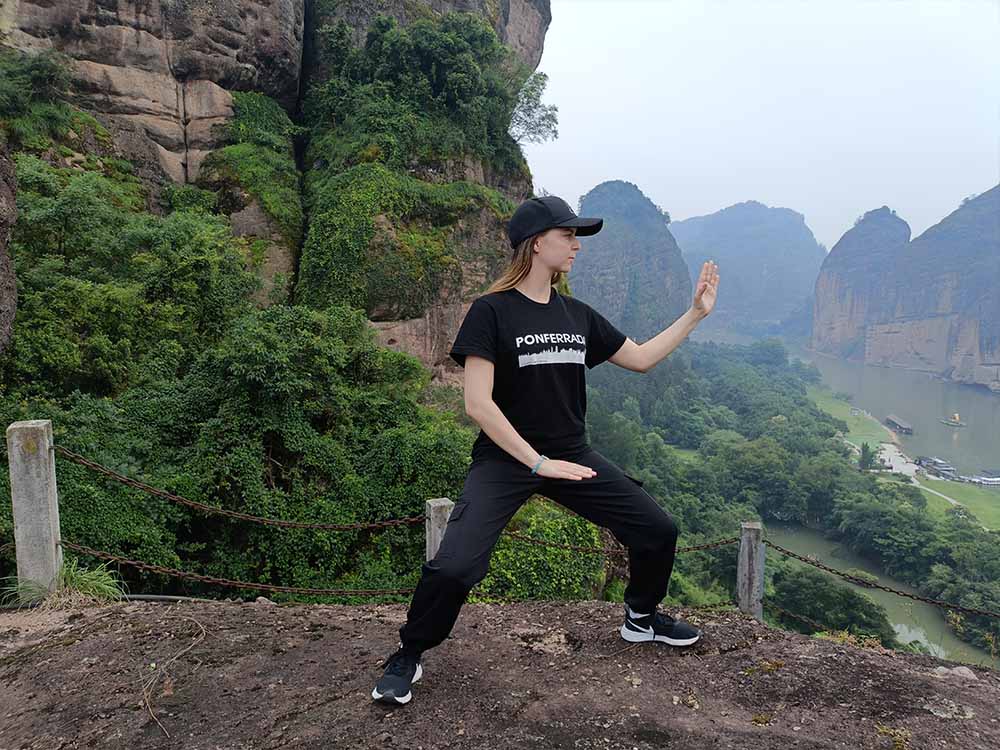
Zhan Zhuang, often practiced standing in a stable posture, gives a visitor a simple test. Watch whether the instructor explains what students are seeking: settled feet, relaxed but supported arms, a lengthened spine, steady breathing, and a calm attention. The exercise may look still, yet it asks much of the body and mind. A person who cannot comfortably stand for long should ask about modifications instead of forcing the posture.
Likewise, form work should not be separated from practical meaning. In Shaolin Quan, observe whether a stance, step, hand position, or change of direction is taught with attention to balance and intent. In Chinese weapon practice, see whether students are given space, clear handling instructions, and progressive material suited to their ability.
Wu De appears in ordinary conduct
Wu De, martial virtue, can be seen in the tone of a class. It appears when students listen carefully, train with restraint, care for shared equipment, and treat partners with respect. It also appears when an instructor corrects firmly without humiliating a learner. These habits support serious practice because skill without self-control has limited value.
Do not expect a trial day to provide a perfect cultural lesson in every moment. Training halls are working places. Students may be tired, concentrating, or dealing with difficult movements. Instead, look for a consistent atmosphere of attention and mutual respect over the course of the session.
Match What You See to the Length of Training You Need
The right program length depends on your purpose, available time, and readiness for sustained repetition. A trial day should help you select a suitable next step rather than pressure you into a longer course.
| Training need |
Suitable next step |
What to confirm during a visit |
Limit to remember |
| A first experience of daily Kung Fu practice in China |
One Week Kung Fu Course |
Whether the pace, climate, daily routine, and teaching style feel manageable. |
One week allows focused exposure but limited time for deep technical change. |
| Focused work on Tai Chi, Zhan Zhuang, a form, or a weapon |
One-month study |
How the instructor sequences basics, repetition, and individual correction. |
A month still requires realistic expectations and regular personal effort. |
| Extended study of physical skills and inner discipline |
Three-month, six-month, or long-term training |
Whether you can live with the daily rhythm and remain engaged with fundamentals. |
Longer study should be chosen only after discussing personal aims and practical arrangements. |
SJF Kung Fu School has a 200㎡ indoor training center, allowing year-round practice regardless of weather. This is relevant for a visitor considering a longer stay because training consistency matters when learning depends on repetition. It does not mean that every session or every style follows the same format; ask which subjects are available during your intended dates.
Real student accounts also show why course length should fit the person. Andrew Williams from the United States trained Tai Chi, Zhan Zhuang, and Dao Fa for 30 days with his son. He described the experience as life-changing for him physically, mentally, and spiritually, and planned to return the following year. This account is one family’s experience, not a promised result for every student. Its practical lesson is that a month can give enough time for a parent and child to settle into a serious training rhythm.
Hayley Noel from the United Kingdom completed a 120-day course including Tai Chi, Zhan Zhuang, Sword, and Broadsword. Her family later wrote that she loved her time in China and that they were grateful for the care she received. For a visitor considering a longer program, this supports asking how a school accommodates gradual development over an extended stay. It does not establish that every learner needs 120 days.
Ask Direct Questions Before You Commit
A respectful conversation after class can clarify matters that observation alone cannot answer. Use your notes, state your aims honestly, and ask questions that connect to the program you are considering.
- Ask which subjects are suitable for your current level. A beginner may benefit from foundational stance work, forms, Tai Chi, Qi Gong, and basic conditioning before more demanding partner material.
- Ask how corrections are given during mixed-level classes. This helps you understand whether the instructor can adapt training without removing the shared class spirit.
- Ask what partner practice is included in your intended course. This is relevant if you are considering San Da, Qin Na, or Ge Dou rather than forms alone.
- Ask how weapon work is introduced. Students should understand whether weapon practice is part of their level and course plan, rather than assuming it is included from the first day.
- Ask what should be agreed before a longer stay. Discuss your training goals, dates, intended duration, physical considerations, accommodation needs, and preferred subjects.
Avoid two common mistakes. First, do not judge a school only by the hardest-looking class. Advanced demonstrations are inspiring, but they may not show beginner instruction. Second, do not judge by comfort alone. Good training can be demanding, particularly when correcting posture or building leg strength. The better question is whether the difficulty has a clear purpose and is presented with care.
For students drawn to Chen-style Tai Chi, Liuhe Quan, Shaolin practice, or quiet methods such as Qi Gong and Zhan Zhuang, the trial day is a chance to see whether movement and reflection belong together. For those seeking combat-oriented study, it is a chance to see whether practical drills are controlled and progressively taught. In either case, the aim is not to find spectacle. It is to find a place where training has direction.
Choose a School That Gives You Reasons to Return
A worthwhile trial day leaves you with more than photographs. You should be able to name the correction you received, describe the class rhythm, explain how students trained together, and identify the next question you need answered.
Authentic Chinese Kung Fu is not confirmed by a uniform, a dramatic pose, or one demanding afternoon. It is shown through patient instruction, disciplined repetition, respectful conduct, and a teacher’s ability to connect tradition with the student standing in front of them. At SJF Kung Fu School, Master Shen Jiangfei’s Liuhe Quan and Chen-style Tai Chi lineage offers a meaningful foundation for visitors who want to observe these qualities in daily practice.
If you would like to discuss a visit or choose a suitable training length, view the one month Kung Fu Course and send your training goals to the school for guidance.



 WhatsApp