Build a Tai Chi Routine for Better Balance
Why do you wobble the moment one foot leaves the ground, and what can ten quiet minutes a day do about it? In Tai Chi, balance is not a trick of the ankles. It grows from a steady stance, patient weight shifts, and a mind that stays calm while the body changes position. This article gives you a short home routine built on exactly those three things, with checkpoints so you can tell when a step is working and when it is not.
We teach this order at SJF Kung Fu School. Master Shen Jiangfei is a descendant of Liuhe Quan and the 11th-generation inheritor of Chen-style Tai Chi, the original and oldest of the five primary family styles. In his hall, every student begins at the feet, long before any graceful arm movement is attempted.
Why Balance Begins With Root, Not Speed
Traditional teachers speak of rooting. A rooted body keeps its weight over a stable base and lets the legs, not the shoulders, decide where it goes. Slow movement is the teaching tool here. At normal speed, momentum hides your errors. At one third of that speed, every leaning shoulder and every locked knee shows itself.
Tai Chi is built on this principle of slowness. It is also where the martial virtues, Wu De, become practical. Humility lets you accept that you wobble. Patience lets you repeat a small movement fifty times. Respect for the body keeps you from forcing a posture it is not ready for.
Your routine rests on three pillars:
Stance stability: a still, comfortable base you can hold without gripping.
Safe weight transfers: moving your weight from one leg to the other in a controlled way, with no sudden drops.
Repeatable balance progressions: small, measurable challenges you add only when the previous one is steady.
The standing posture at the core of Zhan Zhuang is the best companion to the first pillar. Standing like a post teaches the legs to carry you without effort.
How to Structure a Short Practice Around Stance, Weight Transfer, and Balance Progression
Set aside ten to twelve minutes. Use a flat, non-slip floor and bare feet or thin flat shoes. Practice within arm's reach of a wall or a sturdy chair. Move slowly, breathe through the nose, and stop any step that causes sharp pain or dizziness.
| Step | Time | What to do | Key checkpoint | Common failure and why it happens |
|---|
| 1. Settle the stance | 2 min | Feet shoulder width apart and parallel. Knees soft, tailbone heavy, arms hanging loose. Breathe low into the belly. | Weight sits evenly on both feet. Shoulders feel heavy, not lifted. | Locked knees or toes gripping the floor. The legs are tensing to "hold" balance instead of resting on bone structure. |
| 2. Shift weight in place | 2 min | Slowly move weight onto the left leg over about five seconds, pause, then return and repeat to the right. Both feet stay flat. | You can lift the toes of the unweighted foot without your body swaying. | The upper body leans sideways. The shoulders are leading when the hips should be. |
| 3. Empty heel touch | 2 min | Shift weight fully onto the left leg. Rest the right heel lightly forward with no weight on it. Shift back and switch sides. | The loaded leg carries all the weight. The touching heel could float away without disturbing you. | The "empty" foot secretly holds some weight, or the step is too long. Both make the transfer incomplete. |
| 4. Arms with the shift | 2 min | Raise both arms to shoulder height as you inhale, lower them as you exhale, keeping the stance from step 1. | Weight stays centered while the arms move. Breath and motion share one rhythm. | Breath holding, or arms pulling the body backward. Attention has narrowed to the hands. |
| 5. Single leg lift | 2 min | Transfer weight to the left leg, lift the right foot a few centimeters, hold three breaths, lower it, and switch. Keep fingertips near the wall. | The standing knee stays soft and the torso upright. The lifted foot comes down quietly. | Staring at the floor, hiking the hip, or rushing the lift. The weight transfer from step 3 was not finished first. |
| 6. Close and settle | 1 min | Return to the opening stance, rest both hands on the lower belly, and breathe quietly. | Heartbeat and breath slow down. You feel your feet again. | Skipping the closing. Without it, the practice stays a drill and does not become a habit of calm. |
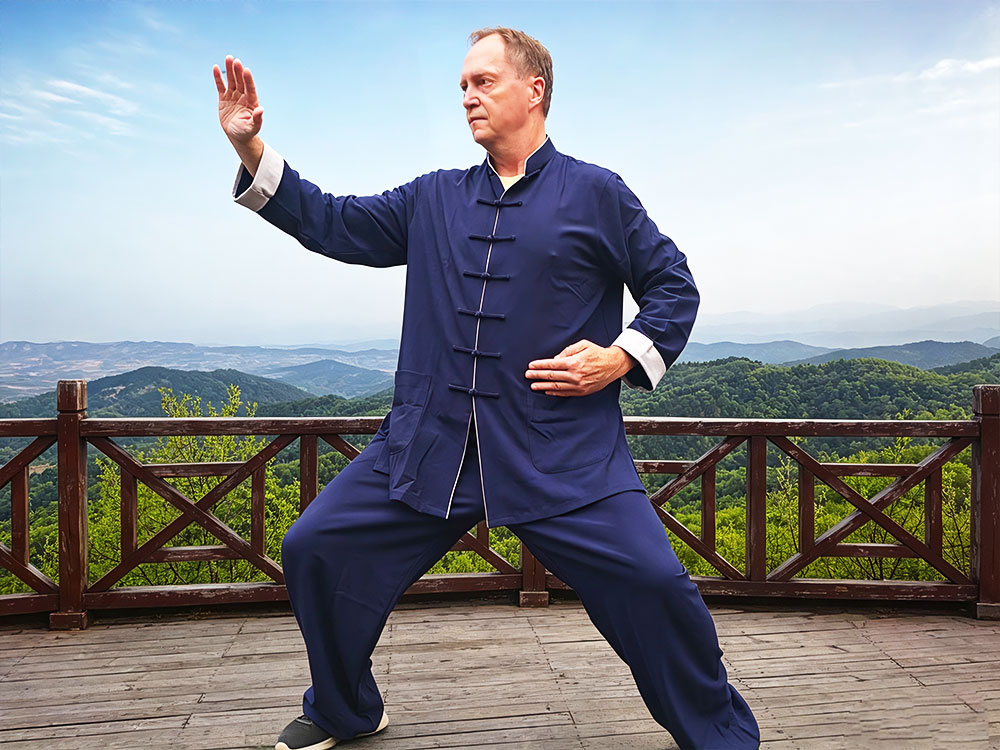
Repeatable balance progressions
The most common reason beginners plateau is that they add difficulty by feel. Use a rule instead. Move to the next level only after you can complete the current one cleanly on three separate days.
| Level | Challenge | Move up when | Stay here if |
|---|
| 1 | Ten weight shifts in place, five seconds per side, eyes open | Neither foot slides and the shoulders stay level | You need to grip the wall or the knees ache |
| 2 | Heel touch with a full transfer, ten per side | The empty foot is truly empty | You step too far or feel pushed backward |
| 3 | Single leg lift, three breaths per side, fingertips near the wall | You can hold without touching the wall | The standing leg trembles before the third breath |
| 4 | Single leg lift with slow arm raise, five breaths | The arms move without any wobble in the torso | You hold your breath during the arm movement |
| 5 | Slow steps forward and back, eyes forward | Each step lands softly and the weight arrives before the foot is planted | You catch yourself falling into the step |
When this structure does not apply: eyes-closed balance work and fast direction changes are not part of this beginner routine. They raise fall risk and are better added with a teacher watching.
A worked example: ten minutes before breakfast
Picture a beginner who practices at 7:00 a.m. next to a kitchen counter. Week one is steps 1, 2, and 6 only, repeated for ten minutes, and that is enough. The counter is there for reassurance, not support. In week two, step 3 is added, and the practitioner checks in the hallway mirror that the heel truly floats. Step 5 is added only in week three, after step 3 has felt boring for several days. Boring is a good sign. It means the foundation is settling.
Common Mistakes That Undo Good Balance Work
Rushing the transfer. Fix: count five slow breaths per shift. It does not apply if you feel any dizziness, in which case you should stop and rest.
Locking the standing knee. Fix: keep a slight bend, as though a thread were lifting the crown of the head. This hides the problem if you overbend, so keep the bend small.
Looking down. Fix: rest your eyes on a point at about eye level. Beginners with very low confidence may glance down briefly, which is fine at Level 1.
Holding the breath. Fix: let the exhale lead the movement. A short Qi Gong breathing set beforehand helps many people settle their rhythm.
Practicing only when motivated. Fix: attach the ten minutes to an existing habit, such as the kettle heating. Short daily sessions beat one long weekend session for balance.
Skipping the mind. Fix: end with one minute of quiet. Our Meditation teaching treats stillness as a skill that supports the stance, not a separate subject.
What Our Students Teach Us About Patience
The arc of the routine above, from small and dull to steady and quiet, matches what we see in students who stay with us. Each story below is a real student's own account, and each result belongs to that person alone.
Klaes Risbjerg Simonsen (Denmark) trained for 30 days in Tai Chi, Zhan Zhuang, and Broadsword. He wanted an authentic, focused experience rather than a touristy resort, and felt from day one that he was in the right place. He grew physically and spiritually, and he praised the Shifu for adapting the training to his needs.
Austin Erkl (USA) completed 30 days of Tai Chi and Sword. He admitted he did not love it at first, but after adjusting he had a great time. In his words, "The master is a great guy that cares for his students."
Pamela Paes Ezawa (Brazil) completed a 7-day Chen-style course. She loved the authentic, traditional training environment, the Taoist heartland location, and the welcoming Shifu and community. Anyone wanting a first taste can look at our Short-Term Kung Fu Course.
Hayley Noel (UK) trained for 120 days in Tai Chi, Zhan Zhuang, Sword, and Broadsword. Her family wrote to Master Shen that she "loved it so much" and had "an awesome time."
Austin's early doubt is the part worth remembering. Balance work asks you to be a beginner again, and the early weeks can feel plain. Our 200㎡ indoor training center lets students practice year-round regardless of weather. The setting near the Shaolin Temple, with more than 30 cultural and historical sites nearby, gives the daily repetition a quiet cultural backdrop.
When a Home Routine Needs a Teacher
A mirror cannot tell you that your pelvis tilts or that your weight sits slightly in the toes. A teacher can see this in seconds. If you notice any of the following, pause the routine and seek advice:
Dizziness, numbness, or a recent fall.
Joint surgery or ongoing knee, hip, or ankle pain.
A diagnosed balance or inner ear condition. Check with your doctor first.
This routine is a practice habit for healthy adults. It is not medical treatment, and the cases above are personal experiences, not guarantees.
If you would like to practice with a teacher who carries this lineage, we welcome you to contact SJF Kung Fu School and talk about your goals, whether you are curious or ready to Learn Tai Chi in China. A short conversation with Master Shen's team is a good place to begin.




 WhatsApp