Build Striking Power With Liuhe Quan Footwork
Why Footwork Determines the Quality of a Direct Strike
A direct strike is not made powerful by the arm alone. In Liuhe Quan, the fist is the final expression of a connected action that begins at the ground: the foot receives pressure, the leg organizes it, the kua settles, the waist turns only as much as needed, and the hand arrives on a clear line. When one part arrives late, power leaks away.
For students attending a Liuhe Quan Class, this is often the first difficult lesson. A punch can look fast yet feel empty. Another punch may travel only a short distance, yet carry clear structure because the step, stance, and hand arrive together. The purpose is not to force strength into the shoulder. It is to make the whole body available behind a simple action.
This principle also appears in Learn Tai Chi training, where students study how relaxed alignment and stable rooting can support movement. Liuhe Quan expresses the same concern in a more direct manner: enter without drifting, connect without leaning, and strike without losing your base.
At SJF Kung Fu School, Master Shen Jiangfei teaches Liuhe Quan as part of a wider traditional martial arts practice. As a descendant of Liuhe Quan and the 11th-generation inheritor of Chen-style Tai Chi, he teaches students to pay attention to timing, stance, and intention rather than collecting empty movements. The form is a teacher. Each step asks whether the body is unified or separated.
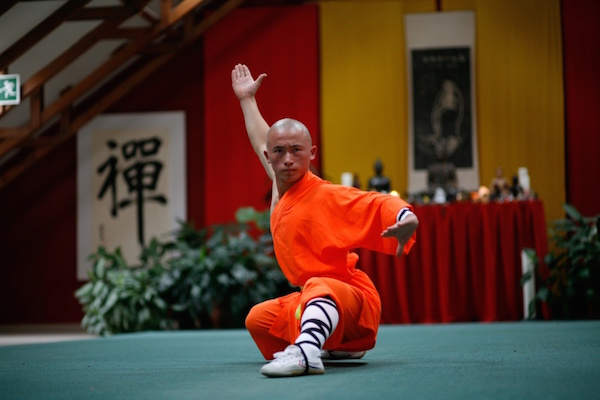
How Coordinated Stepping, Kua Sinking, and Straight-Line Entry Transfer Force Without Overreaching
The key relationship is simple: the step creates a stable route, kua sinking gives the route weight and connection, and straight-line entry sends the strike toward the target without unnecessary motion. None of these elements should be isolated in practice. A low stance without a connected entry is only a low stance. A fast step without kua control can become a forward fall.
| Movement element | What it affects | Useful cue | Common error | Practical consequence |
|---|
| Coordinated stepping | Timing between the foot, body mass, and hand | Let the body arrive behind the lead foot, not ahead of it | Throwing the upper body forward before the base is set | The strike feels long but leaves the practitioner unstable |
| Kua sinking | Connection from pelvis to legs and ground | Allow the hips to settle naturally while keeping the spine upright | Forcing the hips downward or collapsing the knees inward | Leg pressure becomes blocked, and the waist cannot guide the strike cleanly |
| Straight-line entry | Efficiency of the hand path and centerline control | Send the fist from guard to target on the shortest workable path | Drawing the hand back or swinging wide before contact | The opponent receives more warning, while the shoulder works too hard |
| Rear-foot support | Ability to continue or withdraw after the strike | Keep enough pressure in the rear leg to remain mobile | Leaving the rear foot empty and hanging on the front leg | The first attack may extend well, but recovery is slow |
Step first, but do not chase the foot
Coordinated stepping does not mean planting the foot, stopping, and then punching as three separate actions. The foot sets the direction while the body follows in one rhythm. In a basic forward entry, the lead foot touches down quietly, the weight begins to settle, and the fist reaches its line as the body becomes supported.
The conclusion is clear: use a shorter step when learning direct entry. The reason is that a short step allows the knee, hip, spine, and hand to remain connected. This suits solo drilling and close-range practice. It does not apply when distance demands a larger advance; in that case, the larger step must still finish with enough rear-leg support to prevent a lunge.
Sink the kua without dropping the head
The kua refers to the hip crease area where the torso and legs coordinate. “Sinking” does not mean squatting deeply or pressing the pelvis forward. It means allowing the hip joints to release enough that pressure can pass through the legs rather than rising into stiff shoulders.
A useful feeling is that the lower body becomes heavier while the top of the head remains quietly lifted. If the head pitches forward, the student has usually confused sinking with collapsing. If the shoulders rise, the student has likely tried to create power with tension instead of structure.
Enter on one line, not one rigid shape
Straight-line entry concerns purpose, not stiffness. The fist should not wander outward before moving toward the target. Yet the elbow must remain alive, and the shoulder must not be locked. The arm is guided by the body; it is not dragged by it.
For a central punch, keep the knuckles, wrist, elbow, and shoulder arranged so the hand can receive force from behind. If the elbow flares far away from the ribs, the line often breaks. If the elbow is squeezed too tightly into the body, the hand may become slow and cramped. Seek a natural channel rather than a frozen pose.
Build the Force Sequence One Piece at a Time
Trying to coordinate everything at full speed usually creates confusion. Begin with a slow sequence that lets you feel where the body disconnects. The following drill is suitable for students who have already learned a basic forward stance and straight punch from their teacher.
Choose a clear line. Stand facing a wall or a fixed point several steps away. Do not strike the wall. It is only a visual reference for your centerline.
Set a balanced stance. Keep both feet in contact with the floor. Avoid placing all weight on the front leg before you move.
Relax the hip creases. Let the knees soften in the direction of the toes. Keep the chest quiet and the neck long.
Advance with a modest step. Let the lead foot move toward the line. The step should be quiet enough that you could stop at any point without falling.
Allow the kua to settle. As the foot accepts weight, feel the pelvis settle between the legs. Do not force a deep bend.
Send the fist forward. Let the fist travel directly as the body becomes supported. Avoid pushing the shoulder ahead of the hip.
Pause at the end. Check whether you could take another step, retreat, or change direction. If not, you have likely overcommitted.
Return without snapping back. Draw the hand to guard while maintaining the same lower-body organization. Recovery is part of the technique.
Practice five slow repetitions on each side, then rest and assess. The goal is not fatigue. The goal is clear sensation. When the movement remains connected at a slow pace, increase speed only slightly. A fast repetition that loses posture teaches the wrong pattern more quickly.
This drill is especially useful for a beginner or an experienced martial artist adapting to Liuhe Quan body method. It does not replace partner instruction. Distance, target selection, and contact must be taught under supervision, because a correct solo line can change when another person moves, resists, or counters.

Use Stance Length to Prevent Overreaching
Overreaching is not simply taking a long step. It is placing the body where it cannot recover its balance after the strike. A practitioner may use a wide stance successfully if the hips remain connected and the rear leg stays available. By contrast, a short stance can still overreach if the chest races ahead of the feet.
The most reliable check is immediate: after completing the punch, pause for one breath. Can you turn, step back, or deliver a second action without pulling yourself upright first? If the answer is no, reduce the distance of the entry and reorganize the hips.
If your front knee moves far beyond your support: shorten the step. This is appropriate when the strike pulls your chest forward. Do not shorten every stance automatically; some form transitions require a longer route and should follow your instructor’s correction.
If the rear heel lifts too early: keep the rear leg involved until the strike has reached its line. This helps students who feel as if they are falling into the punch. It does not mean gluing the heel to the floor in every transition.
If the shoulder reaches before the hip: slow down and begin the punch later in the step. This fits students whose arm feels tired after a few repetitions. Do not delay so long that the punch becomes disconnected from the body’s arrival.
If the body becomes rigid at impact: reduce effort and check the jaw, neck, and hands. Tension can protect alignment for a moment but usually prevents smooth continuation.
In traditional practice, control is a form of Wu De, or martial virtue. A practitioner who can stop, redirect, and maintain balance shows more understanding than one who simply throws the body forward. Directness is not recklessness. It is disciplined economy.
Correct the Misunderstandings That Make Power Disappear
Students often hear “sink the kua” and “move in a straight line,” then turn those ideas into fixed rules. The body is not a machine made of separate locks. It changes according to range, angle, and the next action.
| Misunderstanding | What changes in practice | Better correction |
|---|
| “Power means dropping lower.” | The thighs burn, but the hips may become stuck and the upper body rises. | Use only enough knee bend to keep the hips available and the spine upright. |
| “A straight punch has no body rotation.” | The arm pushes alone, and the strike loses support from the waist and back. | Use a small natural body turn while preserving the direct route of the fist. |
| “The front foot must carry everything.” | The student becomes rooted only at the moment of attack and cannot recover. | Keep the rear leg connected so the body can continue, retreat, or change angle. |
| “Faster is more powerful.” | Timing becomes scattered, and the shoulder often leads. | Train slow coordination first, then increase speed while preserving balance. |
| “The form is separate from fighting.” | Hand shapes are memorized without understanding entry distance or structure. | Ask what each stance prepares, protects, and makes possible in the next action. |
A Liuhe Quan Class should give you ways to verify these details rather than asking you to copy an outer shape. Film a few slow repetitions from the side and front. Look for three things: whether the head stays roughly above the hips, whether the lead knee follows the toes, and whether the fist reaches its line without the shoulder jumping forward. Video cannot replace teaching, but it can reveal habits that are difficult to feel from inside the movement.
Standing practice can also clarify the issue. Zhan Zhuang teaches patience in the legs, awareness of the hip creases, and calm breathing under mild physical demand. Use it as preparation, not as a substitute for stepping. Standing develops the capacity to organize; stepping teaches when and how to apply that organization.
Apply the Method to Forms, Pads, and Partner Drills
The same mechanics have different limits in different training conditions. A form allows you to study alignment without interruption. Pad work asks whether the line remains clear when there is a target. Partner drills add timing, distance, and the responsibility to control contact.
In forms: make every step answer a question
When practicing a Liuhe Quan sequence, pause after a forward action and ask: Where is my weight? Can my rear hand protect the center? Is my next step available? This method suits students learning a sequence or refining one they already know. It does not mean stopping after every movement during a complete performance; first use pauses to diagnose, then restore continuity.
On pads: preserve shape before adding force
Use a qualified partner or instructor to hold pads at a distance that does not require reaching. Strike with moderate control and check whether the punch lands as the stance settles. If the holder must lean toward you, the range is too long for the drill. If you must bend your elbow excessively, the range is too close.
This is where students can see why direct entry matters. The body should arrive with the hand, not remain behind while the arm searches for the target. For students interested in a more contact-based setting, San Da training can help develop timing and distance, but it is not the same as form study. San Da includes changing range and active opposition; use the Liuhe Quan structure as a reference, not as a rigid script.
With a partner: keep martial virtue in the drill
Begin at low intensity. Agree on the target area, speed, and response before starting. The purpose is to study entry, not to prove toughness. A clean controlled touch can teach more than a hard collision that causes both people to lose form.
At SJF Kung Fu School, students can study within a 200㎡ indoor training center, allowing year-round practice on indoor mats regardless of weather. The school has trained more than 3,000 students worldwide, from short-term visitors to committed long-term practitioners. One useful example is Klaes Risbjerg Simonsen from Denmark, who completed a 30-day course in Tai Chi, Zhan Zhuang, and Broadsword. He described physical and spiritual growth and valued instruction adapted to his specific needs. His experience is personal, not a promised result, but it reflects the value of correction that meets the student’s present condition.
Choose a Practice Rhythm That Lets Structure Settle
Footwork improves through regular attention, not through a single exhausting session. A practical rhythm is to divide training into observation, repetition, and reflection. This gives the body time to learn without turning every session into a struggle for force.
Observation phase: Practice several slow entries and identify one issue only, such as a raised shoulder or an empty rear foot. This is best when beginning a session or returning after a break.
Repetition phase: Repeat the corrected action with a small number of controlled steps on both sides. Stop when the correction disappears. Continuing with poor structure simply repeats the old habit.
Reflection phase: Stand quietly, breathe naturally, and notice whether the legs, kua, and shoulders feel more coordinated. This is useful after form work or pad drills. It does not require forcing breath or sensation.
Students who want enough time to settle these details may find that a one month Kung Fu Course provides a useful period for daily correction, form practice, standing work, and cultural study near the Shaolin Temple. A one-week intensive can introduce the method and give clear practice points, while longer programs give more time for habits to change. Neither duration guarantees a certain result; progress depends on starting experience, physical condition, consistency, and careful instruction.
In a Liuhe Quan practice, the fist may be visible, but the lesson begins below it. Step with purpose. Let the kua settle without collapse. Keep the hand direct, and keep enough balance to continue. This is how striking power becomes a matter of whole-body order rather than arm strength alone.
View the one month Kung Fu Course and contact SJF Kung Fu School to discuss your current Liuhe Quan practice and training goals.



 WhatsApp