Chinese Martial Arts School Costs: Compare Inclusions
Compare the Full Stay Before Paying a Deposit
When comparing a Chinese Martial Arts School, the advertised course fee is only one part of the decision. International students may arrive with a clear goal—better structure, stronger body mechanics, Chen-style Tai Chi practice, Shaolin forms, or quiet time for meditation—yet still face uncertainty about accommodation, meals, airport transfers, uniforms, visa questions, and private instruction.
The regret usually comes from comparing unlike figures. One school may show tuition alone, while another may quote tuition with accommodation and meals. A lower initial number is not always the lower total stay cost. Before paying a deposit, ask every school to state what is included, what is optional, and what remains your personal responsibility in writing.
At SJF Kung Fu School, regular classes have no minimum enrollment requirement, while group bookings require at least two students. This matters for solo travelers who do not want to wait for a group to form before planning a one-week, one-month, or longer stay.
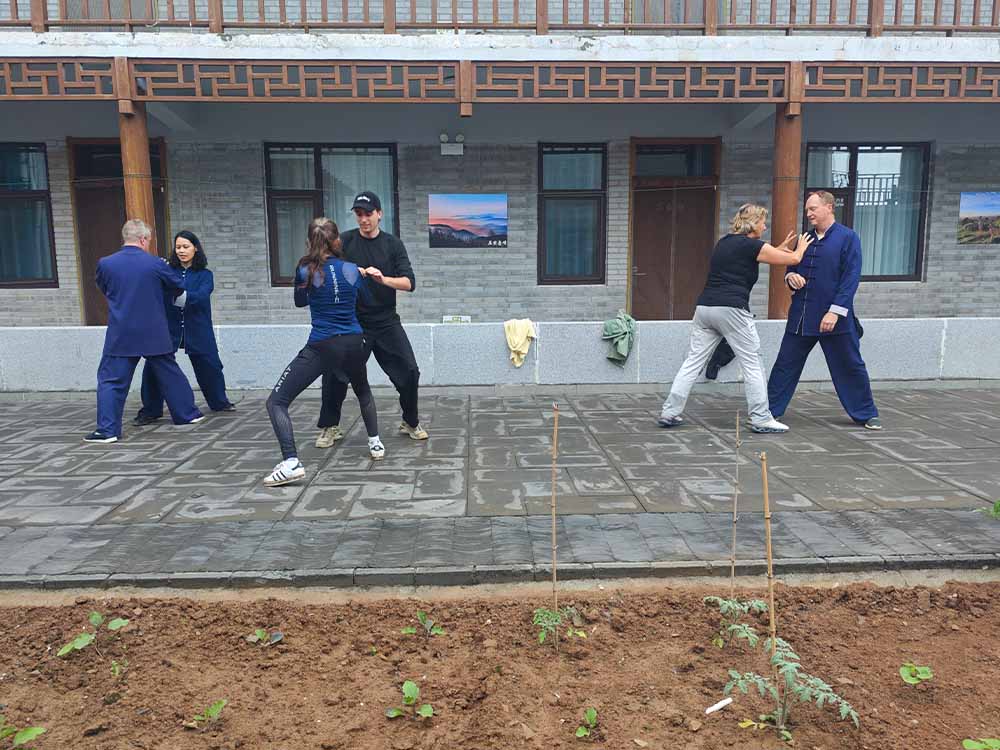
Training in China is not only a timetable of techniques. It is a period of daily discipline: standing practice before movement, repeated correction of posture, respectful conduct, recovery, meals, and the gradual study of Wu De, the martial ethic of respect, restraint, perseverance, and responsibility. The right quote should make room for this real training life rather than leaving basic living arrangements uncertain.
Cost: Compare Tuition, Housing, Meals, Uniforms, Transfers, Visa Support, and Optional Private Lessons
Conclusion: compare every option through a total-stay cost model, not tuition alone. This is the clearest method for a student deciding between short-term intensive training and a longer period of study. It does not produce a final figure until each school supplies its current written quote, but it prevents major omissions before you commit.
Why this works: tuition pays for instruction, while the rest of the stay determines whether the plan is practical. Housing and meals may be recurring costs. Airport or train-station transfers may be charged separately. A uniform may be required or optional. Visa assistance can mean anything from a general guidance letter to formal documentation support, so the scope must be defined rather than assumed.
| Cost category |
What to ask for in a quote |
Why it changes the full-stay budget |
Decision limit |
| Tuition |
Program length, weekly training schedule, included disciplines, group or individual format |
A one-week intensive course and a long-term program should not be compared as though they provide the same training time. |
Do not assume all listed disciplines are included every day; ask which subjects are scheduled for your chosen course. |
| Housing |
Room type, sharing arrangement, start and end dates, utilities, and any cleaning or deposit requirement |
Accommodation often continues beyond training hours and can affect the total more than a small tuition difference. |
Room availability and room type need confirmation for the intended arrival date. |
| Meals |
Number of meals, dietary options, weekend arrangements, and whether meals are included every training day |
Food is a recurring daily expense, especially during a one-month or longer stay. |
Dietary needs should be discussed directly; do not assume a specific diet can be provided. |
| Uniform |
Whether a uniform is required, included, optional, or separately purchased |
A required item belongs in the planned cost, even when the amount is modest. |
Ask whether students may train in suitable personal sportswear before purchasing anything. |
| Transfers |
Pickup point, one-way or return service, waiting-time terms, and price if separate |
Arrival logistics can be stressful after an international flight or train connection. |
Confirm the exact station or airport, arrival time window, and contact method before travel. |
| Visa support |
What documents or guidance the school can provide, timing, and what remains the student’s responsibility |
Visa preparation may affect when a student can travel and how long they can stay. |
Visa rules depend on nationality and current government requirements; the school cannot replace official embassy or consular advice. |
| Optional private lessons |
Teacher availability, lesson duration, price, booking method, and cancellation terms |
Private correction can change the cost plan for students seeking focused work on forms, weapons, or standing practice. |
Private lessons should not be assumed to be part of standard tuition unless written into the quote. |
Use a simple worksheet before comparing schools:
- Total stay cost = tuition + housing + meals + uniform + transfers + visa-related preparation costs + optional private lessons + personal travel expenses.
- Keep personal travel separate: flights, travel insurance, personal spending, and any official visa fees should be recorded outside the school quote unless the school explicitly includes them.
- Match the dates: calculate from arrival to departure, not only from the first to last training day.
- Keep optional items visible: do not quietly add private lessons into “tuition” if they are optional. Decide whether they are essential for your purpose.
Best fit: this model suits quote-ready students from the USA, Europe, Australia, and other overseas locations who have already shortlisted schools. When it does not apply: if you are only exploring martial arts generally and have not decided on a course length, begin with your training goal first; the budget cannot be meaningfully compared without dates and a program scope.
Match the Course Length to Your Training Purpose
Conclusion: choose the shortest program that can realistically serve your present aim, then ask for the full-stay quote for that exact length. A short course is suitable for focused exposure and cultural study; longer training is more suitable when repetition, conditioning, and correction are central to the goal.
SJF Kung Fu School offers programs from one-week intensive courses to long-term training. This range allows an international student to request a quote based on an actual purpose rather than an arbitrary duration. A beginner who wants to experience daily practice may choose a One Week Kung Fu Course. A returning martial artist wishing to spend sustained time on posture, forms, and weapons may need a longer structure.
| Training intention |
Course length to request a quote for |
Useful subjects to discuss |
Limit to recognize |
| First experience of daily martial arts training in China |
One-week intensive course |
Shaolin Quan, basic Tai Chi, Qi Gong, meditation, introductory standing practice |
One week can introduce methods and daily rhythm, but it is not enough time to expect deep technical consolidation. |
| Focused physical and technical practice |
One-month course |
Tai Chi, Zhan Zhuang, forms, basic weapons, conditioning, individual correction |
Progress depends on attendance, health, recovery, and willingness to repeat foundations. |
| Longer study with a defined discipline |
Three-month, six-month, or long-term course |
Chen-style Tai Chi, Shaolin Quan, San Da, Qin Na, Chinese Weapon training, meditation |
Longer stays require clearer planning for visa matters, accommodation dates, and personal finances. |
| Parent-and-child training stay |
Quote for both students and the full shared stay |
Training pace, suitable subjects, room arrangement, meal needs, transfer planning |
Each participant’s physical condition and learning aim should be discussed separately. |
There is practical value in naming the discipline you want to study. For example, students interested in stillness, alignment, and leg strength can ask about Zhan Zhuang. Those seeking a more active combat-oriented element can ask about San Da training. A student drawn to form, balance, and breath-led movement may wish to Learn Tai Chi in China.
The limit is simple: a school should not be selected only because it lists many subjects. Ask which classes are appropriate for your level and available during your intended dates. A focused plan is often more useful than trying to study every discipline at once.
Assess What the Training Environment Supports
Conclusion: look beyond the program name and ask whether the setting supports steady practice in the season you plan to attend. This is especially relevant for students who have limited time and cannot afford to lose training days to unsuitable conditions.
SJF Kung Fu School has a 200-square-metre indoor training center with training mats, wooden dummies, traditional weapons, and a meditation hall. For an overseas student, an indoor practice space gives a clear practical benefit: training can continue year-round regardless of weather. The relevant question is not whether the facility sounds impressive; it is whether its features support the work you intend to do.
- For form training: ask how much clear indoor space is available for repetitions, turns, stances, and weapon safety. This suits Tai Chi, Shaolin Quan, and broadsword or sword study. It does not mean every weapon or form is suitable for a first-time student.
- For standing practice and Qi Gong: ask whether there is a quiet space and how this work is placed within the daily schedule. Standing is physically demanding despite its still appearance. It is suitable for students willing to work patiently with alignment, but it is not a substitute for medical advice or treatment.
- For combat skills: ask which level of San Da, Qin Na, or Ge Dou is suitable for you and what protective expectations apply. This is relevant for students with prior training or clear combat interests. It may not suit someone recovering from injury or seeking only slow meditative movement.
- For cultural study: ask how local visits fit around the training timetable. The school is located near the Shaolin Temple, with more than 30 cultural and historical attractions nearby. Such visits can add meaning to a stay, but they should not be assumed to be included in tuition without confirmation.

The martial arts are often described through external movement, yet their deeper work is orderly attention. In Chen-style Tai Chi, the body must learn connection from foot to waist to hand. In Liuhe Quan, coordination is not merely visual; it asks the practitioner to bring intent, structure, and action into agreement. Meditation and Qi Gong can support that attention, but they should be selected because they fit the student’s aim, not because they appear on a broad course list.
Use Real Student Accounts as Context, Not as a Promise
Conclusion: student experiences are useful evidence when they are specific about course length, subjects, and personal circumstances. They should guide questions, not become a promise that every student will have the same result.
Master Shen Jiangfei is a descendant of Liuhe Quan and the 11th-generation inheritor of Chen-style Tai Chi, the oldest of the five primary Tai Chi family styles. This lineage is relevant to students who want instruction connected to established traditions rather than a general fitness class. It does not mean that lineage alone decides whether a particular course, accommodation arrangement, or schedule is right for you; those points still need to be confirmed in a current quote.
Several student accounts show why the details of a stay matter. Andrew Williams from the USA trained for 30 days with his son, studying Tai Chi, Zhan Zhuang, and Dao Fa. He described the experience as life-changing and said it strengthened him physically, mentally, and spiritually. For a parent considering a shared training stay, the useful lesson is to request a quote for both people, the selected disciplines, accommodation needs, meals, and transfers rather than relying on an individual price.
Hayley Noel from the UK completed a 120-day course including Tai Chi, Zhan Zhuang, Sword, and Broadsword. Her family expressed gratitude that she enjoyed her time in China after initially worrying about her travelling so far. This account supports the value of planning communications, accommodation, arrival details, and course duration carefully for a long stay. It does not establish that every long-term student will follow the same schedule or have the same experience.
For shorter stays, Pamela Paes Ezawa from Brazil completed a seven-day Chen-style Tai Chi course and appreciated the traditional training environment, Taoist heartland location, training-focused accommodation, and welcoming community. Othmane Echaouki and his wife from France also attended a seven-day Chen-style Tai Chi course and thanked Master Shen for taking good care of the students. These examples suggest that a short stay can still feel meaningful when the scope is clear. They do not remove the need to ask what each current package includes.
Request a Like-for-Like Quote With These Exact Details
Conclusion: send the same request to each shortlisted school. This creates comparable answers and reduces the chance that one quote appears cheaper simply because it leaves out necessary items.
- State your dates: give planned arrival and departure dates, plus your preferred course start date.
- Name the program length: request a quote for one week, one month, three months, six months, or long-term training.
- List your training priorities: for example, Chen-style Tai Chi and Zhan Zhuang; Shaolin Quan and traditional weapons; or San Da and Qin Na.
- Identify your experience level: beginner, returning student, martial arts practitioner, or parent travelling with a young learner.
- Ask for every inclusion separately: tuition, housing, meals, uniform, transfers, visa-related support, and optional private lessons.
- Ask what is excluded: flights, travel insurance, official visa fees, sightseeing, personal expenses, and any other items not named in the quote.
- Confirm the booking basis: regular class participation has no minimum enrollment at SJF Kung Fu School; group bookings require a minimum of two students.
- Request written clarification before payment: if a term is unclear, ask for the answer in the quotation or email record.
This process fits students who are ready to compare real options. It is less useful for someone who has not yet chosen dates, a discipline, or an approximate training length. In that case, begin by describing your aim and physical background, then ask which course structure is appropriate.
For a respectful, itemized discussion of your proposed stay, view the one month Kung Fu Course and contact SJF Kung Fu School with your dates, training interests, and requested inclusions.



 WhatsApp