Chinese Weapon Training: Staff-to-Spear Progression
Start With the Question: Is Your Body Ready to Carry a Longer Weapon?
When an empty-hand practitioner picks up a weapon, the first task is not to move faster or learn a longer form. The task is to discover whether the hands, shoulders, stance, and attention can carry a line of force beyond the body without losing balance.
This is why Chinese Weapon training should begin with a clear progression rather than an immediate move toward advanced tools. A staff gives direct feedback: if the hands squeeze too hard, the shoulders rise; if the stance is narrow, the tip wanders; if the waist stops turning, the arms attempt to do all the work. A spear makes each of these errors more visible because its length asks for greater range control and steadier alignment.
At SJF Kung Fu School, the purpose of weapon practice is not simply to collect forms. Traditional weapons offer a practical way to study Wu De, or martial virtue: patience before speed, control before display, and respect for training partners and equipment. The staff teaches the student to organize the body. The spear then asks the student to extend that organization into a finer, longer line.

This guide is for practitioners who already have basic empty-hand form experience. You should be able to hold a standing posture without locking the knees, turn the waist with control, and follow a short sequence on both sides. You do not need prior spear experience. You do need the willingness to repeat simple actions until the body becomes quieter.
Set the Starting Conditions Before You Add Length or Speed
Begin with a staff that you can move without forcing the shoulders upward. The aim is not to prove strength. It is to establish a repeatable relationship between the feet, waist, elbows, hands, and the weapon. If the staff feels too heavy for slow, controlled repetitions, reduce the training volume or use a lighter practice tool under instructor guidance.
What you need before the first staff drill
Basic empty-hand coordination: You should be able to shift weight from one leg to the other without the knee collapsing inward or the torso leaning ahead of the hips.
Enough clear space: Leave room in every direction so the staff can travel without striking walls, people, furniture, or low ceilings.
A stable stance: Your feet should remain connected to the ground. A wide stance is not automatically stable if the knees are locked or the weight is trapped in one leg.
Relaxed shoulder awareness: Before every set, notice whether the tops of the shoulders are creeping toward the ears. If they are, reset before continuing.
A teacher for corrections: Solo repetition can develop familiarity, but it cannot always reveal a shoulder line that has shifted or a grip that has become too tight.
A basic form background is enough for the first stage. Advanced flexibility, acrobatics, or combat experience is not required. However, do not begin spear thrusting if you cannot yet move a staff from guard to extension without rocking backward, gripping until the forearms burn, or losing the line of the wrists. Those signs mean the staff stage needs more time.
Standing work can help clarify this foundation. The principles taught in Zhan Zhuang are useful here: settle the weight, lengthen through the crown of the head without stiffening the neck, and let the shoulders rest while the arms remain present. This does not replace weapon practice. It prepares the body to receive it.
Use a Staged Staff-to-Spear Progression for Grip, Range Control, and Alignment
The staff-to-spear sequence works because it changes one demand at a time. First, the student learns to connect both hands through a shorter, more forgiving weapon. Next, the student learns to slide, guide, and stop the staff without over-gripping. Only then does the longer spear ask the body to manage a more exact point and a longer line.
The following progression is a training framework, not a promise that every student will move through it at the same rate. Stay in a stage until its checkpoint is reliable. Rushing to the spear when the shoulders are unstable merely carries the same problem farther from the body.
| Stage | Primary action | What it develops | Checkpoint before progressing | Common failure and recovery |
|---|
| 1. Empty-hand line | Extend one palm forward while the other hand stays near the ribs; turn from the waist. | Shoulder placement, elbow direction, and connection from rear foot to hand. | Both shoulders remain level and the front wrist does not bend back. | Failure: reaching with the shoulder. Recovery: shorten the reach and turn the waist first. |
| 2. Two-hand staff hold | Hold the staff with space between the hands; extend and withdraw on a straight path. | Shared hand responsibility and basic line control. | The staff stops without a jolt in the elbows or a raised shoulder. | Failure: both hands clamp down. Recovery: soften the fingers slightly and use the rear hand to guide the return. |
| 3. Staff sliding drill | Allow one hand to guide while the other changes position as the staff extends and retracts. | Timing, reach adjustment, and controlled hand transitions. | The staff remains on one intended line while the torso stays upright. | Failure: hands move independently of the waist. Recovery: slow the drill and begin each action with a small waist turn. |
| 4. Staff range drill | Stop the forward end at a chosen point, then withdraw to guard without stepping excessively close. | Distance judgement and braking control. | You can stop short of the target point without locking the elbows. | Failure: falling into the reach. Recovery: reduce extension and make the rear leg receive the return. |
| 5. Spear entry | Use the same extension and withdrawal pattern with a spear under direct supervision. | Fine point direction and a longer structural line. | The spear point stays predictable as the rear hand guides the shaft. | Failure: unstable shoulder loading. Recovery: return to staff work and shorten the spear action until the shoulder settles. |
Step-by-step practice sequence
Set the stance first. Stand with the feet placed so you can shift weight without lifting the heels. Bend the knees naturally. Do not force a deep position; depth without balance does not build usable structure.
Find a neutral grip. Hold the staff firmly enough that it cannot slip, but not so firmly that the knuckles whiten. The feeling should be secure rather than rigid. If the forearms fatigue almost immediately during slow practice, the hands are likely doing work that should come from the body.
Extend from the ground through the waist. Begin with a small pressure through the rear foot, allow the waist to turn, and let the hands carry the staff forward. The front elbow should not snap straight. A soft bend keeps the shoulder from bearing the entire stop.
Pause at the end of the line. Hold for a brief moment. Look for three signs: the shoulders remain low, the chest has not pushed forward, and the weapon is not shaking. If the tip trembles, reduce the distance rather than adding more muscular effort.
Withdraw with the rear hand guiding. Do not yank the weapon back with the front arm. Let the rear hand lead the return while the weight settles back into a balanced guard. This teaches the student that range control includes returning safely, not only reaching outward.
Add a target point only after the line is steady. Choose a visual point in open space. Stop the weapon before it, then return. Do not strike hard objects during this learning stage. The goal is to recognize distance, not to test force.
Transfer the pattern to the spear slowly. A spear should preserve the same body order: feet, waist, shoulder, elbow, hands, point. If the point swings widely at the end, the body has skipped a link in that order.
The deeper lesson is simple: power does not begin at the weapon’s tip. It begins where the practitioner meets the ground. The weapon reveals whether that connection has been maintained or lost.
Prevent Over-Gripping and Unstable Shoulder Loading
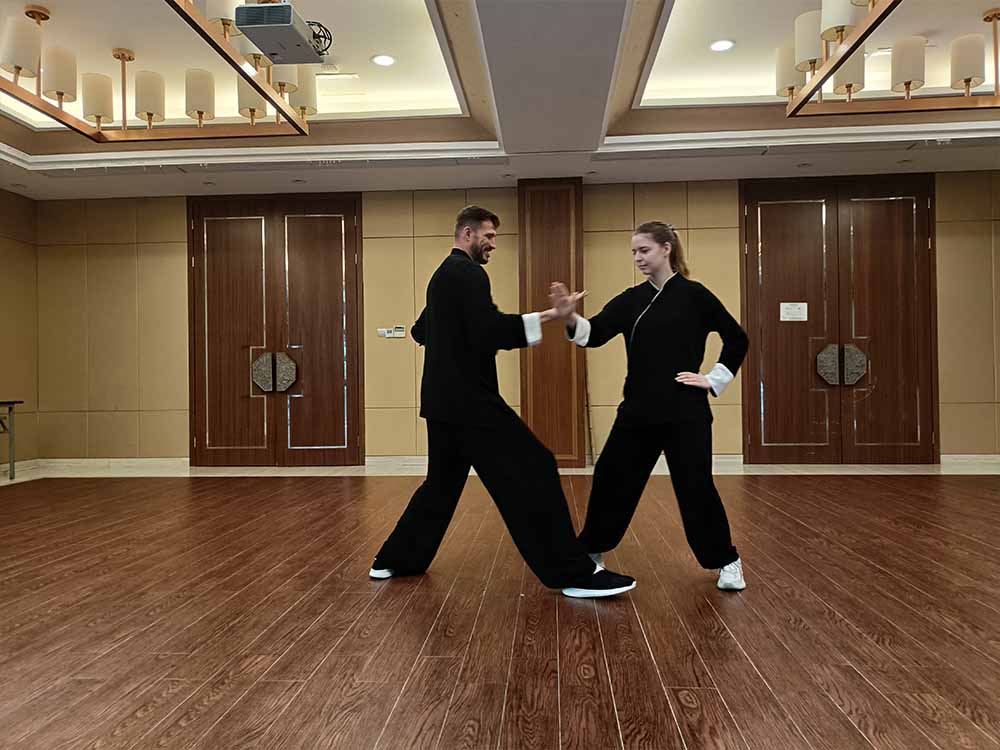
Over-gripping is one of the most common obstacles in staff and spear practice. It often appears when a student tries to control every part of the weapon with the hands alone. The result may be tight forearms, a shortened neck, raised shoulders, and a weapon that feels heavier with each repetition.
The answer is not to hold the weapon loosely. A loose weapon is unsafe. Instead, use enough finger pressure to maintain control while allowing the wrists, elbows, and shoulders to remain responsive. The hands direct the weapon; they should not become a substitute for stance and waist movement.
Use these checks during each set
Check the knuckles: If they have turned pale during a slow drill, ease the grip slightly and repeat at half speed.
Check the shoulders: If either shoulder rises toward the ear, stop at once. Lower the weapon, exhale, and restart with a shorter extension.
Check the elbows: If the forward elbow locks at full reach, shorten the movement. A locked elbow sends the stopping force into the joint rather than allowing the body to absorb and redirect it.
Check the rear hand: If the rear hand is passive, the front shoulder will often take too much load. Give the rear hand a clear guiding role during both extension and withdrawal.
Check the feet: If the front foot lifts or the body falls forward at the end of the thrust, the range is beyond your present control. Train a shorter range until the stance remains settled.
These checks are especially useful for practitioners coming from powerful empty-hand systems. Empty-hand strikes can sometimes be recovered quickly through footwork. A spear carries length beyond the body, so a late correction may become a large correction at the tip. Slower practice is not a lesser practice. It is how the body learns to stop with clarity.
Training in related disciplines can also improve this control. The listening skills developed in Learn Tai Chi can help a practitioner notice when tension has entered the shoulder before it becomes a habit. Tai Chi does not make a spear technique by itself, but it can refine the sensitivity needed to recognize excess force.
Know When to Stay With the Staff and When to Begin Spear Work
The staff is not merely a beginner’s weapon to abandon. It remains a teacher of timing, changing grip, blocking angles, and whole-body power. A student should remain with staff work when basic control is inconsistent. Begin supervised spear practice only when the staff can be extended, stopped, and withdrawn with the same calm structure on both sides.
| Observation in practice | Best next choice | Reason | What not to do |
|---|
| The staff tip wobbles after every extension. | Continue slow staff line drills. | The body has not yet learned to stop the weapon without a late shoulder correction. | Do not use a longer weapon to force steadiness. |
| Your shoulders stay level and the staff returns smoothly to guard. | Introduce short, supervised spear extensions. | The required body sequence is becoming consistent. | Do not add speed, footwork, and full range on the first day. |
| You can reach the intended point only by leaning forward. | Reduce the distance and rebuild stance control. | Range should come from foot placement and body organization, not from falling into the line. | Do not lock the front knee or stretch the shoulder forward. |
| The rear hand guides the weapon naturally through extension and return. | Begin simple spear point-direction drills. | The rear hand can now support a longer shaft and more refined point control. | Do not turn this into partner contact without instructor direction. |
A useful completion test is to perform several slow extensions on each side and ask four questions: Did the shoulders remain level? Did the feet remain grounded? Did the weapon stop on the intended line? Did the return feel guided rather than pulled? If one answer is no, return to the earlier stage that addresses it. This is not failure. It is correct practice.
Bring Traditional Method and Personal Instruction Together
Weapons are part of a living body of Chinese martial arts, where external shape and internal attention support one another. A staff can teach straightforward force. A spear can teach a quieter quality: the point must be clear, but the body behind it cannot be scattered. This balance reflects Wu De. Skill is not measured only by what a practitioner can project, but also by what they can restrain.
At SJF Kung Fu School, Master Shen Jiangfei brings his lineage as a descendant of Liuhe Quan and the 11th-generation inheritor of Chen-style Tai Chi to instruction in traditional Chinese martial arts. His teaching includes Chinese weapons alongside Shaolin Quan, Tai Chi, Qi Gong, Zhan Zhuang, San Da, Qin Na, Ge Dou, and Meditation. The school’s 200㎡ indoor training center allows students to maintain focused practice throughout the year.
Personal instruction matters because weapon work changes from person to person. A taller practitioner may need to examine how foot placement affects distance. A student with strong arms may need reminders to release the shoulders. Someone who has trained forms for years may need to slow down and rebuild the first extension. Andrew Williams of the USA spent 30 days at the school training Tai Chi, Zhan Zhuang, and Dao Fa with his son, later describing the experience as life-changing for physical, mental, and spiritual strength. His experience does not predict the same outcome for every student, but it reflects the value of giving a traditional practice enough time and attention.
For practitioners planning a longer period of focused study, a one month Kung Fu Course can provide time to work through foundational posture, empty-hand coordination, and supervised weapon basics without treating the first lesson as the final destination. Regular classes have no minimum enrollment, while group bookings require at least two students.
Use This Final Readiness Checklist Before Advancing
I can maintain a stable stance while extending and withdrawing a staff.
I can keep my shoulders from rising during slow repetitions.
I can stop the staff at a chosen point without locking my elbows.
I use the rear hand to guide the return instead of pulling only with the front arm.
I can identify when my grip has become too tight and reset it.
I understand that a longer weapon magnifies errors in range, posture, and timing.
I have access to clear space and qualified instruction before beginning spear drills.
If these points are becoming consistent, you are ready to approach spear work as an extension of staff fundamentals rather than a separate challenge. The staff prepares the line. The spear refines it. Both ask the practitioner to become more settled, more observant, and more responsible with force.
View the one month Kung Fu Course to discuss a respectful training plan with SJF Kung Fu School.



 WhatsApp