Chinese Weapon Training: When Weight Overloads Your Joints
How heavy is too heavy when you pick up a sword, broadsword or staff?
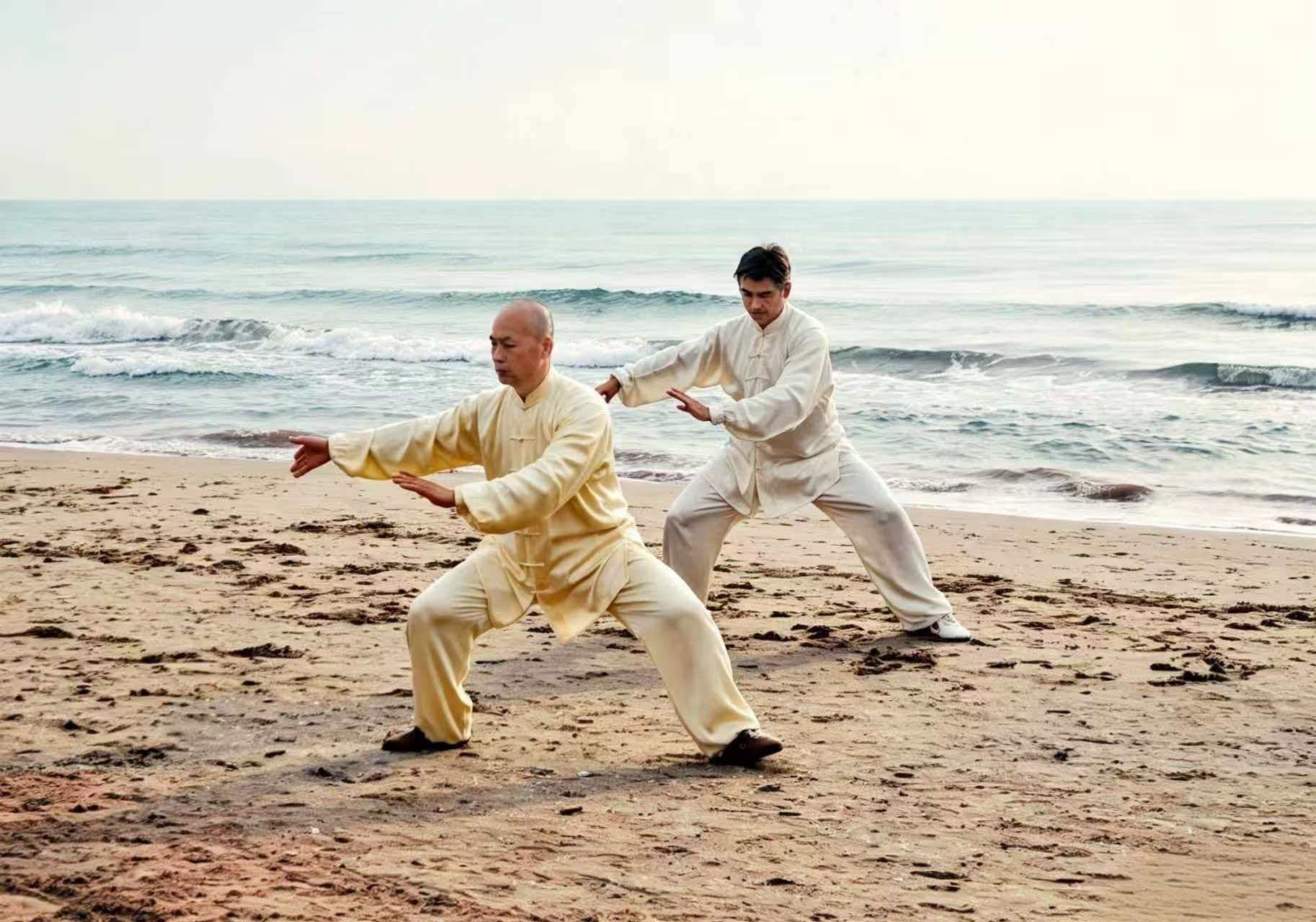
A weapon is too heavy the moment your posture changes in order to carry it. That is the plainest test we know. If your shoulder lifts, your wrist bends, or your lower back arches to finish a cut, the weapon is leading and you are following. Good Chinese Weapon Training reverses that order. The body stays rooted and quiet, and the blade, staff or spear becomes an extension of an arm that already knows how to move.
Many articles praise heavy implements as strength builders, and in the right hands they can be. What they rarely explain is where the line sits between useful loading and joint overload. This guide draws that line for adult beginners and returning martial artists who are about to buy equipment or start longer sessions with traditional Chinese weapons.
What does each weapon actually ask of your joints?
Each weapon loads the body differently. A light sword is hard on the wrist because it demands precision. A heavy staff is hard on the shoulders and back because its lever is long. Knowing which joint a weapon "borrows" tells you where to watch first.
| Weapon | Main stress point | Why it happens | Where this guidance falls short |
|---|
| Straight sword (Jian) | Wrist, forearm, grip | Fine control of the point; a loose or over-squeezed grip both strain the tendons | Does not cover unusually long or decorative blades with poor balance |
| Broadsword (Dao) | Elbow, shoulder | Cutting and wrapping actions create momentum that the joint must stop | Less relevant for very light practice blades |
| Staff (Gun) | Both shoulders, lower back | A long lever multiplies small errors at the hands | Changes if the staff is much shorter than you |
| Spear (Qiang) | Lead shoulder, lower back, hips | Thrusting and rotating with a long shaft depend on the waist | Needs a teacher to check the hip turn |
None of this means you should avoid a weapon. It means you should match it to the stage of your body, not to your enthusiasm.
Where is the boundary? Grip, elbow, shoulder and lower-back warning signs
Tiredness is welcome. Pain that sharpens, lingers or changes your movement is not. Use this table as a quick check during and after practice.
| Body area | Productive loading feels like | Overload warning sign | What to do |
|---|
| Grip and wrist | Forearm warmth; the hand stays soft and responsive | Knuckle or wrist ache, numb or tingling fingers, you squeeze harder to stop the weapon drifting | Rest, switch to a lighter or shorter weapon, or practise the form empty-handed |
| Elbow | Mild fatigue in the upper arm after many repetitions | Sharp pain on the inside or outside of the joint, the elbow locks straight at the end of a cut, or it hurts when you lift a cup the next morning | Stop cutting drills, slow the form down, and ask the teacher to check whether the elbow is absorbing impact the waist should absorb |
| Shoulder | Even tiredness; the shoulder stays low and wide | The shoulder hikes toward the ear, a pinching feeling at the front or top, the weapon swings you off balance | Reduce weight and range of motion; return to standing and shoulder-opening work |
| Lower back | Steady heat across the waist; the spine feels long | A tight band or stabbing ache, arching to counterbalance, or stiffness that stays into the next day | End the session, shorten the stance, and rebuild hip and leg strength before loading again |
Three simple signals that the training volume is too high
- Form breaks before the count ends. If your tenth repetition looks different from your third, the set was too long.
- Pain follows you out of the hall. Soreness that eases within a day is ordinary. Pain that is still present the next day, or grows, means you did too much.
- You hold your breath. Breath-holding means effort has replaced coordination.
Sharp, radiating, or numbing pain deserves a doctor, not another round of practice. This table cannot diagnose anything, and previous injuries change every threshold above.
Does training volume matter as much as weight?
Yes, and for beginners it often matters more. A moderate weapon swung for too long damages joints just as a heavy one swung briefly does. Tendons adapt slower than muscles, so the arms may feel ready while the elbows are not.
Here is a sensible ramp for an adult starting Chinese Weapon Training after a break from exercise:
- Learn the footwork and the empty-hand version of the form first. If you cannot do it without the weapon, the weapon will hide your mistakes.
- Add a light practice weapon and repeat short sections slowly, stopping while the form is still clean.
- Increase repetitions before you increase weight, and change only one of the two in any given week.
- Take at least one full rest day between hard weapon sessions, using that day for gentle standing or breathing work.
- Only after the form stays steady from first to last repetition should you consider a heavier weapon.
This ramp suits adults in general health. It does not suit anyone with a recent tendon, shoulder or spinal injury, who should get medical guidance before choosing a weapon at all.
Why do traditional teachers build the body before the blade?
In the Chen-style Tai Chi tradition that Master Shen Jiangfei carries as its 11th-generation inheritor, power rises from the feet, turns through the waist and only then reaches the hands. A weapon placed in an uncoordinated body breaks this chain, and the small joints pay the price. This is why many weapon forms are taught after a student has spent time on Tai Chi and standing practice.
Zhan Zhuang, or standing like a post, teaches the legs to hold weight and the shoulders to stay loose. Qi Gong trains breath and softness. Together they prepare the body for a weapon without any extra load. There is also a cultural reason. Wu De, the martial virtues of humility and restraint, asks the student to respect the limits of the body. In the Zen view, forcing a movement is already a loss of awareness.

What have students at SJF Kung Fu School experienced?
Several students who trained with weapons at SJF Kung Fu School did so alongside Tai Chi and Zhan Zhuang, not instead of them.
- Hayley Noel (UK) completed a 120-day course covering Tai Chi, Zhan Zhuang, Sword and Broadsword. Her family later wrote to Master Shen that she "loved it so much."
- Klaes Risbjerg Simonsen (Denmark) completed 30 days of Tai Chi, Zhan Zhuang and Broadsword. He praised the Shifu for being highly qualified and for adapting the training to his specific needs.
- Austin Erkl (USA) completed 30 days of Tai Chi and Sword. He admitted he did not love it at first, but after adjusting he had a great time.
These are individual experiences, not guarantees. They do show a pattern that matches the advice above: weapon work sits inside a wider practice, and the teacher adjusts the load to the person. The school's 200㎡ indoor training center also allows practice to continue on rainy or cold days, so rest and progression can be planned by the body's needs rather than the weather.
What are the common mistakes before buying a weapon?
- Buying the heaviest option "to grow into it." The joints adapt more slowly than your motivation does.
- Training the weapon every day with no rest. Tendons need recovery time that muscles do not.
- Ignoring pain in the elbow because it is "only a little." Small elbow pain often precedes longer layoffs.
- Copying videos without a teacher. A camera cannot tell you if your shoulder has lifted.
- Skipping warm-up and cool-down. Cold wrists and hips take the worst of a first cut.
A short checklist before you pick up a heavier weapon
- Can you finish the full form with the same posture you started with?
- Is your grip relaxed enough that a teacher could slide the weapon from your hand without a fight?
- Are your elbows and shoulders pain-free the morning after practice?
- Is your lower back long and quiet at the end of the session?
- Has a qualified teacher watched you with the current weapon recently?
If any answer is no, stay with the present weapon. Heavier steel can wait.
Next step: ask before you load the joints
Some questions cannot be answered in an article: your age, previous injuries, the length of your arms and how often you can practise all change the right weapon. If you are unsure, a teacher watching you move will tell you more than any chart.
To see how a structured month of Tai Chi, standing practice and weapon work is arranged, view the one month Kung Fu Course. If you would rather talk first, send a message through SJF Kung Fu School with your experience level and any joint concerns, and we will reply with guidance on a suitable starting point. Genuine seekers of the traditional arts are always welcome.



 WhatsApp