Compare Kung Fu Schools by Live Class Evidence
Use Live Class Evidence Before You Choose a School
When comparing programs from directories and academy websites, the greatest risk is choosing from attractive descriptions rather than visible teaching evidence. Before selecting the Best Kung Fu School for your goals, look beyond style names, scenic photos, and broad promises. Ask what you can actually observe: how beginners are corrected, whether students understand the purpose of each drill, and how a teacher responds when one person needs more time.
A school’s public course list matters, but its daily class culture matters more. At SJF Kung Fu School, training options include traditional forms, internal practice, combat-oriented study, weapons, and meditation. A visitor considering a short stay may begin with a One Week Kung Fu Course, while a student seeking a longer period of correction may consider a one month Kung Fu Course.
School name: SJF Kung Fu School. The school supports international students who want Chinese martial arts study in China, from one-week intensive courses to long-term programs. Regular classes have no minimum enrollment requirement. Group bookings require at least two students. This distinction matters when you are planning alone, with a training partner, or as a small group.

Live evidence does not mean demanding a performance from a school. It means asking respectful questions that reveal how teaching works in ordinary practice. A good observation request focuses on the learning process: warm-up, stance work, correction, form practice, partner drills, recovery, and reflection. These moments show whether a class is built around patient skill development or only around outward appearance.
Compare Beginner Progression, Sparring Access, Feedback, and Class Ratios
The table below gives a practical way to compare several schools on the same basis. Do not assume that a named style automatically answers these questions. A school may offer Tai Chi, Shaolin practice, or San Da, yet the actual beginner pathway can differ greatly. Ask each school to answer the same points in writing, during a live call, or through a current class recording where available.
| Decision Factor | What to Look For | Question to Ask the School | Why It Matters | Limit or Caution |
|---|
| Beginner progression | A visible sequence from stance, mobility, and basic coordination to forms or partner work | “What do students normally study first, and what determines when they move forward?” | Beginners need a clear foundation before speed, power, or weapons work. | Progress should not be judged only by the number of forms taught. |
| Sparring access | Clear distinction between partner drills, controlled contact, and sparring | “Is San Da or partner practice available, and what preparation is expected before participation?” | This prevents a mismatch between a student seeking combat training and a class focused mainly on forms. | Do not treat sparring as suitable for every student or every training stage. |
| Instructor feedback | Specific corrections to posture, balance, timing, breathing, and intent | “How do instructors correct an individual student during class?” | Traditional martial arts depend on repeated adjustment, not imitation alone. | A short observation may not show every type of feedback used over a longer course. |
| Class ratios | The number of students training with each instructor during your intended dates | “What is the expected student-to-instructor ratio for my course period?” | It helps you estimate how often your movement may receive direct attention. | Ratios can change with season, course dates, and group arrivals. |
Clear conclusion: choose the school that can explain these four points plainly and consistently, not the school that offers the longest list of styles. This approach fits adults who are new to Kung Fu, returning martial artists, and parents comparing training environments for a young learner. It does not apply when a traveler only wants a brief cultural visit with no expectation of structured skill development; in that case, a sightseeing-focused program may be a better fit.
At SJF Kung Fu School, students may study among nine distinct areas: Shaolin Quan, San Da, Qin Na, Tai Chi, Qi Gong, Zhan Zhuang, Ge Dou, Chinese Weapon practice, and Meditation. The presence of these disciplines gives a student several directions to discuss with the school, but it should not be treated as a guarantee that every discipline is appropriate for every level, schedule, or physical condition. Ask which subjects are suitable for your own training period.
Read a Live Class Through the Details That Brochures Rarely Show
Traditional Chinese martial arts are not only collections of movements. They are methods for shaping attention. A stance is not simply a low position. It teaches weight distribution, rootedness, patience, and awareness of the body’s structure. In Tai Chi and Zhan Zhuang, stillness may reveal tension that fast movement conceals. In Shaolin forms, rhythm and posture show whether the body is coordinated as one unit. In San Da or Ge Dou, distance and control reveal whether a student can remain calm under pressure.
When reviewing live class evidence, look for the following observable signals:
Corrections have a reason. The instructor explains whether a hand position protects the centerline, connects with the waist, supports balance, or prepares a later technique.
Beginners are not abandoned. New students receive a manageable task rather than being expected to copy advanced students immediately.
Training has layers. Warm-up, stance work, basics, form practice, partner work, strength, breathing, or quiet reflection may appear in different proportions depending on the class.
Partner work shows control. Students should understand the purpose and level of contact before performing drills.
Senior students are still corrected. This indicates that practice remains a process of refinement rather than a display of rank.
The teacher’s language is concrete. Useful feedback refers to hips, shoulders, feet, breath, distance, timing, or relaxation instead of vague praise alone.
These signs are especially useful for students interested in Learn Tai Chi in China. Chen-style Tai Chi is often misunderstood as slow movement without martial purpose. A meaningful class should show how alignment, spiraling force, stepping, and calm attention relate to one another. The same principle applies to Zhan Zhuang: standing practice may look simple, yet careful instruction can reveal whether a student is lifting the shoulders, collapsing the knees, holding the breath, or losing balance through the feet.
Master Shen Jiangfei is a descendant of Liuhe Quan and the 11th-generation inheritor of Chen-style Tai Chi, described as the original and oldest of the five primary Tai Chi family styles. For a student comparing schools, lineage should be treated as a meaningful starting point rather than the final decision. Ask how that inherited knowledge appears in practical instruction: body mechanics, forms, partner drills, martial ethics, and daily conduct.
Match the Evidence to Your Actual Training Purpose
Not every student needs the same class evidence. A seven-day visitor, a 30-day learner, and a long-term practitioner should ask different questions. The right program is the one whose visible training method fits your available time, present condition, and purpose.
| Your Main Purpose | Evidence to Prioritize | SJF Kung Fu School Option to Discuss | When It Fits | When It May Not Fit |
|---|
| Short cultural immersion with daily practice | Beginner orientation, instructor guidance, training setting, and daily schedule | Kung Fu Camp or a One Week Kung Fu Course | Travelers with limited time who want focused training in China | Students expecting deep technical mastery in only a few days |
| Build a base in Tai Chi and standing practice | Posture correction, stepping, breath awareness, and individual feedback | Tai Chi, Qi Gong, and Zhan Zhuang study | Beginners and experienced practitioners seeking careful internal training | Those looking only for high-contact combat practice |
| Explore combat-oriented training | Preparation standards, partner drills, safety expectations, and access to San Da or Ge Dou | San Da training, Qin Na, or Ge Dou | Students who want to understand distance, timing, and practical application | Anyone who is unwilling to begin with conditioning and controlled basics |
| Develop over several months | Progress reviews, changing training emphasis, and instructor availability during your stay | Three-Month Course or a Long Term Kung Fu Course | Students able to commit to repeated practice and gradual correction | Travelers who only have a short holiday window |
Recommendation: if your time is short, choose a school that can state what you can reasonably focus on during the first week. If your goal is long-term development, ask how the curriculum changes after the first month. The first option suits travelers who need a concentrated introduction. The second suits students who can stay long enough to revisit basics after early habits become visible.
SJF Kung Fu School has a 200㎡ indoor training center, allowing year-round practice regardless of weather. This is useful evidence for travelers planning a fixed training date: ask how indoor space is used for forms, stance work, partner drills, weapons, or quiet practice during your intended season. The facility itself does not determine teaching quality, but it can support consistency when outdoor conditions change.
Use Student Cases as Context, Not as a Promise
Student accounts can reveal the atmosphere of a school, especially when they describe specific training subjects and course lengths. They should guide your questions, not replace them. Your body, schedule, previous experience, and expectations may differ from another student’s.
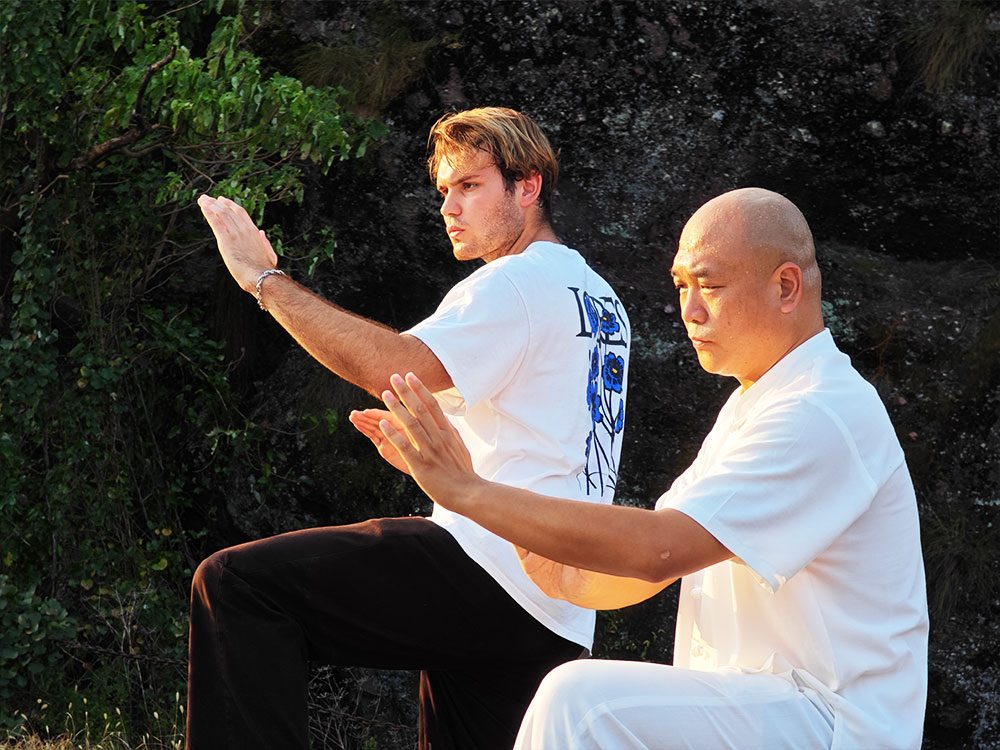
Andrew Williams from the United States trained for 30 days with his son, studying Tai Chi, Zhan Zhuang, and Dao Fa. He described the experience as life-changing physically, mentally, and spiritually, and said he planned to return the following year. For a parent or family member considering shared training, the useful question is not whether the same result will occur. Ask instead: “Can two family members with different ages or backgrounds follow suitable practice plans during the same stay?”
Klaes Risbjerg Simonsen from Denmark completed a 30-day course covering Tai Chi, Zhan Zhuang, and Broadsword. He sought a focused environment and reported that Master Shen adapted training to his particular needs. This case is relevant to an adult who wants individual attention within a structured course. Its limit is clear: a single account cannot establish the class ratio or level of individual correction for every future date. Confirm those details directly.
For a shorter example, Pamela Paes Ezawa from Brazil completed a seven-day Chen-style Tai Chi course and appreciated the traditional training setting, Taoist heartland location, training-focused accommodation, and welcoming community. This suggests that a one-week period can hold meaningful value when expectations are realistic. It does not mean that seven days can replace sustained study of Tai Chi principles.
These accounts also point toward Wu De, often understood as martial virtue. Respect, discipline, restraint, humility, and care for training partners are not decorations around Kung Fu. They shape the way skills are practiced. When you observe a class, notice whether students listen, correct one another with restraint, care for shared equipment, and treat beginners with patience. Such conduct can tell you much about the school’s daily values.
Send a Focused Inquiry Instead of a General Request
A useful inquiry makes comparison easier for both you and the school. Rather than asking only, “What is your best course?”, provide enough information for a relevant answer. This is particularly helpful when deciding between Tai Chi, Shaolin Quan, weapons, meditation, or combat-oriented practice.
State your available dates. Say whether you are considering one week, one month, three months, or longer.
Describe your starting point. Mention prior martial arts experience, fitness concerns, injuries, or complete beginner status.
Name your main purpose. Examples include cultural study, Tai Chi structure, traditional forms, San Da basics, standing practice, or meditation.
Ask the four comparison questions. Request details on beginner progression, sparring access, instructor feedback, and expected class ratio for your dates.
Clarify booking type. Regular classes have no minimum enrollment; groups need a minimum of two students.
Confirm practical boundaries. Ask what is included in the proposed course, what you should bring, and which parts of the schedule still need agreement.
Do not assume that a website can answer every date-specific question. Class composition, training focus, and suitable practice intensity should be confirmed before travel. A respectful school should be able to explain what is known, what depends on your arrival period, and what must be discussed after understanding your needs.
For students drawn to quiet internal practice, Qi Gong and Meditation may provide a valuable balance to more physical sessions. For those interested in traditional applications, ask how Qin Na training is introduced and whether prior partner-work experience is expected. The point is not to collect many subjects. It is to choose a training focus that can be practiced with attention.
Choose Evidence That Respects Both Skill and Tradition
The Best Kung Fu School is not simply the one with the most impressive website or the widest course list. It is the one whose teaching evidence answers your real questions with clarity: how you will begin, how you will be corrected, what partner practice is available, and whether the class setting fits your intended stay.
For students seeking Chinese martial arts study near the Shaolin Temple, SJF Kung Fu School offers programs from one-week intensive training to extended study, guided by a head instructor with more than 20 years of experience. Master Shen has trained over 3,000 students worldwide in Shaolin Kung Fu, practical combat skills, and traditional Chinese martial arts. These facts provide useful context, but your final decision should still rest on a clear discussion of your own goals and the class evidence available for your dates.
Ask about the one month Kung Fu Course and request guidance on the most suitable training focus for your experience and available time.



 WhatsApp