Discover Chinese Language and Culture Through Taichi
What Is Taichi and How It Teaches Chinese Culture
Taichi is a traditional Chinese martial art that combines slow, flowing movements with deep breathing and philosophical depth. At SJF Kung Fu School, we teach authentic Taichi to students from around the world. Master Shen Jiangfei leads our school. He is a descendant of Liuhe Quan and the 11th-generation inheritor of Chen-style Taichi. He grew up in a martial arts family and has dedicated his life to teaching these arts. Our international students come from Germany, the UK, the Netherlands, Austria, the United States, Libya, the Philippines, and more. Many find that Taichi is a gateway to understanding Chinese language and culture in a way that textbooks and documentaries simply cannot provide. The practice offers a living connection to centuries of Chinese wisdom and tradition.
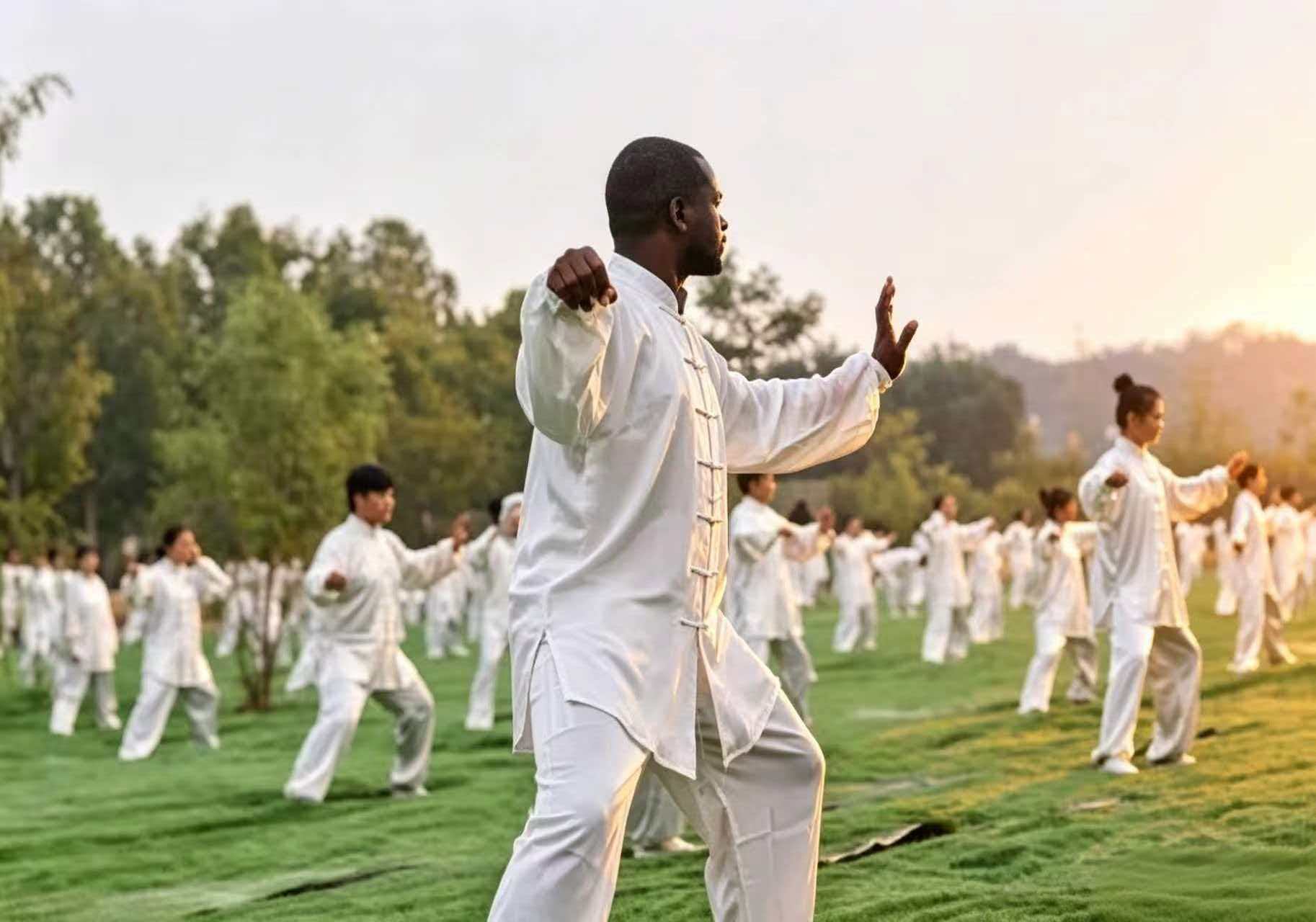
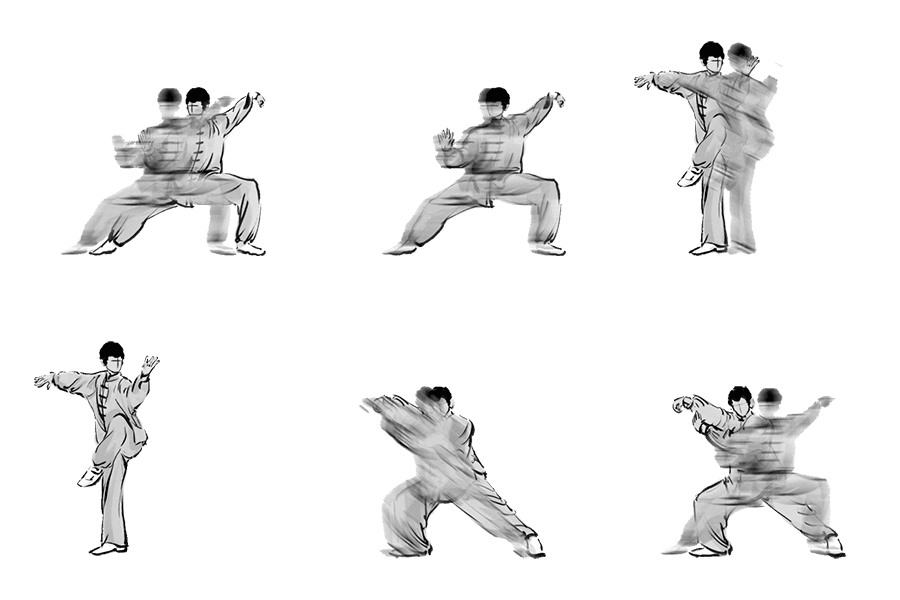
Taichi and Chinese language are deeply connected. Many movement names are poetic Chinese phrases that paint vivid pictures of nature and movement—White Crane Spreads Its Wings, Wave Hands Like Clouds, Golden Rooster Stands on One Leg. The philosophy of Taichi is expressed in classical Chinese, carrying layers of meaning that unfold through practice. When you learn Taichi, you learn cultural concepts through physical experience rather than abstract study. You pick up words and phrases naturally as you move, breathe, and listen. Taichi makes learning Chinese culture more accessible and enjoyable because you are not just studying it—you are living it with every movement.
How Taichi Teaches Chinese Culture
You learn classical concepts that are central to Chinese thought. Concepts like Yin and Yang, Qi, and Dao are not merely abstract ideas in Taichi—they become tangible realities. You feel the balance of Yin and Yang in your body as you shift weight and transition between movements. You sense the flow of Qi as you breathe deeply and move with intention. You understand the Dao through the natural, effortless quality of correct practice. Taichi brings these philosophical concepts to life through direct experience, creating a deeper, more intuitive understanding than reading alone can achieve. This experiential learning is what makes Taichi such a powerful tool for cultural education.
You learn through movement in a way that embeds cultural knowledge in your body. Chinese culture is embodied in Taichi—every posture, every transition, every breath carries meaning. You feel the philosophy in your body as you move, creating a powerful and lasting form of learning. You remember cultural concepts because you have experienced them physically, not just mentally. This embodied learning is one of the most effective ways to internalize cultural understanding. When you feel the principle of softness overcoming hardness in a push hands exercise, you understand it at a level that no book can convey.
You learn through immersion in the Chinese environment. You are in China, surrounded by the language, food, and daily rhythms of Chinese life. You eat Chinese food, hear Chinese language spoken around you, and observe Chinese customs in action. This immersion is the best way to learn culture because it engages all your senses and creates authentic, memorable experiences. Your understanding grows naturally as you navigate daily life in a Chinese setting, from ordering meals to greeting neighbors to observing local festivals.
You learn from your teacher, who embodies Chinese culture in his teaching. Master Shen teaches with tradition and respect, passing down not just techniques but also the values and attitudes that accompany them. You absorb culture through his example, his corrections, and his stories. This is authentic cultural transmission—the way knowledge has been passed down for generations in China. The relationship between teacher and student in Chinese culture is unique, carrying deep respect and responsibility that you come to understand through direct experience.
Chinese Language Through Taichi
You learn Taichi movement names, which are poetic and descriptive. Each movement has a name that tells a story or describes an action. White Crane Spreads Its Wings, Wave Hands Like Clouds, Golden Rooster Stands on One Leg, Grasp the Sparrow's Tail, Step Back and Repulse Monkey. These names are not just labels—they are windows into Chinese language and imagination. You learn new Chinese words naturally as you memorize and practice these movements, building vocabulary in a meaningful context. The poetic quality of the names also introduces you to Chinese aesthetics and the cultural appreciation of nature.
You learn Chinese commands used during training. Instructions like start, stop, breathe, relax, faster, slower, and repeat are given in Chinese during class. Over time, you develop the ability to understand and respond to these commands without translation, a valuable skill that reinforces language learning through active use. This practical listening comprehension builds confidence and prepares you for real-world communication. You also learn numbers, directions, and body part names through the training process.
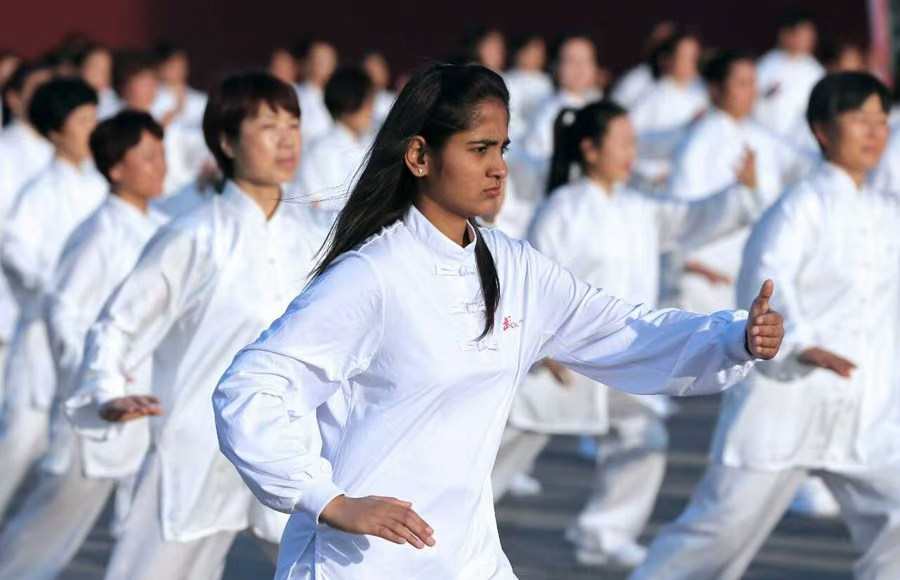
You learn greetings and etiquette, including how to greet your teacher and show proper respect. In Chinese culture, proper greetings and forms of address are important social skills. You learn to bow appropriately, address your teacher and senior students correctly, and show respect through your words and actions. These are practical cultural skills that you use daily, building confidence and cultural competence. Understanding how to interact respectfully in Chinese culture is essential knowledge that enhances your overall experience.
You learn through practice rather than textbooks, making language acquisition organic and natural. You pick up words in context, understanding their meaning through use and repetition. This is how children learn language—through immersion and practice—and it is remarkably effective. The practical, context-rich environment of the school accelerates language learning in a way that classroom study alone cannot match. You are not memorizing vocabulary lists; you are acquiring language that you actually use.
Cultural Values in Taichi
Respect for tradition is central to Taichi practice. You learn to value the art's lineage and honor your teacher. This respect is a core Chinese value that extends beyond the training hall into all areas of life. Balance and harmony are taught through every movement. Taichi teaches you to find balance in body and mind, a principle that applies to relationships, work, and personal well-being. Patience and persistence are essential to learning Taichi. Progress comes gradually, teaching you the value of consistent effort over time. Simplicity and naturalness are philosophical ideals reflected in Taichi. The practice values natural movement and simple, effective techniques over force and complexity.
Immersive Cultural Activities
Chinese meals are shared together, offering opportunities to practice cultural dining. You eat local cuisine and use chopsticks, experiencing authentic Chinese food culture. Festivals and celebrations provide colorful, meaningful cultural experiences. Weekend cultural excursions let you visit temples, historic sites, and villages. Conversations with locals offer real interactions that build language skills and cultural awareness.
The Setting at SJF
Our school is culturally rich, located in a region with deep cultural heritage and historic sites nearby. The environment is inspiring, with mountains and rivers that are culturally significant in Chinese art and poetry. The community is international, bringing together students from many countries who share cultural experiences and learn from each other. The teaching is traditional, preserving the authentic transmission of Chinese martial arts culture.
What You Can Learn About China
You can learn Chinese philosophy, including Daoism, Confucianism, and Buddhism, through Taichi practice. You can learn about Chinese medicine, including Qi, meridians, and health principles connected to Taichi. You can appreciate Chinese art and poetry through the poetic movement names and the artistic setting. Most importantly, you can learn about the Chinese way of life—values, habits, and traditions—from the inside.
Language Learning Tips
Learn movement names in Chinese by practicing saying them aloud, building vocabulary in context. Practice simple commands to build comprehension and practical language skills. Practice with locals by engaging in real communication, the most effective form of practice. Use a language app to supplement your learning, but prioritize real-life practice.
What Students Say
Students say Taichi taught them China in a way tourism cannot. They learned more than martial arts—they learned philosophy and traditions. Many picked up enough Chinese to communicate. They describe the cultural experience as authentic, not a tourist show but real life and real culture. This authenticity is what makes the SJF experience truly unique and transformative.
Begin Your Cultural Journey at SJF Kung Fu School
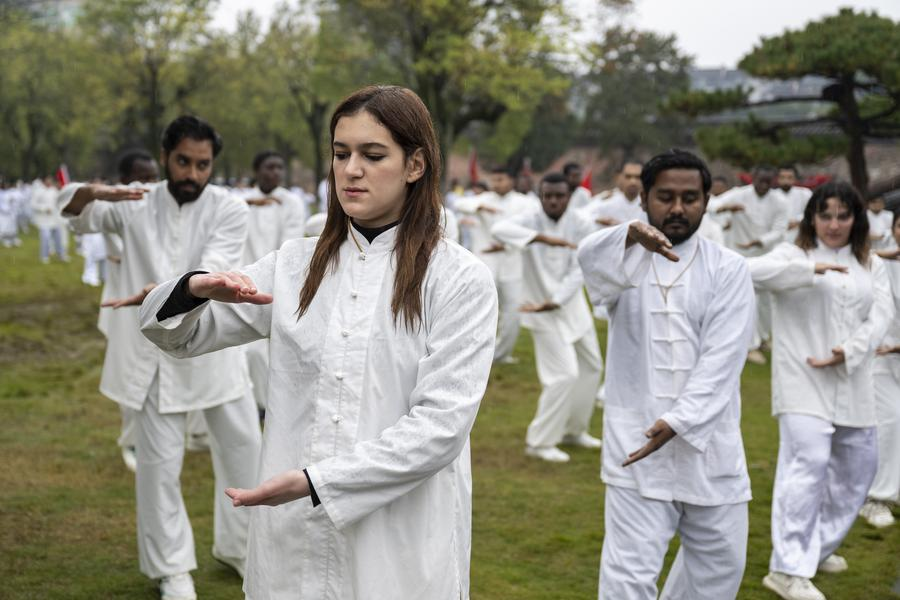
Your cultural immersion begins at SJF Kung Fu School. We are a professional Chinese Kung Fu training center in China, open to international students from all over the world. Our school has successfully trained students from Germany, the UK, the Netherlands, Austria, the United States, Libya, the Philippines, and more. Master Shen Jiangfei, a descendant of Liuhe Quan and the 11th-generation inheritor of Chen-style Taichi, leads all instruction. He grew up in a martial arts family and has dedicated decades to preserving these authentic arts. Our school is nestled among majestic mountains and serene rivers, offering a breathtaking natural setting that is deeply connected to Chinese culture. We offer flexible programs from one-week intensives to longer courses. Contact us today to begin your journey.




 WhatsApp