Find the Right Adult Kung Fu Training for Your Goals
Choosing to begin adult Kung Fu training is a significant decision. It is more than a fitness program; it is a commitment to a discipline that shapes the body, mind, and spirit. The wrong choice leads not just to wasted time and money, but to a missed opportunity for genuine transformation. An inauthentic school can teach you movements without substance, offering a hollow imitation of a profound art. The greatest risk is investing your hope in a path that leads nowhere.
At SJF Kung Fu School, we have guided over 3,000 students from around the world on this path since 2009. We believe the foundation of true progress is finding a school that aligns with your personal goals and respects the traditions it represents. This guide will help you understand the critical factors in selecting a program, ensuring your efforts are dedicated to authentic practice and meaningful growth.
Evaluating a School for the Right Fit
Knowing how to choose a kung fu school requires looking beyond flashy websites or convenient locations. The connection between student, teacher, and tradition is what produces results. Use these criteria to evaluate potential schools and find a true home for your practice.
| Factor to Consider | Why It Matters | What to Look For |
|---|
| Instructor Lineage & Credentials | Authenticity flows from a verifiable source. An instructor's lineage is their connection to the history and essence of the art. Without it, you may learn a modern interpretation, not a traditional system. | Look for a Shifu with a clear, traceable connection to a known style. For example, our founder, Master Shen Jiangfei, is a descendant of Liuhe Quan and the 11th-generation inheritor of Chen-style Tai Chi, the original family style. |
| Training Goals Alignment | Are you seeking self-defense, physical fitness, mental clarity, or cultural immersion? A school focused on competition fighting will not suit someone seeking meditative practice. | The school should offer a range of programs. We teach 9 distinct styles, from combat-focused San Da to internal arts like Qi Gong and Tai Chi, allowing us to tailor training to individual needs. |
| Beginner Progression | A good school has a structured approach for beginners. You should not be thrown into an advanced class without foundational training. This prevents injury and builds a solid base. | Ask about the curriculum for new students. Is there a focus on stances, basic forms, and conditioning? This is essential for safe and effective beginner kung fu training. |
| Training Environment | The space should be dedicated to serious practice. A clean, well-equipped facility shows respect for the students and the art. It should feel like a place of focus, not just a gym. | Look for proper equipment like training mats, wooden dummies, and traditional weapons. Our 200㎡ indoor training center ensures practice can continue year-round, regardless of weather. |
| Community and Support | You will be spending significant time with your instructors and fellow students. A welcoming, supportive community is vital for motivation and growth. | Read testimonials. Othmane from France noted how the Shifu "took such good care of all the students," making them feel they were "in the best conditions." This sense of community is a hallmark of a great school. |
Internal Arts vs. External Styles: Defining Your Path
Many people searching for adult kung fu classes are not aware of the fundamental distinction between internal (Neijia) and external (Waijia) styles. Understanding this difference is key to aligning your training with your personal temperament and goals.
External Styles (Waijia)
These are the styles most people picture when they think of Kung Fu. They emphasize physical power, speed, and agility. Training often involves rigorous conditioning, striking, kicking, and acrobatic movements. Styles like Shaolin Quan are prime examples. The goal is to develop muscular strength and explosive force to overcome an opponent.
Best for: Individuals seeking improved athletic performance, practical self-defense skills, and a high-intensity workout.
Training typically includes: Stance work, forms (Taolu), sparring (San Da), and weapons practice.
Mindset: Focuses on conditioning the body to react with speed and power.
Internal Arts (Neijia)
Internal arts, such as Tai Chi and Qi Gong, cultivate the body's intrinsic energy, or Qi. The focus is on relaxation, fluid movement, and mind-body awareness. Power is generated from the ground up through structure, leverage, and coordination, rather than brute muscular force. This approach makes it a sustainable practice for a lifetime.
Best for: Those interested in stress reduction, improved balance, health, and a meditative practice. While they contain profound martial applications, the initial focus is on internal cultivation.
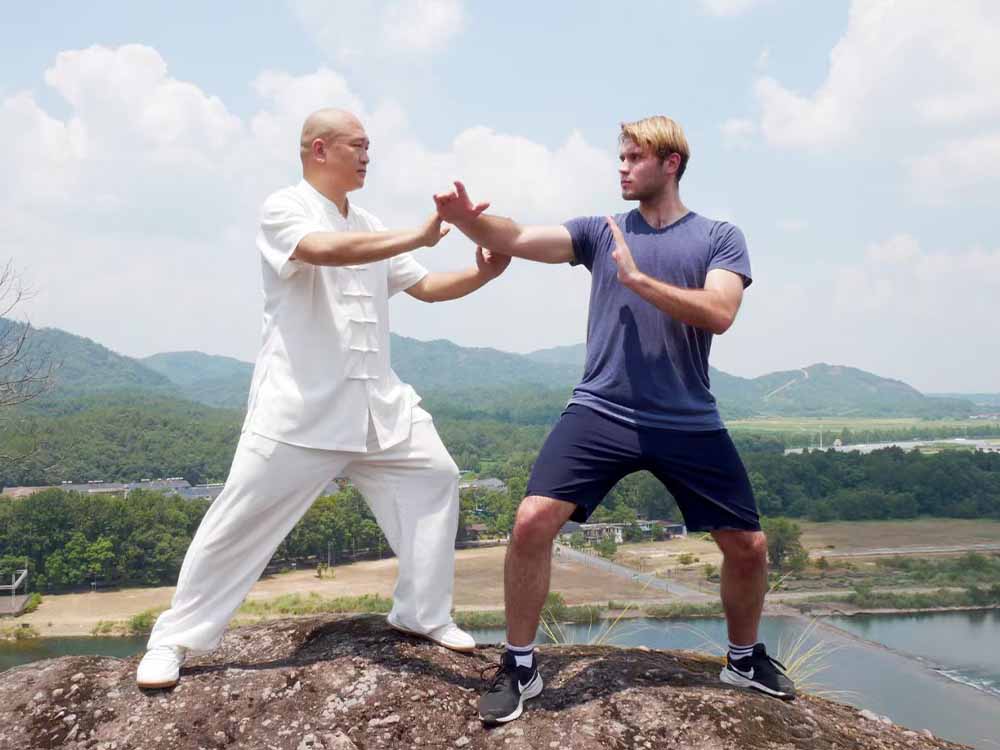
Training typically includes: Slow, deliberate forms, standing meditation (Zhan Zhuang), and sensing exercises (Tui Shou or "push hands").
Mindset: Focuses on cultivating internal calm, awareness, and rootedness.
At our school, we honor both paths. A student can focus solely on one or integrate elements of both. For example, Andrew Williams from the USA spent a month training Tai Chi and Zhan Zhuang, calling it a "life-changing experience" that strengthened him physically, mentally, and spiritually. This integration is where the deepest growth often occurs.
What to Expect from an Authentic Training Experience
When you commit to authentic training, especially through an immersion program in China, you are stepping into a different way of life. It is not a vacation or a tourist resort. It is a focused environment designed for growth. Many students who search for "adult martial arts near me" find that local options lack the depth and dedication of a true training sanctuary.
Klaes Risbjerg Simonsen from Denmark chose our school specifically because he wanted an authentic, focused experience, not a tourist trap. From his first day, he knew he was in the right place. An authentic school provides:
A Dedicated Master: A true Shifu is more than a coach. They are a mentor who cares for their students' well-being. Austin Erkl from the USA noted, "The master is a great guy that cares for his students." Master Shen Jiangfei personally adapts training to each student's needs, a quality Klaes praised as well.
A Structured Routine: Discipline is built through routine. A typical day involves waking early for Qi Gong, followed by breakfast, morning training sessions, lunch, afternoon training, dinner, and evening meditation or theory classes. This structure removes distractions and allows you to fully immerse yourself.
Cultural Immersion: Learning Kung Fu in China connects you to its source. Our location is near the legendary Shaolin Temple and surrounded by over 30 cultural and historical attractions. Pamela Paes Ezawa from Brazil loved the authentic environment and the Taoist heartland location.
Personal Challenge and Growth: Authentic training will push you. Austin admitted he "didn't love it at first," but after adjusting, he had a great time and made lifelong memories. This period of adjustment is normal and is where real character is built. Hayley Noel from the UK completed a 120-day course, and her family was overjoyed at how much she loved the experience, a testament to the supportive yet challenging environment.
Common Misconceptions About Starting Kung Fu as an Adult
Many potential students hesitate due to common myths about martial arts. Let's address some of them directly.
"I am too old or out of shape." This is perhaps the most common concern. A good school adapts the training to your current level. The goal of beginner kung fu training is not to perform incredible feats on day one, but to build a foundation. Internal arts like Tai Chi are particularly beneficial for adults of all ages and fitness levels.
"It is only for self-defense." While many styles like Qin Na and Ge Dou offer effective self-defense techniques, the purpose of traditional Kung Fu is much broader. It is a system for cultivating health, focus, and discipline. The self-defense aspect is a natural outcome of dedicated practice, not its sole purpose.
"I need to be flexible to start." Flexibility is a result of training, not a prerequisite for it. Consistent practice of stances, forms, and stretching will gradually and safely increase your range of motion.
"I have to commit for years to see any benefit." While mastery takes a lifetime, the benefits begin immediately. Even a One Week Kung Fu Course can improve your posture, breathing, and focus. You will leave with foundational knowledge that you can continue to build upon.
The journey of a thousand miles begins with a single step. The most important quality is not your current ability, but your willingness to learn and your commitment to practice. We welcome students of all backgrounds and levels to our Chinese Kung Fu School, where the only requirement is a sincere desire to grow.
If you are ready to explore a path of discipline, health, and self-discovery, we invite you to contact us. Let's discuss your goals and find the right training program for you.




 WhatsApp