How to Choose Qi Gong Training in China: A Student's Guide
The Risk of Choosing the Wrong Qi Gong Program in China
Committing to training in China is a significant decision. It involves not just a financial investment, but an investment of your time, trust, and aspirations. The wrong choice can lead to a superficial, tourist-centric experience that misses the deep internal work at the heart of practices like Chinese Qi Gong. You risk returning home with little more than photos, instead of a tangible change in your health, mindset, and energy.
Many programs look appealing online, promising peaceful retreats and ancient secrets. However, the difference between a genuine martial arts school and a well-marketed resort is immense. A real school focuses on disciplined practice, personal growth, and direct transmission from a qualified master. A resort often provides a light schedule, prioritizes comfort over challenge, and offers a glimpse of the culture without true immersion. Choosing the right Qi Gong training in China means looking beyond beautiful pictures and asking the difficult questions before you enroll. This ensures your journey is one of substance, not just spectacle.
Verifying Your School: A Pre-Enrollment Checklist
Before you commit to a program, it is essential to verify the school's legitimacy and its suitability for your goals. A reputable institution will be transparent and able to provide clear answers to your questions. Use this checklist to assess potential schools and ensure you are choosing a place of dedicated practice.
| Verification Point | What to Look For (Green Flags) | What to Avoid (Red Flags) |
|---|
| Instructor Lineage & Credentials | The school openly shares the head instructor's name, martial lineage, and years of experience. For example, our founder, Master Shen Jiangfei, is a descendant of Liuhe Quan and the 11th-generation inheritor of Chen-style Tai Chi. This is verifiable information that shows a direct link to the art's origins. | Vague claims of "ancient masters" or "secret techniques" with no specific names or verifiable history. Instructors with no clear lineage or who have only trained for a few years. |
| Daily Class Hours & Structure | A structured schedule with multiple training sessions per day (e.g., 5-6 hours of focused practice). The curriculum should be clear, covering foundations, forms, and application. | A loose schedule with only 1-2 hours of training per day, mixed with extensive sightseeing or leisure activities. This suggests a holiday, not a training program. |
| Accommodation & Facilities | Clean, functional accommodation designed to support training. On-site facilities like a dedicated training hall are crucial. Our 200㎡ indoor training center allows for consistent, year-round practice, regardless of weather. | Luxurious, hotel-like accommodations that are separate from the training environment. This can detract from the immersive, community-focused atmosphere of a traditional school. |
| Translation & Communication | Clear information about translation support for non-Chinese speakers. There should be a dedicated person or system to ensure you can understand the instructor's detailed instructions. | No mention of translation, or assumptions that you will "pick it up." Complex internal arts require precise language that cannot be learned casually. |
As Klaes Risbjerg Simonsen from Denmark noted after his 30-day course with us, he chose SJF Kung Fu School because he "wanted an authentic and focused experience — not a touristy resort." From his first day, he felt he was in the right place because the Shifu was highly qualified and adapted the training to his specific needs. This is the kind of experience that comes from proper verification.
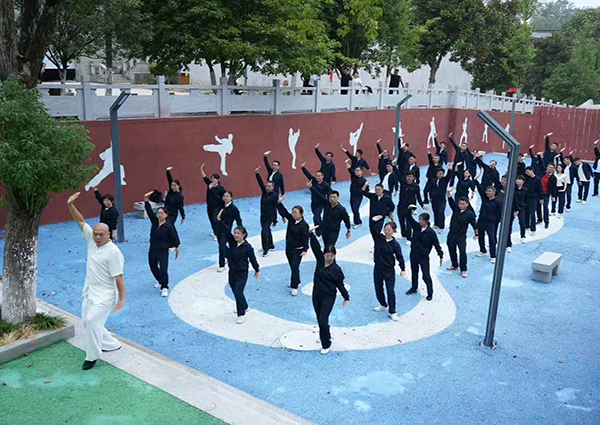
What Does a Genuine Qi Gong Curriculum Include?
Effective Qi Gong training is a systematic process that builds the body and mind from the ground up. It is far more than simply waving your arms slowly. A proper curriculum integrates several key components that work together to cultivate internal energy, strength, and tranquility. When evaluating a program, look for a balanced approach that includes the following elements.
Foundational Stances (Zhan Zhuang): Often called "standing pile" or "standing like a tree," Zhan Zhuang is the bedrock of nearly all internal Chinese martial arts. It involves holding specific postures for extended periods to build structural alignment, root the body, and develop internal awareness. It is not glamorous, but it is non-negotiable for serious progress.
Breath Work (Tu Na): This involves learning various breathing techniques to guide the Qi. "Tu" means to spit out or exhale, and "Na" means to accept or inhale. Proper breath work oxygenates the body, calms the nervous system, and links the physical movements to the flow of internal energy.
Dynamic Forms (Dong Gong): These are the moving sequences most people associate with Qi Gong. Each movement is designed to stretch the meridians, massage the internal organs, and guide Qi to specific areas of the body. A good instructor will explain the purpose and internal feeling of each movement, not just the external shape.
Mind Intent (Yi Nian): The mind leads the Qi. A critical part of the practice is learning to use focused, yet gentle, intention to guide energy through the body. This mental training is what elevates Qi Gong from simple physical exercise to a sophisticated mind-body discipline.
Meditation: Both still and moving meditation are integral. This practice cultivates a calm, clear, and focused mind, which is essential for sensing and guiding Qi. It helps integrate the physical benefits of the practice into your daily life, reducing stress and improving mental clarity.
Andrew Williams from the USA, who spent 30 days training with his son, called his experience "life-changing," strengthening him physically, mentally, and spiritually. This kind of holistic development is the goal of a well-structured curriculum that addresses the whole person.
Training Environment: The Difference Between a School and a Resort
The environment where you train has a profound impact on your progress. A traditional school is a "chang," a field for cultivation, where every aspect of daily life supports your practice. This is fundamentally different from a resort, which is designed for passive relaxation. A true training environment is built on discipline, community, and cultural immersion.
Discipline is not about punishment; it is about creating a structure that fosters focus. Waking up early, training consistently, eating simple and nutritious food, and living with fellow students creates a powerful momentum for growth. Austin Erkl from the USA, who completed a 30-day course, admitted he didn't love it at first. But after adjusting to the disciplined routine, he had a "great time," praising the accommodation, food, and the master. He concluded, "I made some lifelong memories here and will cherish my time." This initial challenge is often a sign of a genuine environment that pushes you beyond your comfort zone.
The community is your support system. Training alongside dedicated students from around the world creates a shared sense of purpose. You learn from each other, motivate one another, and build lasting friendships. Pamela Paes Ezawa from Brazil highlighted this in her feedback, mentioning how much she loved the "welcoming Shifu and community." This sense of belonging is something a resort cannot replicate.
Finally, cultural immersion deepens your understanding of the art. Being located near historical sites like the Shaolin Temple provides context and inspiration. You are not just learning movements in a sterile studio; you are breathing the air and walking the ground where these arts have been practiced for centuries. It connects your personal training to a living tradition.

From One Week to One Year: Matching a Program to Your Goals
The ideal duration for your Qi Gong training in China depends entirely on your objectives. Are you seeking a brief but potent introduction, or are you ready for a life-altering deep dive? Reputable schools offer flexible programs to accommodate different goals and schedules. Understanding the focus of each duration helps you make the right choice.
Common Training Durations and Their Focus
| Program Length | Primary Focus & Ideal For | Expected Outcome |
|---|
| 1-2 Weeks | Intensive Introduction & Cultural Immersion. Perfect for beginners with limited time or experienced practitioners wanting to learn a specific form from a master. | A solid foundation in core principles, learning a complete short form, and a powerful, rejuvenating experience. Othmane and his wife from France found their 7-day course provided them with "the best conditions." |
| 1-3 Months | Deep Skill Development. This duration is for students who want to go beyond the basics and begin internalizing the practice. It's enough time to see significant changes in health, posture, and energy levels. Consider a one month Kung Fu Course to build a strong foundation. | Noticeable improvement in physical health, reduced stress, proficiency in several forms, and a deeper understanding of the art's philosophy. This is the point where the practice starts to become a part of you. |
| 6 Months or More | Transformational Change & Mastery. For those dedicated to making the internal arts a central part of their life. This long-term commitment allows for the study of advanced forms, weapons, and the deeper philosophical aspects of the art. | A fundamental shift in one's physical and mental state. Hayley Noel from the UK completed a 120-day course, and her family noted, "She has had an awesome time, and we are so grateful." She plans to return, a common sentiment among long-term students. |
Since 2009, we have trained over 3,000 students from around the world. This experience has taught us how to tailor our teaching to meet the unique goals of each student, whether they are with us for a week or a year. The key is to be honest about your own capacity and objectives, and then choose the program that aligns with them.
Choosing to train in China is the first step on a remarkable path. By conducting careful research and asking the right questions, you can ensure your experience is one of meaningful growth and discovery. If you have questions about our philosophy or how our programs can align with your personal goals, we welcome you to get in touch.
Contact us to discuss your training goals and find the right program for you.



 WhatsApp