How Weapon Forms Improve Empty-Hand Structure & Power
The Weapon as a Mirror: Exposing and Correcting Empty-Hand Flaws
Many students ask why they should practice with a weapon when their goal is to master empty-hand combat. The answer is simple: a weapon does not teach you new principles; it magnifies the principles you already know. Think of a staff, saber, or spear as a mirror that reflects every subtle flaw in your posture, balance, and power generation. An error you might not notice in an empty-hand form becomes an undeniable mistake when you are trying to control a six-foot staff. This is the foundation of our approach to traditional Chinese weapons at SJF Kung Fu School.
When you hold a weapon, your body is forced to be honest.
Balance: A slight lean that is manageable on its own will cause you to stumble when you extend a spear.
Structure: Using arm strength instead of your core to punch is inefficient; trying to swing a heavy broadsword with only your arms is impossible and dangerous.
Intent: A disconnected mind in an empty-hand form leads to a sloppy movement. A disconnected mind in weapon practice means losing control of the weapon entirely.
The weapon demands whole-body connection. It forces you to generate power from the ground, channel it through your legs, direct it with your waist, and express it through your limbs. This is the very same mechanic required for a perfect punch or a stable block. In my 20+ years of teaching, I have seen students struggle for months to understand a concept in their empty-hand forms, only to have it click into place after a single week of weapon practice. The feedback is immediate and unforgiving, which makes it an exceptional teacher.
Unifying Principles: Mapping Weapon Movements to Empty-Hand Forms
The core mechanics of Kung Fu do not change when you pick up a weapon. The weapon simply becomes an extension of the body, subject to the same rules of physics and biomechanics. Understanding how these movements translate across disciplines is key to developing integrated martial skill.
Here is a breakdown of how three fundamental weapons—the staff (gun), saber (dao), and spear (qiang)—train the exact same body mechanics used in empty-hand forms like Shaolin Quan.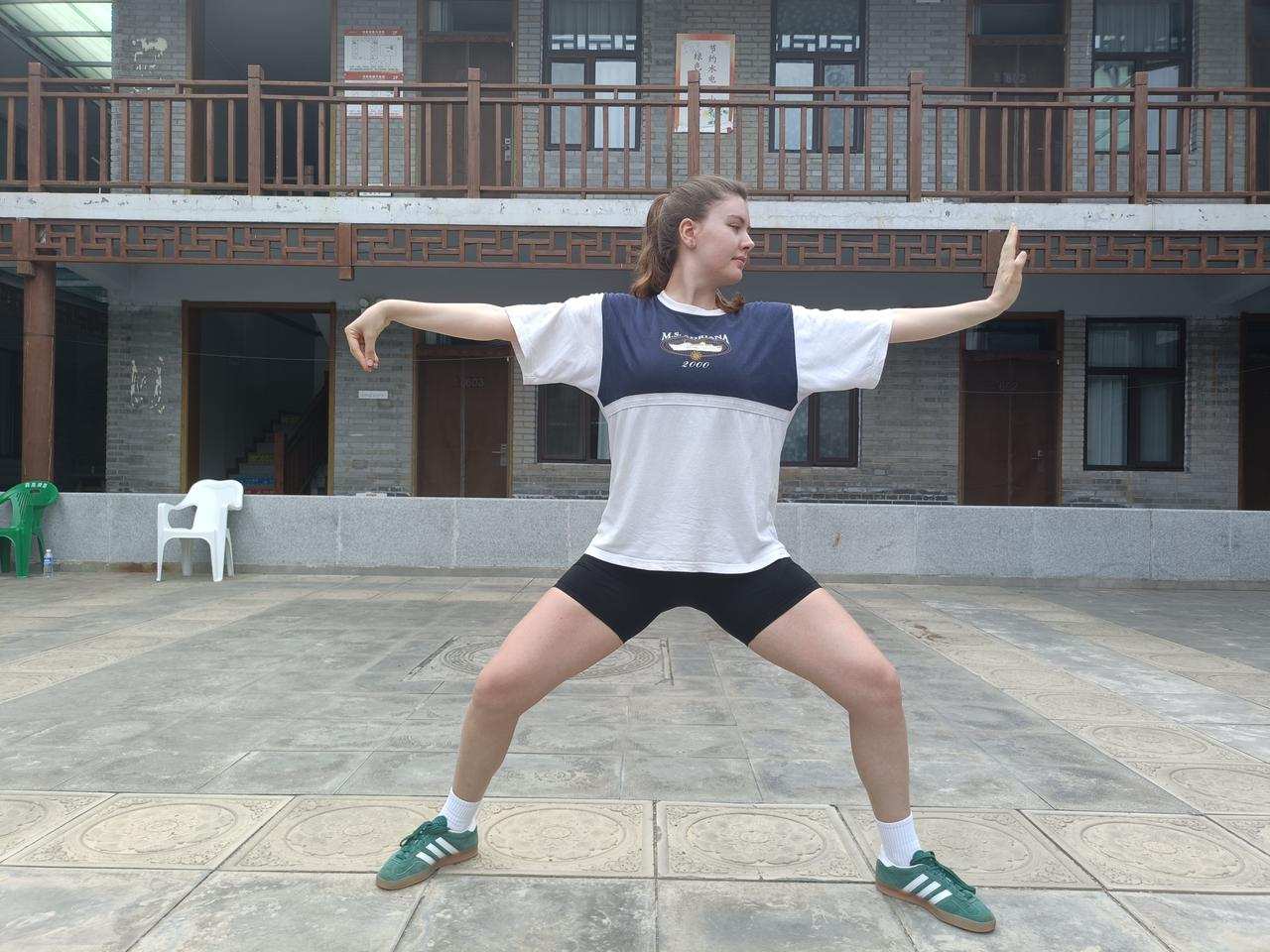
Stance and Footwork (Zhuang Bu / Bu Fa)
Empty-Hand: Your stance (e.g., Horse Stance, Bow Stance) is your root. It provides the stability to issue and absorb force. Weak footwork leads to being easily unbalanced.
Staff: The length and weight of the staff amplify any instability. A weak stance will cause you to be pulled off-balance during a simple block or swing. It forces you to sink your weight and grip the ground with your feet.
Saber: The flowing, cutting motions of the saber demand seamless transitions between stances. If your footwork is clumsy or your stances are not solid, you cannot generate the continuous, slicing power the weapon requires.
Spear: The thrust of a spear is one of the purest expressions of linear power. This power originates from the push of the rear leg. If your back foot lifts or your stance is too narrow, all the force dissipates before it reaches the spear tip.
Waist-Driven Power (Yi Yao Wei Zhou)
Empty-Hand: The waist is the central axis of rotation for all strikes, blocks, and throws. Power does not come from the arm; it is directed by the arm but generated by the coiling and uncoiling of the torso.
Staff: It is physically impossible to wield a long staff effectively using only arm and shoulder muscles. The large, circular movements are driven entirely by turning the waist, which swings the staff with immense force and minimal effort.
Saber: The characteristic "wrapping" (chan tou) and "slicing" (pi) of the saber are direct results of waist rotation. The weapon must feel like it is orbiting your center, not being pushed and pulled by your hands.
Spear: An explosive thrust comes from a sharp, sudden rotation of the hips and waist. This action is identical to the mechanics of a straight punch (chong quan), but the spear's length makes the requirement for waist connection undeniable.
Shoulder and Arm Alignment (Chen Jian Zhui Zhou)
Empty-Hand: The principle of "sink shoulders, drop elbows" is vital for connecting the arm to the torso. Tense, raised shoulders create a structural break, preventing power from the waist from reaching the hands.
Staff/Saber/Spear: This principle becomes even more critical with a weapon. A raised shoulder disconnects the weapon from your body's engine (the waist and legs). The weapon will feel heavy, clumsy, and "dead." By keeping the shoulders sunk and relaxed, the weapon becomes a connected part of your structure, moved by your center, not your limbs. You guide it, but your whole body powers it.
Common Mistakes in Early Weapon Training
When students begin Chinese weapon training, they often make mistakes that reveal deeper issues in their fundamental structure. Correcting these errors with a weapon in hand provides a direct path to improving their empty-hand skills. Here are some of the most common faults I observe.
| Common Mistake | Weapon Symptom | Underlying Empty-Hand Flaw |
|---|
| "Arming the Weapon" | Trying to lift or swing the weapon using only shoulder and arm strength. The movement is slow, weak, and fatiguing. | Relying on muscular tension for punches and blocks instead of using whole-body connection and waist power. |
| Fighting the Weapon's Momentum | Abruptly stopping or changing the direction of the weapon, creating jerky, inefficient movements. | A lack of "flow" in forms. Movements are disconnected, and the practitioner struggles to blend from one technique to the next smoothly. |
| Disconnected Hands and Feet | The hands move the weapon before the feet have settled into a solid stance. The strike has no root and no power. | "Floating" hands in empty-hand forms. The practitioner's blocks and strikes lack grounding and can be easily pushed aside. |
| Staring at the Weapon | Fixating on the tip of the spear or the blade of the saber, losing awareness of the body and surroundings. | Focusing only on the hands during forms practice, rather than feeling the whole-body connection and extending intent (Yi) to the target. |
As a descendant of Liuhe Quan and the 11th-generation inheritor of Chen-style Tai Chi, I emphasize that these are not separate skills. They are one and the same. The principles that allow you to control a broadsword are the same ones that give power to your empty-hand techniques.
From Theory to Embodiment: A Student's Experience
Theory is valuable, but embodiment is the goal. Many students arrive at our school seeking an experience that goes beyond rote memorization of forms. Klaes Risbjerg Simonsen from Denmark came to us for a 30-day course specifically because he wanted a focused, non-touristy environment to deepen his practice. He was not interested in a resort; he wanted to train. From his first day, he felt he was in the right place. We worked on Tai Chi, Zhan Zhuang, and the Broadsword. The broadsword, in particular, challenged him. Initially, like many, he tried to muscle it. But through persistent practice in our 200㎡ indoor training center, he began to understand. He learned to let his waist guide the blade and to let the weapon's momentum flow naturally.
The result? He told me he grew immensely, both physically and spiritually. The broadsword didn't just teach him how to use a weapon; it taught him how to connect his body and mind in a more unified way. This newfound connection translated directly back to his Learn Tai Chi practice, which became more rooted, fluid, and powerful. His experience, like that of over 3,000 students we have trained, shows that weapon practice is a powerful catalyst for growth in all aspects of martial arts. It's a method for turning abstract concepts into tangible, physical skill.
If you wish to truly understand the unity of martial arts, do not neglect weapon forms. They are not an accessory to your training; they are a key that unlocks a deeper understanding of your own body.
Explore our flexible programs, from one-week intensives to long-term study, to begin integrating Chinese weapon training into your practice. Contact us to discuss your training goals.



 WhatsApp