Kung Fu For Beginners: Can You Learn at Home Safely?
Where Self-Teaching Ends: The Question Behind "Can I Learn Kung Fu by Myself?"
Almost every newcomer asks it: can I learn kung fu by myself? The honest answer is "partly". The useful part of that answer is knowing exactly where "partly" stops. For Kung Fu for beginners, a few quiet foundations such as gentle mobility, natural breathing, and short standing practice can be explored in a living room. Strikes, kicks, joint locks, weapons, and anything done with a partner cannot be corrected by a video, however good it is.
At SJF Kung Fu School, our teaching comes from Master Shen Jiangfei, a Liuhe Quan descendant and the 11th-generation inheritor of Chen-style Tai Chi. The old masters taught that the body is the first teacher and the Shifu is the second. When the body complains and nobody is there to read the complaint, small errors harden into habits. This article gives you a diagnostic order: what to check first, what each signal may mean, and when to stop and find a qualified person to watch you move.
Think of it as a map of limits, not a ban on home practice. Traditional training has always included hours of solitary work. The skill lies in choosing the right solitary work.
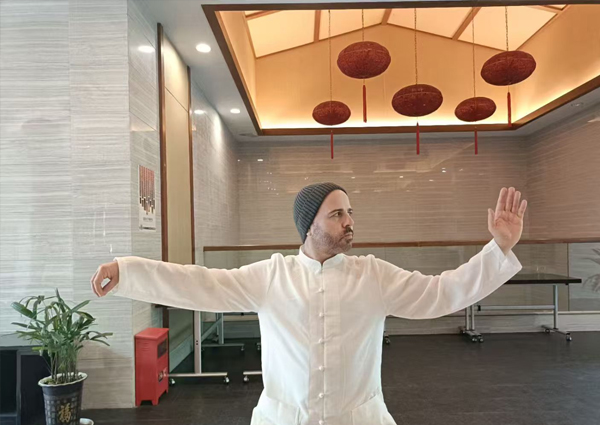
Preliminary Checks Before Your First Session of Beginner Kung Fu at Home
Check the simple things first. Most home injuries start with the room and the body's condition, not with the technique.
Floor. Use a flat, dry, non-slippery surface. Bare feet on polished tile or socks on wood invite slips. A thin mat helps, but a soft, springy surface makes balance work harder to judge.
Space. You should be able to extend both arms and turn in a full circle without touching furniture. If not, limit yourself to standing and breathing.
Body status. Note any current pain, recent injury, dizziness, or a long period without exercise. These are observations. They do not prove a problem, but they tell you to start slower, and to speak to a doctor before training if something is unresolved.
Warm-up. Spend five to ten minutes on slow joint circles: ankles, knees, hips, spine, shoulders, wrists. Cold joints under load are the usual starting point for a strain.
Time limit. Set a short session of 15 to 20 minutes. Fatigue is when form quietly breaks down, and nobody is there to tell you.
If any of these checks fail, fix that first. Do not push on and hope the technique will compensate.
Solo Practice Boundary: What You Can Train Alone and What Needs a Teacher
Here is the line that most how-to pages leave blurry. The rule of thumb: the more a movement involves speed, impact, leverage on another person's joints, or a blade, the less it belongs in unsupervised practice. The table below applies this to common starting points in Kung Fu for beginners.
| Skill | Alone at home? | Reasoning | Warning sign that calls for in-person coaching |
|---|
| Gentle stretching and joint mobility | Yes | Low load, easy to self-monitor. | Sharp pain, numbness, or a joint that catches or clicks with pain. |
| Natural breathing and basic Qi Gong movements | Yes, kept gentle | Slow, low-impact, and easy to stop. | Lightheadedness, chest tightness, or the urge to force the breath. |
| Short standing practice such as Zhan Zhuang | Yes, in short holds | No impact. You can rise at any moment. | Knee pain, back pain, or shaking that does not ease when you rise. |
| Basic stances held briefly | With caution | The posture can look correct while the knees are loaded wrongly. | Knees collapsing inward, heels lifting, or pain on the joint's inner edge. |
| Slow shadow punches | With caution | Without a target, wrists and elbows can lock out and strain. | Wrist soreness, elbow ache, or a twisting low back. |
| High kicks and jumps | No | Hamstrings and hips need staged preparation, and landings need correction. | Any pulling at the back of the thigh or groin. |
| Qin Na joint control and San Da sparring | No | These need a partner, graded pressure, and a teacher who sees what you cannot. | Any attempt at partner work without supervision. |
| Traditional weapons | No | Edge control and distance sense come from direct correction. | Any weapon work in a small room. |
This is a judgment guide, not a medical rule. It fits healthy adults with no prior injury. It does not apply if you have a joint condition, are pregnant, or are returning from surgery. Those readers should consult a doctor first and then a teacher.
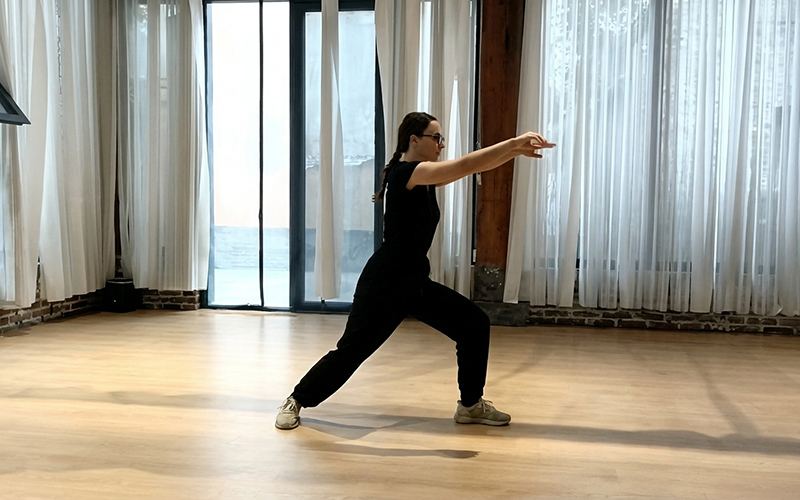
Reading the Signals: A Diagnostic Order for Pain, Wobble, and Doubt
Practice is a conversation with your body. The table separates what you observe, what it might mean, and what to do next. None of these causes is confirmed by the signal alone, so treat each as a hypothesis to test.
| What you observe | Possible meaning (unconfirmed) | Next action |
|---|
| Legs tremble after a minute or two in a stance | Ordinary muscle fatigue in a new posture | Rise when the form changes, rest, and repeat. No escalation needed if the trembling stops with rest. |
| Sharp or pinching pain at the knee | Knee tracking inward, a stance that is too deep, or an existing joint issue | Stop at once. Come up higher next time. If the pain returns even in a shallow stance, stop stance work and seek a professional. |
| Lower back ache after punching practice | Over-arching, or arms moving without hips and legs | Slow right down. Film yourself from the side. If the ache lingers for a day or more, pause the drill. |
| Wrist or elbow soreness after air strikes | Locking out the joint at full extension | Stop punching. Keep the arm slightly soft. Have a teacher check the structure before you resume. |
| Dizziness during breathing exercises | Holding or forcing the breath | Return to natural breathing and sit down. If it repeats, stop and ask a doctor. |
| Your video looks different from the demonstration, and you cannot tell why | Missing feedback, not lack of effort | This is the cleanest sign that you need an in-person eye. Send the clip to a teacher or book a short course. |
Stop conditions are simple. Sharp pain, numbness, dizziness, or pain that stays after rest means you stop the session. Pain that returns in two sessions in a row means you stop that drill until someone qualified has looked at it.
Common Mistakes in Home Martial Arts Training
Copying a form from video without a base. Sequences look impressive, but a stance held badly for months teaches the knees the wrong lesson.
Stretching to force the splits. Flexibility follows strength and patience. Forcing it is a common cause of hamstring strain.
Practicing when tired or rushed. Wu De, the martial virtue of humility and restraint, starts here. An ego that wants to finish the set overrides the body's warning.
Adding kicks and jumps in week one. A good teacher builds the base first, and so should you.
Treating one video as a diagnosis. A recording shows what you did, not what your joints felt. Always compare it with the sensation.
Working through pain as a sign of toughness. Soreness in the muscle belly is one thing. Pain at a joint is different and calls for stopping.
What Students Found When Someone Could Watch Them Move
Our students come from different countries with different expectations, and their accounts show what a teacher's eye adds.
Klaes Risbjerg Simonsen from Denmark completed a 30-day course in Tai Chi, Zhan Zhuang, and Broadsword. He wanted a focused experience rather than a touristy resort, and he said the Shifu adapted the training to his specific needs. That adaptation is exactly what a recorded lesson cannot do.
Austin Erkl from the USA completed 30 days of Tai Chi and Sword. He admitted he did not love it at first, but after adjusting he had a great time. His comment about the master: "The master is a great guy that cares for his students." The early discomfort of a new discipline is common, and a teacher can tell you whether it is healthy resistance or a warning.
Pamela Paes Ezawa from Brazil completed a 7-day Chen-style Tai Chi course. She valued the traditional training environment, the Taoist heartland setting, and the welcoming Shifu and community. Short courses like hers suit people who want to test their foundations under supervision before deciding how far to go. Our Kung Fu Beginner Course follows the same idea.
These accounts do not mean home practice is useless. They show that guided time gives you a reference point, and practice at home afterwards becomes safer.
A Four-Week Home Plan That Respects the Limits
If you decide to begin at home while you plan a trip, keep the plan modest. This sequence suits a healthy adult, three to four sessions a week.
Week 1: mobility and breath. Ten minutes of joint circles, then five minutes of natural breathing while standing. Nothing else.
Week 2: short standing. Add one to three minutes of a high, comfortable standing posture. Rise as soon as the form changes.
Week 3: simple stance transfer. Shift weight slowly from one leg to the other. Check the knees against the toes in a mirror.
Week 4: film and review. Record a front and a side view. Mark anything that feels odd or looks uneven, and keep the clip for a teacher.
This plan does not cover punches, kicks, partner work, or weapons, on purpose. It will not turn you into a martial artist in a month. It prepares the body and gives a teacher something clear to correct. Our indoor training hall of 200 square meters, with mats, wooden dummies, and a meditation hall, is where those next steps are taken with supervision, whatever the weather.
Bring Your Questions and Your Video to Master Shen's School
If something in your practice feels wrong, or you simply wish to know whether your standing posture is sound, we welcome genuine seekers of traditional Chinese martial arts to write to us. For a useful reply, send the following:
A short front and side video of the posture or movement in question.
The location and nature of any pain: sharp or dull, and whether it eases with rest.
Any past injuries and how long you have been practicing.
Your goal: health, Tai Chi, Shaolin Kung Fu, or a cultural stay.
Message us through the contact page of our website, or take the next step directly. If you are ready for supervised training, the 30 Day Kung Fu Course gives you time to build foundations in the calm setting of the Taoist heartland, near the Shaolin Temple, under a teacher who will watch each posture with care.



 WhatsApp