Kung Fu for Beginners: When Home Training Needs Coaching
Can You Start Kung Fu at Home Without a Coach?
Yes. Kung Fu For Beginners can begin at home when the first goal is simple: build a regular practice habit, improve mobility, and become familiar with basic posture. Home training is useful for quiet repetition. It gives you time to notice your breathing, your stance, and the relationship between a relaxed mind and a steady body.
However, home practice is a starting point, not a complete training method. A video can show the outer shape of a movement, but it cannot feel whether your knee is turning inward, whether your shoulders are rising during a punch, or whether your weight is held too heavily on one leg. Those details matter because traditional Chinese martial arts are built through alignment, timing, intention, and repeated correction.
For a gentle foundation, beginners may study Learn Tai Chi principles such as upright posture, controlled weight shifting, and calm breathing. These practices fit home training well because they can be performed slowly and without contact. They are not a substitute for instruction when a student wants to apply movement under pressure or develop combat skills.
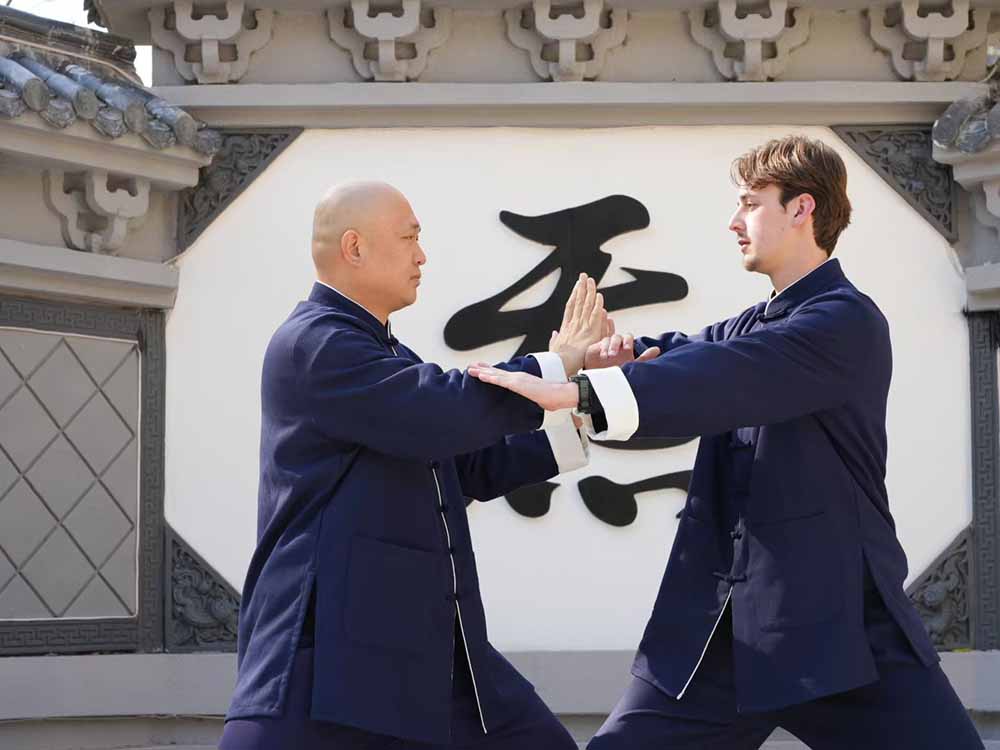
What home training can do well
- Build consistency: short daily sessions can make training part of normal life.
- Improve body awareness: slow stance work helps a student notice tension in the hips, shoulders, and neck.
- Support flexibility and coordination: controlled mobility work is appropriate when it remains pain-free.
- Prepare for class: basic conditioning makes it easier to focus when a teacher introduces new material.
- Give time for reflection: traditional practice includes attention, patience, and respect for the process, not only physical drills.
What home training should not try to replace
Do not use solo practice to test throws, joint controls, hard impact drills, or unrestricted sparring. Qin Na, San Da, Ge Dou, weapon work, and partner applications require spacing, timing, safety rules, and supervision. A student can rehearse a simple movement pattern alone, but application requires another person who understands how to cooperate safely.
Online kung fu lessons can also be helpful, especially for reviewing a form or following a warm-up routine. Their limit is feedback. A recorded lesson cannot always identify the error that a qualified instructor would see from the side, behind, or during a change of direction.
When Is Solo Practice No Longer Enough?
The answer is direct: solo practice has reached its limit when you cannot identify or safely correct your own errors. This often happens before a beginner feels “advanced.” A person may know several movements yet still need coaching for the most basic skill: placing the body correctly while moving.
The following signs do not mean that you have failed. They mean your training needs a different setting. A kung fu class for beginners offers observation, correction, and structured progression that videos and mirrors cannot fully provide.
| Sign during home practice |
Why it matters |
Best next step |
Limit of self-correction |
| Persistent balance errors, such as wobbling in a bow stance or losing control when turning |
Balance problems can come from foot placement, hip position, posture, or rushed weight transfer. |
Ask an instructor to watch your stance from more than one angle and correct one issue at a time. |
A mirror shows appearance, but it may not reveal where your weight is actually placed. |
| Impact training feels unsafe or causes repeated discomfort |
Punching, kicking, and conditioning drills need correct distance, target choice, and gradual loading. |
Stop hard impact work and seek supervised pad or bag instruction. |
Videos cannot judge whether your wrist, knee, or shoulder position is safe at contact. |
| No sparring supervision |
Distance, control, protective habits, and emotional restraint are learned with a partner and clear rules. |
Join supervised partner drills before attempting free sparring. |
Practicing combinations in the air does not teach reaction, timing, or safe contact. |
| Technique feedback has stalled |
Repeating the same uncorrected movement can make the error more familiar rather than more effective. |
Book a class, a live online review, or a short in-person course with direct correction. |
You may not know which detail is causing the problem. |
| You want to learn locks, throws, weapons, or combat applications |
These methods affect another person’s balance, joints, and safety. |
Train under a teacher and use agreed partner protocols. |
Solo rehearsal cannot confirm safe pressure, distance, or response. |
There is a traditional saying in martial practice: form is visible, but skill must be tested through correction. This does not mean beginners must rush into contact training. It means that the body needs honest feedback. Good coaching begins with control, not force.
What Should a Beginner Practice Alone Before Joining a Class?
A sensible home routine should be modest and repeatable. Do not copy long forms before you can stand with stability. Do not chase speed before you can move without strain. For people asking how to learn kung fu at home, the most useful answer is to practice a few basic tasks carefully and then bring questions to a teacher.
A 25-minute home foundation routine
- Warm up for five minutes: use gentle shoulder circles, hip rotations, ankle movement, and easy walking. The purpose is to prepare the joints, not force a stretch.
- Practice upright standing for three minutes: keep the feet comfortable, knees soft, head lifted, and breathing natural. Stop if you feel sharp pain or numbness.
- Use basic stance transitions for five minutes: move slowly between a natural stance and a wider training stance. Keep the knees aligned with the direction of the feet.
- Perform controlled hand techniques for five minutes: extend and return each punch without snapping the elbow straight. Focus on balance and a relaxed shoulder.
- Practice slow stepping for four minutes: place the foot gently, shift weight gradually, and avoid leaning forward.
- Finish with breathing and stillness for three minutes: stand or sit comfortably. Notice whether your shoulders, jaw, and hands can soften.
This routine suits a healthy adult who wants basic coordination before beginner martial arts coaching. It does not suit someone training through an injury, recovering from surgery, or experiencing dizziness. In those cases, seek appropriate medical guidance before beginning physical practice.
Standing practice has a respected place in Chinese martial arts. Zhan Zhuang teaches patience and structural awareness through stillness. Yet stillness should not become stubbornness. If you repeatedly feel pressure in the knees, lower back, or neck, a teacher should check the posture rather than telling you to endure it.
When Should Beginners Join Kung Fu Classes?
Beginners should join kung fu classes when they want reliable correction, a clear curriculum, safe partner work, or cultural context that cannot be gained through isolated practice. You do not need to become flexible, strong, or confident first. Coaching is often most useful at the beginning because it prevents the student from building habits that later take longer to change.
The right timing depends on your purpose. Someone seeking calm movement and basic health may spend several weeks preparing at home. Someone interested in San Da, Qin Na, weapons, or sparring should seek supervision much earlier. Contact skills involve another person’s safety as well as your own.
| Your main aim |
Can home practice help? |
When coaching becomes the better choice |
Suitable training direction |
| Better posture, breathing, and calm focus |
Yes, with gentle standing and mobility work. |
When you cannot maintain alignment or want detailed form correction. |
Tai Chi, Qi Gong, Zhan Zhuang, Meditation |
| Fitness and basic striking coordination |
Yes, for light shadow practice and conditioning. |
Before hard bag work, partner drills, or any sparring. |
Shaolin Quan, San Da |
| Self-protection concepts |
Only at a very basic movement level. |
As soon as joint control, escaping, falling, or partner response is involved. |
Qin Na, Ge Dou |
| Traditional weapons |
Not beyond basic safety awareness. |
Before handling training weapons or learning sequences. |
Chinese Weapon training |
| Focused cultural immersion in China |
Home practice can prepare the body and attention. |
When you want daily structure, instruction, and a training environment. |
One-week, one-month, or longer programs |
At SJF Kung Fu School, students can train across nine traditional disciplines, including Shaolin Quan, Tai Chi, Qi Gong, Zhan Zhuang, San Da, Qin Na, Ge Dou, Chinese Weapon practice, and Meditation. This range matters because not every beginner needs the same first step. A student drawn to quiet internal work may begin differently from a student who hopes to develop striking skills.
Master Shen Jiangfei is a descendant of Liuhe Quan and the 11th-generation inheritor of Chen-style Tai Chi. For students, lineage should not be treated as decoration. It points to a responsibility: methods should be taught with care, respect for their roots, and attention to the student standing in front of the teacher.
How Does Coached Training Change the Way You Learn?
A good instructor does more than demonstrate movements. The instructor observes how you stand, explains why a correction matters, and gives you a manageable task for the next practice session. This is especially valuable for adults who have spent years sitting at desks, young learners who rush their movements, or experienced athletes whose previous training habits do not match Chinese martial arts body mechanics.
Consider the difference between copying a punch and learning a punch. At home, you may see the fist travel forward. In coached practice, you can learn when the foot settles, how the waist turns, where the shoulder should remain relaxed, and why the other hand returns to guard. The visible movement is only one part of the lesson.
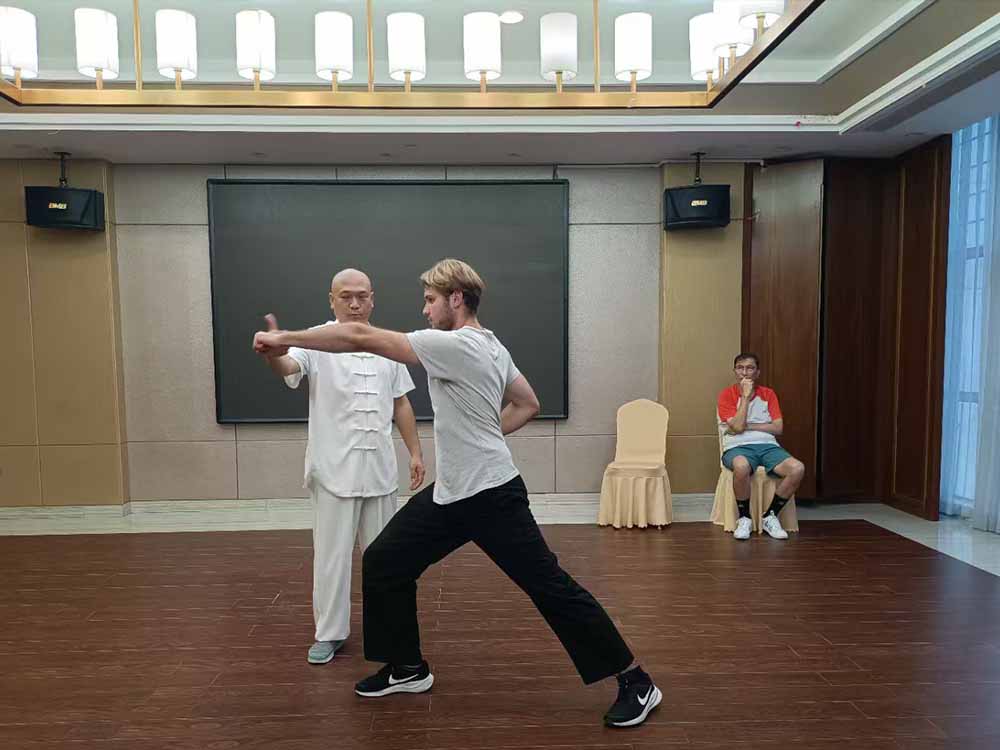
Questions to ask before choosing beginner martial arts coaching
- Will the teacher correct basic alignment? This matters if you are new, returning after a long break, or unsure about knee, hip, and shoulder positioning.
- Is partner practice introduced gradually? Beginners should learn control and distance before faster exchanges.
- Can the course match my available time? A short course may suit a first experience, while regular or longer study is better for students seeking deeper repetition.
- Is there a suitable indoor space? Weather should not force students to skip fundamental practice. SJF Kung Fu School has a 200㎡ indoor training center with mats, wooden dummies, traditional weapons, and a meditation hall.
- Does the training include more than physical copying? Look for instruction that addresses Wu De, or martial virtue: respect, self-control, humility, discipline, and responsibility toward training partners.
Wu De is not an abstract decoration around martial arts. It appears in ordinary actions: arriving prepared, listening when corrected, controlling a technique before contact, and treating fellow students with care. For a beginner, these habits are as valuable as learning a new stance.
Real student experiences also show why the setting matters. Andrew Williams from the United States trained Tai Chi, Zhan Zhuang, and Dao Fa with his son for 30 days. He described the experience as life-changing for physical, mental, and spiritual strength and planned to return. His result belongs to his own commitment and circumstances; it should not be treated as a promise for every visitor. What it does show is the value of sustained practice, shared training, and direct instruction.
Which First Course Fits a Beginner Who Has Practiced at Home?
Choose a first course based on the question you need answered, not on how impressive a style appears online. A short course is suitable when you need to test whether in-person correction and daily practice suit you. A longer course is appropriate when you want time to absorb fundamentals, receive repeated feedback, and develop a steadier routine.
- Choose a one-week course if you want an introduction to supervised training, need a focused break from normal routine, or want guidance on basic stance and movement. A One Week Kung Fu Course can help you see what needs correction, but it cannot replace months of steady practice.
- Choose a month of training if you already know that home practice alone is not enough and want time for repetition. A month gives more space to build routines, but progress still depends on health, attendance, recovery, and willingness to accept correction.
- Choose longer study if traditional practice is becoming a serious part of your life and you want to develop a stronger foundation across forms, conditioning, internal work, and partner training. Long-term study requires patience; it is not a shortcut to skill.
For beginners curious about controlled combat practice, San Da training should begin with supervision, technical drills, and respect for safety. For those who are drawn to stillness and breath, Qi Gong can support a quieter beginning. Neither path is better for every person. The useful choice is the one that fits your condition, intention, and readiness to train consistently.
What Is the Best Next Step After Recognizing You Need Coaching?
Start with an honest assessment. Record yourself performing a basic stance transition from the front and side. Notice whether you lean, rush, tense the shoulders, or lose balance. Write down the single question you most want a teacher to answer. It may be “Why do my knees hurt in this stance?” or “How can I practice a punch without tightening my neck?” A specific question leads to better instruction.
Then choose a setting where feedback is possible, partner work is introduced responsibly, and traditional values are practiced alongside physical training. Home practice can remain part of your life. It becomes more useful after coaching because you understand what to repeat and what to avoid.
Ready for guided practice? Explore the one month Kung Fu Course and contact SJF Kung Fu School to discuss a suitable starting point.



 WhatsApp