Kung Fu for Beginners: Why Stances Must Precede High Kicks
The Foundation of Power: Why Stances Come First in Kung Fu
Many who begin their study of Chinese martial arts are eager to learn the dynamic, powerful kicks they see in films. They ask, "Shifu, when will we learn to kick?" This is a natural question. Yet, in our school, the answer is always the same: first, we build the foundation. Before the house, you must lay the groundwork. In Kung Fu, that groundwork is your stance.
A stance is not merely a way of standing; it is the root from which all movement, defense, and attack grows. Without a strong root, a tree cannot withstand the wind, nor can it bear fruit. Similarly, a martial artist with a weak stance has no true power, no stability, and no ability to either issue force or absorb it. This principle is central to every style we teach, from the explosive power of Shaolin Quan to the yielding grace of Tai Chi.
At SJF Kung Fu School, we have guided over 3,000 students on this path since 2009. We see time and again that those who dedicate themselves to stance training develop faster, avoid injury, and achieve a much deeper understanding of the art. Whether you join a One Week Kung Fu Course to begin your training or commit to longer study, the first lesson is always under your feet.
The energy of a punch or a kick does not originate in the arm or the leg. It begins from the ground, traveling through the body and expressed through the limb. Your stance is the connection to that source of power. A weak, unstable stance is like a kinked hose—no matter the water pressure, only a trickle will come out. A solid, rooted stance allows energy to flow freely and powerfully.
Stances vs. Kicks: A Technical Breakdown of Stability and Control
To understand why foundational positions must precede advanced kicks, it is useful to contrast the mechanics of a technique performed from a weak structure versus a strong one. A beginner's impatience to throw a high kick often overlooks the fundamental physics involved. An unstable base cannot support a dynamic, powerful movement. The following table breaks down the critical differences.
| Parameter | Execution from a Weak Stance | Execution from a Strong Stance (e.g., Horse Stance) |
|---|
| Stance Stability & Balance | The center of gravity is high and the base of support is narrow. The practitioner is easily pushed off balance, especially during or after a kick. The kicking leg's movement creates significant instability. | The center of gravity is lowered and the base is wide and solid. The body is rooted to the ground. This creates a stable platform from which to launch a kick, allowing for a safe return to a defensive position. |
| Range of Motion & Power Generation | Movement originates from the leg muscles alone. The hips are tight and cannot rotate freely, severely limiting the power and reach of the kick. The technique is isolated and weak. | Power is generated from the ground up, engaging the legs, hips, and core. A stable stance allows for full hip rotation, which is the primary engine for powerful kicks and strikes. The entire body contributes to the movement. |
| Kicking Control & Safety | The kick is often uncontrolled, more of a fling than a targeted strike. After the kick, the leg is difficult to retract quickly, leaving the practitioner vulnerable to counter-attacks. There is a high risk of hyperextending the knee or pulling a muscle. | The supporting leg is strong and properly aligned, protecting the knee joint. The kick can be delivered with precision and immediately retracted to a guarded stance. The practitioner remains in control throughout the entire motion, minimizing risk and exposure. |
As the table illustrates, attempting high kicks without a proper foundation is not only ineffective but also dangerous. It builds bad habits that are difficult to correct later and can lead to chronic injury. True martial arts skill is built layer by layer, and the first layer is always the stance.
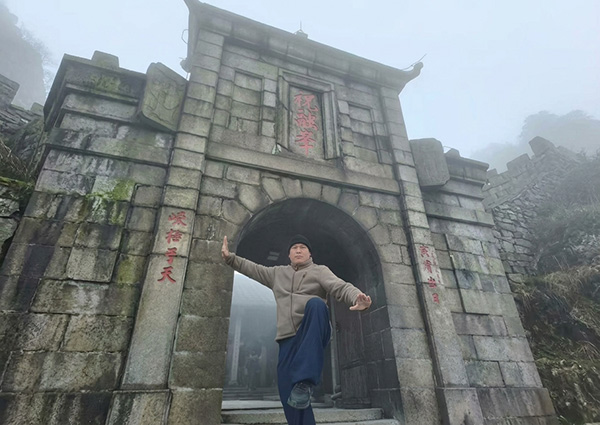
Mastering 3 Core Kung Fu Basic Stances
While there are many stances in Chinese martial arts, beginners typically start with a few key positions to build strength, structure, and body awareness. Our 200㎡ indoor training center provides the ideal space to practice these fundamentals year-round. As the 11th-generation inheritor of Chen-style Tai Chi, I emphasize that these static postures are not just physical exercises; they are a form of standing meditation, or Zhan Zhuang, that cultivates internal energy and focus.
1. Mǎ Bù (马步) – The Horse Stance
Purpose: The horse stance is the ultimate foundation-builder. It develops powerful legs, increases endurance, and teaches the feeling of being rooted to the ground. It is essential for stability in nearly all Kung Fu styles.
How to Practice:
Stand with your feet double your shoulder-width apart, toes pointing forward.
Bend your knees and sink your hips as if sitting on a horse, keeping your back straight and your chest up.
Your thighs should be as close to parallel with the ground as you can manage.
Keep your knees pushed outwards, aligned over your feet. Do not let them collapse inward.
Hold the position, breathing deeply and calmly. Start with 30 seconds and gradually build your time.
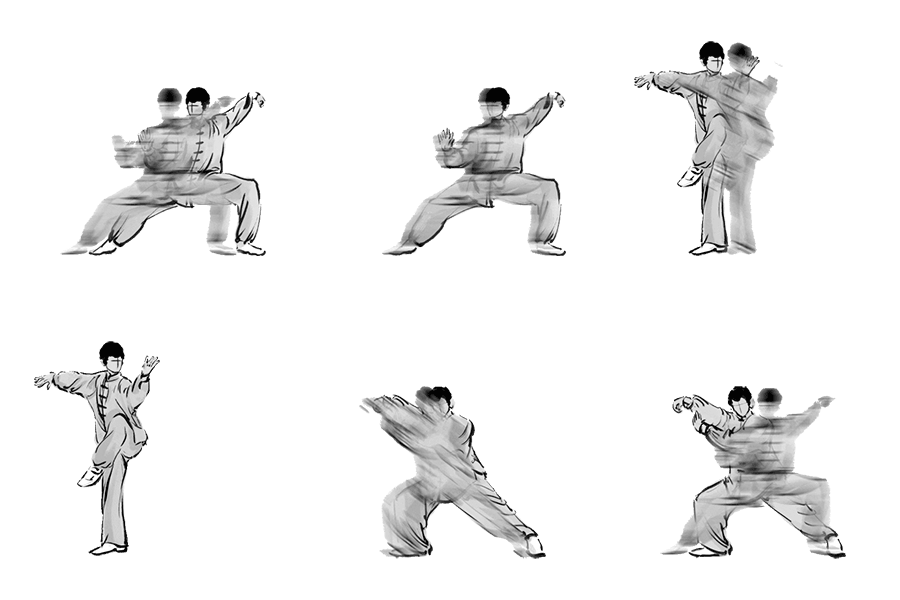
2. Gōng Bù (弓步) – The Bow Stance
3. Pū Bù (仆步) – The Crouching Stance
Common Mistakes in Stance Training and How to Correct Them
Dedication to stance training is key, but correct practice is even more important. Incorrect alignment can lead to injury and reinforce bad habits. Many students, like Klaes Risbjerg Simonsen from Denmark, come to our school seeking an authentic, focused experience. He appreciated how our instructors adapt the training to individual needs, which includes identifying and correcting these common errors.
Here are some of the most frequent mistakes beginners make in their kung fu footwork basics and how to fix them:
Mistake: Knees collapsing inward. This puts immense pressure on the knee ligaments and is one of the most dangerous structural faults. It's especially common in the horse stance.
Mistake: Leaning the torso too far forward or backward. This compromises your balance and disconnects the upper body from the lower body's power. Your structure is broken.
Mistake: Rising up out of the stance. As muscles fatigue, it's natural to want to stand up. This defeats the purpose of the exercise, which is to build endurance and strength in a low, rooted position.
Mistake: Holding your breath. Tensing up and holding your breath starves your muscles of oxygen and creates unnecessary tension throughout the body.
Correction: Focus on deep, slow, diaphragmatic breathing. Inhale as you prepare, exhale as you sink into the stance. Let your breath be the anchor for your practice.
Correcting these details is the work of a lifetime. It requires patience and expert guidance. As Austin Erkl from the USA, who completed a 30-day course, noted, "The master is a great guy that cares for his students." That care is often expressed through the diligent correction of these foundational details.
If you are ready to build a true foundation in traditional Chinese martial arts, we invite you to explore our programs. See our one month Kung Fu Course for an immersive start to your training.



 WhatsApp