Kung Fu Retreat China: Is It Right for Beginners?
Why Beginners Hesitate Before Booking a Retreat in China
A week of gentle forms or a month of daily drilling: the same photo of a mountain courtyard can sit above both. For a first-timer weighing a Kung Fu Retreat China trip, the real tension is how much your body and temperament can absorb. A short, structured start such as a One Week Kung Fu Course tells you quickly whether this art suits you. A longer, harder program rewards you only if you arrive ready for it.
The honest answer is often yes, with conditions. I am Master Shen Jiangfei, an 11th-generation inheritor of Chen-style Tai Chi and a descendant of Liuhe Quan. The first thing I tell new students is that Kung Fu is not an exam you pass in week one. It is a slow conversation with your own body. This article is about how to start that conversation without hurting yourself or your enthusiasm.
What a First-Timer Actually Meets on the Training Floor
Photos show flying kicks and weapon flourishes. A beginner's first days look quieter, and in some ways harder.
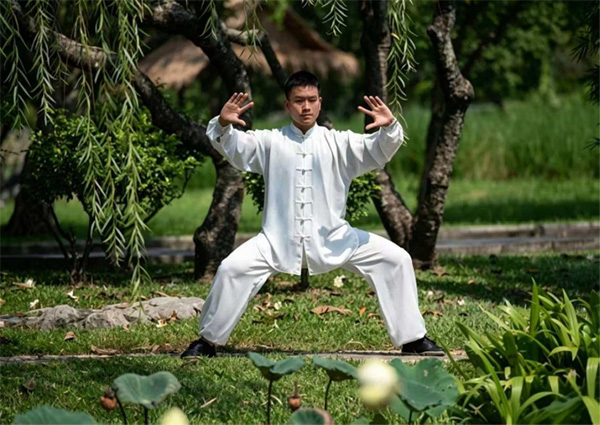
- Standing practice. Zhan Zhuang asks you to stand still with bent knees and relaxed shoulders. Nothing moves, yet the legs shake within minutes. It is the traditional way to learn rooting and alignment.
- Slow forms. Tai Chi looks gentle, but low, sustained knee flexion works the thighs, hips and ankles. In Chen-style, slow movement also contains spiraling force that takes repetition to understand.
- Breath and stillness. Qi Gong and seated meditation train attention. For many Western students, sitting quietly is the most unfamiliar task of the day.
- Etiquette. Wu De, martial virtue, begins with how you greet your teacher, how you treat classmates and how you handle frustration. It is part of the training, not decoration.
Dynamic styles such as Shaolin Quan add jumping, fast changes of direction and stretching under load. That is a different physical demand, and it is where untrained joints complain first.
Readiness Checklist: Is Your Body Prepared?
No school can see your knees from across the ocean, so use this as a self-check before booking. It is a practical guide, not a medical clearance.
- You can walk briskly for about half an hour without joint pain.
- You can squat down to a chair-height position and stand again without sharp knee or lower-back pain.
- You have no unresolved injury to the knee, hip, spine or shoulder, or your doctor has cleared light-to-moderate training.
- You can tolerate repeating one small movement fifty times without losing patience.
- You have time to recover. Sleep, meals and rest days matter as much as the sessions themselves.
If you can tick most of these, a structured first program is reasonable. If two or three are doubtful, read the next section closely.
When a Beginner Should Choose a Lower-Intensity Retreat Instead of a Daily Intensive
A good Kung Fu Retreat China plan fits your starting condition, not your enthusiasm. A daily intensive pace suits some beginners and not others. The table below shows where I would draw the line.
| Your situation | Better first choice | Why |
|---|
| Sedentary for years, little recent exercise | Lower-intensity start focused on Tai Chi, Zhan Zhuang and Qi Gong | Tendons and joints adapt more slowly than muscles. Soreness can hide strain. |
| Past knee, back or ankle injury | Lower-intensity start, after medical advice | Stances and kicks load these joints repeatedly. Forms can be adjusted in range and height. |
| Age 50 or older, new to martial arts | Short stay in the first trip, extend later | Recovery between sessions is slower, and a short trip lets you test it. |
| Travelling from a long flight and a big time difference | Easier first days, then build up | Jet lag and unfamiliar food reduce what you can absorb. |
| Regular exercise, mobile hips, some martial arts or dance background | Daily intensive program is reasonable | Your body already knows how to repeat and recover from effort. |
| You want Shaolin Quan or Ge Dou for fighting skill | Build a base first, then add contact or fast work | Power and speed on weak foundations lead to injury. |
The limit of this table: it is a general guide, not a diagnosis. It cannot replace a conversation with your doctor, or with us about your actual history. A lower-intensity start also does not mean a weak experience. Many students find the quiet work of standing, breathing and slow forms is where the culture of this art becomes clearest.
What Past Students Recorded
These are real accounts from students who trained with us. They show a range of stay lengths and attitudes. They do not prove that every beginner will respond the same way, and their fitness levels before arrival were not recorded in these notes.
| Student | Program | What they reported |
|---|
| Pamela Paes Ezawa, Brazil | 7-day Chen-style Tai Chi | Valued the traditional training setting, the Taoist heartland location, training-focused accommodation and a welcoming Shifu and community. |
| Othmane Echaouki and his wife, France | 7-day Chen-style Tai Chi | Thanked the Shifu for caring for all the students and said they felt they were in the best conditions. |
| Austin Erkl, USA | 30-day Tai Chi and Sword | Admitted he did not love it at first, then adjusted and had a great time. He wrote, "The master is a great guy that cares for his students." |
| Klaes Risbjerg Simonsen, Denmark | 30-day Tai Chi, Zhan Zhuang and Broadsword | Wanted a focused experience, not a touristy resort. Said the training was adapted to his needs and that he grew physically and spiritually. |
| Andrew Williams, USA | 30 days of Tai Chi, Zhan Zhuang and Dao Fa, with his son | Called it life-changing, physically, mentally and spiritually. He plans to return next year. |
| Hayley Noel, UK | 120-day Tai Chi, Zhan Zhuang, Sword and Broadsword | Her family wrote that she loved it and had an awesome time. She plans to return soon. |
Austin's note is the one I value most for beginners. Nobody should expect to love every hour of the first week. Discomfort at the start, followed by adjustment, is common in physical training. The records cannot tell us why Austin's feelings changed, so I will not claim a cause. What they do show is that a rough first stretch was not the end of the experience for him.
Klaes's account points to something else: fit. He chose a focused place on purpose, and he felt right from the first day. Matching your expectations to the setting matters as much as matching your fitness.
Want a plan shaped around your own body? See the 30 Day Kung Fu Course or tell us your background and we will suggest a starting length.
An Illustrative Scenario: The Office Worker's First Trip
This is a constructed example to show the planning logic. It is not a record of a specific student.
Imagine a 42-year-old who sits at a desk most of the day, walks on weekends and has a mildly stiff lower back. They want to learn Tai Chi properly and feel nervous about hard training. A sensible sequence looks like this:
- Disclose everything. Share the back history and any medical advice before arrival so the teacher can adjust stance height and range.
- Spend week one on foundations. Basic Tai Chi movements, short Zhan Zhuang sessions and Qi Gong breathing. Stop at fatigue, not at pain.
- Review at the end of week one. Ask: what hurt, what recovered overnight, what felt natural?
- Extend only if recovery is good. Moving to a month adds repetition, not necessarily harder techniques.
- Consider long-term training later. If the practice proves sustainable, a Three-Month Course allows deeper work.
Our 200㎡ indoor training center means rain or cold does not cancel practice, so a short plan stays on schedule. If the same person arrived with a sore lower back and tried to match a fit twenty-year-old in daily conditioning, the likely result would be an early injury and a bad first impression of the art. This is a general reading of how load and recovery work, not a documented case.
Common Mistakes First-Timers Make
- Booking the longest program first. Test your response with a short stay if you have never trained daily.
- Hiding an old injury. Teachers can adapt movements, but only if they know.
- Expecting fighting skill in a week. A week builds vocabulary: stance, posture, breathing and etiquette.
- Treating soreness as a badge. Muscle fatigue is normal; joint pain is a warning.
- Skipping the quiet practices. Students who treat Meditation as an optional extra often miss the calm that makes harder training easier to absorb.
- Choosing by scenery alone. Ask about the teacher's lineage, who will actually instruct you and how the schedule is structured.
Questions to Bring to Your First Conversation
Over 3,000 students have trained with me, and the best outcomes begin with a clear, honest message before booking. When you contact us, it helps to share:
- Your age, current activity level and any injuries or medical conditions.
- Any previous martial arts, yoga or dance experience.
- What you want: calm, fitness, cultural understanding, or practical combat skills.
- How many days you can stay, and whether you are travelling alone or with family.
With that, we can say plainly whether a short, gentle start or a fuller program suits you. If a Kung Fu Retreat China plan is not right for you yet, we will say that too.
Take the Next Step
Ready to explore? Start with the 30 Day Kung Fu Course page to see how a longer stay is structured, or write to us through the contact form on the SJF Kung Fu School website to book a consultation. Genuine seekers of traditional Chinese martial arts are always welcome here, and we are happy to talk before you decide.



 WhatsApp