Learn Tai Chi Beginners: Weight-Shift Balance Drills
Why Weight Shifting Feels Unstable After Learning a Tai Chi Routine
Many people can remember the hand movements in a form yet still feel uncertain when a foot leaves the ground. The problem is rarely a lack of effort. More often, the body begins the next step before the standing leg has accepted the weight. For those who Learn Tai Chi Beginners methods, balance improves when each transfer becomes clear: one leg supports, the hips remain organized, and the stepping foot stays light until it has a reason to receive weight.
At Learn Tai Chi classes, this principle is often described simply: distinguish empty from full. A full leg carries the body. An empty leg is free to step, touch, turn, or withdraw. When these roles become confused, the upper body often leans, the knee twists, or the stepping foot searches for the floor too early.
Tai Chi does not ask the student to freeze. It asks for calm movement with a clear root. In Chen-style Tai Chi, a weight shift is not merely moving from left to right. It is a coordinated change through the feet, ankles, knees, hips, waist, and hands. The arms may appear to lead, but stable movement begins below them.
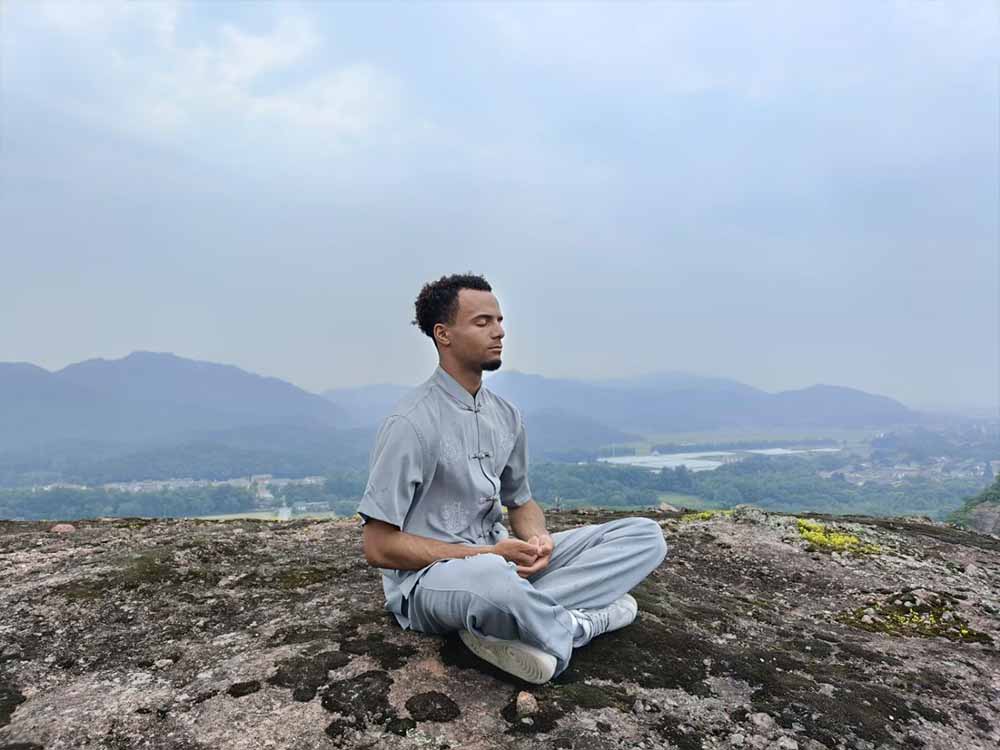
At SJF Kung Fu School, Master Shen Jiangfei teaches from a lineage that includes Liuhe Quan and Chen-style Tai Chi. As an 11th-generation inheritor of Chen-style Tai Chi, he emphasizes that form practice is not a performance of hand shapes. The lower body must explain the movement. If the feet and hips do not agree, even a graceful posture can feel unsteady.
How Foot Pressure, Hip Alignment, and Empty-Versus-Full Leg Transitions Prevent Tipping During Beginner Movements
The most useful correction for a tipping beginner is not “try harder to balance.” It is to identify which part of the transfer happened too soon. Foot pressure, hip alignment, and the distinction between empty and full legs work together. Each has a different job.
| Key parameter |
What to observe |
Practical effect |
Common misunderstanding |
| Foot pressure |
Feel the standing foot connected across the ground without gripping the toes. |
Helps the body settle before the other foot moves. |
Pressing hard into the floor or curling the toes for security. |
| Hip alignment |
Keep the pelvis level enough that one side does not drop or swing outward. |
Allows weight to pass into the standing leg without sending the torso sideways. |
Turning the shoulders first and allowing the hips to chase them. |
| Full leg |
The knee, hip, and foot accept the body’s weight in one connected line. |
Provides the support needed for the next action. |
Calling a leg “full” while part of the body still hangs between both feet. |
| Empty leg |
The foot can touch the floor lightly without carrying the body. |
Makes a controlled step, toe placement, or change of direction possible. |
Placing the foot and immediately leaning onto it. |
Conclusion: first settle into the supporting leg, then free the other leg. This fits beginners who lose balance during forward steps, backward steps, or turns. It does not mean locking the supporting knee or becoming rigid. A locked knee stops the leg from adjusting and can make balance worse.
Foot pressure should feel broad rather than forceful. If pressure rushes to the inside edge of the standing foot, the knee may collapse inward. If it moves too far to the outside edge, the body may lean away from the center. Instead of chasing a perfect sensation, check whether the standing foot can remain quiet while the other foot becomes light.
Hip alignment is the bridge between the feet and torso. When the pelvis tilts or rotates without control, the chest often compensates by leaning. This is why a student may feel stable in a stationary stance but wobble during a turn. The turn has moved into the shoulders while the hips and supporting foot were not ready.
The empty-versus-full distinction prevents that problem. Before a forward step, the rear leg must become full enough to release the front foot. Before stepping back, the front leg must accept the body clearly enough to free the rear foot. The stepping leg does not pull the body forward. The standing leg supports the body while the other foot finds its place.
A Practical Weight-Shift Drill Sequence for Steadier Tai Chi Steps
Use the following sequence in a clear, open space. It is suitable for learners who can stand comfortably and who are refining their basic form mechanics. If you have pain, recent injury, dizziness, or a condition that affects balance, seek appropriate professional guidance before practicing unsupported standing drills.
- Choose a moderate stance. Stand with both feet placed naturally, not in an exaggeratedly wide position. Let the knees soften without collapsing inward. Keep the head upright and the shoulders relaxed.
- Pause before moving. Feel both feet on the ground. Do not begin by shifting your chest. Let the change start quietly through the legs and hips.
- Move weight toward one leg. Allow one leg to receive more of the body while the other gradually becomes lighter. Keep the torso centered rather than leaning over the standing foot.
- Test the empty foot. When the non-supporting foot feels light, lift the heel slightly or slide the toes a short distance without changing the height of the body. If the pelvis sways, return the foot and settle again.
- Place before loading. Set the empty foot down gently. Treat it as a contact point, not yet as a pillar. Keep most of the body over the original supporting leg.
- Transfer only after placement. Let weight travel gradually into the newly placed foot. Watch whether the knee follows the direction of the toes and whether the hips stay level.
- Finish with stillness. Once the transfer is complete, pause. The new supporting leg should feel capable of freeing the other foot without a hurried adjustment.
This drill is useful because it separates actions that beginners often blend together: shifting, stepping, placing, and loading. In a form, these actions may appear continuous. During training, separating them reveals where balance is lost.
A slower drill is not always better. If you slow down so much that you hold tension in the thighs, the body may shake and the hips may stiffen. The aim is deliberate movement, not strain. Let the breath remain natural. In Zhan Zhuang practice, students can develop the quiet standing awareness that makes this sequence easier to feel, but standing alone does not replace stepping practice.
What Changes When You Step Forward, Backward, or Turn
Different directions expose different errors. A learner may manage a forward step but lose balance when moving back because the eyes, chest, and hips all pull in separate directions. The following comparison helps identify the correction that fits the movement.
| Movement |
Most useful checkpoint |
Why it helps |
Limit of the checkpoint |
| Forward step |
Keep the rear leg supporting while the front heel or toes find the ground. |
Prevents the chest from falling ahead of the front foot. |
Do not keep weight back so long that the step becomes stiff or fearful. |
| Backward step |
Make the front leg full before the rear foot travels. |
Stops the body from reaching backward with an empty base. |
Do not look down constantly; use occasional checks, then train spatial awareness. |
| Side step |
Keep the pelvis from drifting ahead of the stepping foot. |
Reduces sideways tipping and knee collapse. |
A level pelvis does not mean a frozen pelvis; it still adjusts naturally. |
| Change of direction |
Turn from the supported leg and hips before asking the empty foot to place. |
Keeps the torso from twisting beyond the base. |
Do not force a large turn when the stance has not yet settled. |
Consider a common form moment: you complete a posture, turn slightly, and step forward with the left foot. If you turn the shoulders first, then reach with the left foot, the upper body may move beyond the right leg before the left foot has support. The correction is simple but demanding: settle into the right leg, organize the hips with the turn, release the left leg, place it, and only then shift forward.
This is also why Tai Chi stepping is sometimes quieter than beginners expect. A noisy step can indicate that the foot arrived with too much weight already committed. Quiet placement is not an aesthetic rule by itself; it gives the body time to verify the floor and maintain control.
Common Weight-Shift Mistakes and Their Direct Corrections
Do not try to correct every detail at once. Select the error that causes the first loss of balance. A useful order is foot pressure first, then hip position, then the direction of the torso and hands.
- Mistake: Reaching with the chest.
When the chest leads a forward step, the front foot becomes a rescue point. Correction: keep the torso above the standing leg until the stepping foot has settled. This applies to basic walking steps; it does not mean the chest should be rigid or pulled backward.
- Mistake: Locking the supporting knee.
A locked knee may feel secure for a moment but reduces the leg’s ability to receive and adjust weight. Correction: maintain a gentle bend that follows the toes. Do not force a deep bend if your current strength or mobility does not support it.
- Mistake: Letting the empty foot carry weight too early.
The foot touches down and the body immediately falls onto it. Correction: place first, then transfer. This distinction is especially useful when learning backward steps and turns.
- Mistake: Rotating the shoulders away from the hips.
The hands may look correct, but the base becomes divided. Correction: let the waist and hips organize the turn while the supporting foot remains stable. Small turns are the right place to begin.
- Mistake: Gripping with the toes.
Toe gripping creates tension that travels into the ankles and knees. Correction: let the sole spread naturally on the floor. This does not apply when footwear or an uneven surface requires a different safety response; practice on stable, suitable ground.
These corrections reflect a traditional training idea: the body should be connected, but not forced. Wu De, often translated as martial virtue, includes patience and respect for the process. In practice, patience means repeating a small transfer until the body understands it, rather than hiding instability under faster hand movements.

Use Stillness to Verify Movement Before Adding Form Speed
A useful test is whether you can pause at three points: before the step, after the foot touches, and after the weight transfer. If one of these pauses feels unstable, the movement is not yet ready for greater speed. This is not a judgment. It is information.
At SJF Kung Fu School, students train in a 200㎡ indoor training center, allowing year-round practice on a stable surface. That setting matters for beginners because changing weather and uneven ground can hide whether the issue is in the movement or the environment. Once the mechanics are clearer indoors, students can gradually apply the same calm control in different conditions.
For a real example of sustained foundational practice, Andrew Williams from the United States trained Tai Chi, Zhan Zhuang, and Dao Fa with his son during a 30-day stay. He described the experience as life-changing physically, mentally, and spiritually. His experience should not be treated as a guaranteed outcome for every learner. What it does show is that regular practice of standing, stepping, and form work can create enough repetition for body awareness to change.
For learners who want more than a short correction during a weekly class, a one month Kung Fu Course offers time to study Tai Chi alongside other traditional practices. Tai Chi balance work can also be supported by breathing awareness and quiet attention through Qi Gong, provided that breath exercises remain relaxed rather than forced.
A Self-Check List Before You Continue the Form
Use this list after practicing a weight shift. It gives you a practical way to verify what happened rather than relying only on whether the movement looked smooth.
- Can the supporting foot stay settled without toe gripping?
- Did the hips remain organized, or did one side drop and pull the torso with it?
- Could the stepping foot move freely before it touched the floor?
- Did the foot place first before the body transferred onto it?
- Did the knee continue in the same general direction as the toes?
- Could you pause after the transfer without immediately making a recovery step?
- Did your shoulders remain relaxed while the lower body did the supporting work?
If the answer is “no” to one point, return to a smaller step rather than repeating the full form with the same imbalance. For people who Learn Tai Chi Beginners foundations, smaller and clearer often teaches more than larger and faster.
Master Shen Jiangfei’s teaching brings together Chen-style Tai Chi transmission and the practical body methods found in traditional Chinese martial arts. The aim is not to make every movement look identical. It is to help each student understand why a step works, where the weight is, and how a quiet base supports a calm mind.
View Tai Chi Training Options



 WhatsApp