Match a Three-Month Kung Fu Course to Your Goal
Is a 90-Day Immersion the Right Path for You?
Choosing the right duration for Kung Fu training in China is a critical decision. A week is an introduction; a year is a transformation. A three-month period occupies a unique middle ground. It is the first serious commitment to building a foundation that will last a lifetime. This is not a short vacation, nor is it a complete life change. It is a dedicated block of time for deep, focused work.
Many students arrive with a desire to learn but uncertainty about the time required. A shorter program, like a one month Kung Fu Course, is excellent for experiencing the training life and learning fundamentals. However, a 90-day immersion allows for the repetition and correction necessary to truly internalize movements and principles. The body begins to adapt, the mind starts to quiet, and techniques move from memory to muscle.
This duration is ideal for those who:
Want to build a solid, correct foundation in a specific style before continuing their practice at home.
Are on a career break or extended holiday and seek a meaningful, skill-building experience.
Have prior martial arts experience and want to immerse themselves in a traditional Chinese training environment.
Need to move beyond the beginner plateau and make significant progress in their physical and mental discipline.
Conversely, a three-month course may not be suitable if you are only seeking a brief cultural taste or are not prepared for the physical and mental challenges of daily training. The structure is demanding because the results are real. It requires discipline and a willingness to be reshaped.
What to Expect: Mapping Your Goals to a 90-Day Outcome
A common question is, "What can I actually achieve in three months?" The answer depends on your dedication, but a structured program yields predictable results. As the 11th-generation inheritor of Chen-style Tai Chi and a descendant of Liuhe Quan, I have seen over 3,000 students progress through our programs. A 90-day period is where true foundational skill is forged. Below is a realistic map of what a dedicated beginner can expect to achieve.
| Goal Category | What a Beginner Can Achieve in 90 Days | Key Training Focus |
|---|
| Foundational Fitness & Conditioning | You will see significant improvements in flexibility, stamina, cardio-respiratory endurance, and core strength. You will master fundamental stances (like Ma Bu, Gong Bu) and the footwork that connects them, building the "root" for all advanced techniques. | Daily stretching routines, cardio (running), bodyweight conditioning circuits, and dedicated practice of Zhan Zhuang (standing post) to build internal strength and structure. |
| Learning Traditional Forms (Taolu) | You can expect to learn one or two complete foundational empty-hand forms (e.g., a basic Shaolin Quan form or the beginning section of a Tai Chi form) with correct structure and an understanding of the initial applications for key movements. | Repetitive drilling of form sequences, one-on-one correction of posture and mechanics from a certified instructor, and breakdown of the form into smaller, manageable parts. |
| Practical Self-Defense Skills | You will learn effective blocks, punches, and kicks with proper body mechanics. You will be introduced to fundamental Qin Na joint locks and escapes and begin practicing them with partners. Basic application drills from San Da (Chinese kickboxing) will build your timing and distance management. | Pad work, partner drills focusing on attack and defense combinations, light, controlled sparring to test techniques in a safe environment. |
| Introduction to Chinese Weapons | You can learn the safe handling, fundamental stances, basic strikes, and a simple short form for one traditional Chinese weapon, most commonly the staff (Gun) or broadsword (Dao). The focus is on creating a correct foundation. | Solo drills for weapon handling and basic movements, form practice, and understanding how the weapon becomes an extension of the body. |
This progress is not automatic. It is the direct result of consistent effort within a proven curriculum. As Klaes Risbjerg Simonsen from Denmark noted after his 30-day course, he chose our school for an authentic, focused experience. He felt the Shifu was highly qualified and adapted the training to his specific needs, allowing him to grow both physically and spiritually. A three-month stay builds upon this initial progress exponentially.
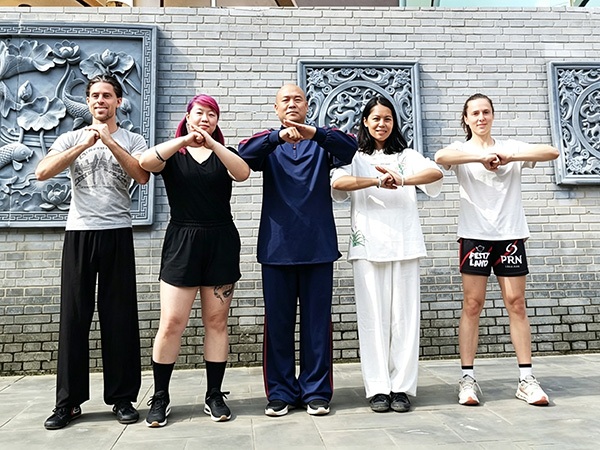
A Look Inside a Typical Training Week
To understand the commitment, it helps to visualize the daily life. Our training is immersive and structured, designed to build skill layer by layer. While schedules are adapted for individual student goals, a typical week follows a consistent rhythm that balances intense physical practice with recovery and internal cultivation.
Life here is simple and focused. As Pamela Paes Ezawa from Brazil shared after her course, she loved the authentic, traditional training environment and the training-focused accommodation. This environment is by design—it removes distractions and allows you to concentrate fully on your development.
Weekly Training Schedule Example:
Monday to Friday (Full Training Days):
Morning Session (2.5 - 3 hours): Begins with a warm-up, stretching, and stamina training. This is followed by fundamentals: stances, kicks, and punches. The remainder of the session is dedicated to form (Taolu) practice and correction.
Afternoon Session (2.5 - 3 hours): Focus shifts to application. This includes San Da sparring drills, Qin Na grappling techniques, or Chinese Weapon training. The specific content depends on your chosen curriculum.
Evening Session (1 hour, optional): A gentler session focused on internal arts. This is the time for Qi Gong, Meditation, or gentle Tai Chi to calm the mind and cultivate internal energy.
Saturday: Typically a half-day of training, followed by an afternoon of rest, personal study, or visiting one of the 30+ nearby cultural attractions.
Sunday: A full day of rest for recovery and recuperation. The body needs this time to repair and grow stronger.
All training takes place with access to our 200㎡ indoor training center, ensuring practice continues year-round, regardless of the weather. This consistent, structured approach is how real progress is made.
Common Challenges in a 90-Day Program (And How to Overcome Them)
An immersive training program is a powerful experience, but it is not without its difficulties. Being prepared for these challenges is the key to moving through them successfully.
One student, Austin Erkl from the USA, was honest about his 30-day experience: he found the initial adjustment difficult. But after pushing through that period, he had a great time, praising the master, food, and accommodation, and ultimately made "lifelong memories." His experience highlights the most common hurdle: the adjustment phase.
Anticipating and Overcoming Obstacles:
The Initial Shock (Weeks 1-2): The volume of training can be a shock to the body and mind. You will experience muscle soreness and fatigue. The key is to listen to your body, communicate with your instructors, and trust the process. This phase always passes.
The Plateau (Weeks 4-6): After a period of rapid initial progress, it's common to feel like your improvement has slowed. This is a normal part of skill acquisition. The solution is persistent, mindful practice. This is where the instructor's guidance is most valuable, as they can identify small details to refine that will lead to the next breakthrough.
Homesickness and Mental Fatigue (Varies): Living in a new culture and a focused environment can be mentally draining at times. Building a connection with fellow students is vital. The community becomes a source of support. Othmane Echaouki from France mentioned how the Shifu taking "good care of all the students" made them feel they were in the best conditions. We foster a family-like atmosphere for this very reason.
Frustration with Technique (Ongoing): You will have days where a movement just won't click. This is part of the path. The mistake is to force it. The correct approach is to relax, return to the basics, and ask for help. Frustration is a sign that you are at the edge of your current ability, which is exactly where growth happens.
Understanding these challenges beforehand transforms them from frustrating roadblocks into expected parts of the training. Hayley Noel from the UK trained with us for 120 days. Her family was naturally worried, but she loved the experience so much that she plans to return. Her success demonstrates that with the right mindset and a supportive environment, these challenges become the very experiences that build resilience and character.
If you are ready to build a true foundation in Chinese martial arts, a three-month immersion is a powerful and effective way to do so.
To begin planning your training, you can book a Three-Month Course or contact us directly to discuss how we can tailor the program to your personal goals.



 WhatsApp