One-Month Kung Fu: Test Skills You Keep After 30 Days
What should remain after one month of Kung Fu training?
The useful question is not simply whether you completed a form, learned a weapon routine, or trained hard for 30 days. The better question is this: what can your body and mind still do when a teacher is no longer correcting you in the moment?
One Month Kung Fu training can create meaningful progress, especially when the month has a clear focus. Yet retained skill is different from fresh memory. A sequence learned yesterday may look smooth because the order is still familiar. A skill retained after returning home shows itself in quieter ways: steadier stances, easier hip movement, calmer breathing under effort, better posture, and the ability to correct one’s own movement.
At SJF Kung Fu School, training is rooted in traditional Chinese martial arts practice rather than quick performance. Master Shen Jiangfei is a descendant of Liuhe Quan and the 11th-generation inheritor of Chen-style Tai Chi. His teaching places value on body structure, discipline, respect, and repeated correction. These are the foundations that remain useful after the visible excitement of a month abroad has passed.
A 30-day course is long enough to establish a baseline, train with intention, and check whether the body has absorbed practical changes. It is not long enough to claim mastery of a system. That limit matters. The purpose of testing is not to judge yourself harshly; it is to identify what you can continue practicing with honesty and care.

Comparison: uses a before-and-after skills test to distinguish temporary form memorization from retained balance, mobility, conditioning, and technique.
A form can be remembered through repetition alone. Retained martial ability requires more. It asks whether posture, weight transfer, breath, attention, and technique remain available without a coach giving each cue. For that reason, use the same short assessment at the beginning and end of your month.
| Skill area |
Beginning check |
30-day check |
What improvement may mean |
What the test cannot prove |
| Balance |
Hold a stable stance with relaxed shoulders and even breathing. |
Repeat the same stance on each side without rushing or gripping the floor. |
Better awareness of foot pressure, knee direction, and weight distribution. |
It does not prove fighting ability or long-term leg strength. |
| Mobility |
Observe how comfortably you can sink, turn the waist, and raise the arms with upright posture. |
Repeat the same motions slowly, without forcing depth. |
More usable range of motion and improved coordination between hips and spine. |
It does not replace medical assessment or justify training through pain. |
| Conditioning |
Complete a short, familiar sequence while noticing breathing and recovery. |
Repeat the same sequence at the same pace and record how quickly breathing settles. |
More efficient movement and improved ability to maintain attention while tired. |
It does not measure all aspects of fitness. |
| Technique |
Perform a basic hand, step, block, or partner drill from instruction. |
Perform it again after a pause, then explain its purpose in simple words. |
Understanding of timing, direction, distance, and body alignment. |
It does not mean the technique will work in every situation. |
| Form recall |
Learn a short section and note how many prompts are needed. |
Perform it after several days without review, then identify one correction yourself. |
Memory joined to self-observation rather than memorized order alone. |
It does not show whether the form has deep internal quality. |
Conclusion: prioritize the checks that remain stable after rest and without prompting. This fits beginners who want proof of progress, experienced martial artists comparing new training methods, and parents helping a young learner reflect on a month away. It does not apply as a competition ranking system. A person recovering from injury, illness, or unusual fatigue should simplify the checks and seek appropriate professional guidance where needed.
How to score without turning practice into an exam
Use a simple four-point record for each skill: 0 means unable to complete safely; 1 means completed with major tension or repeated prompts; 2 means completed with basic control; 3 means completed with calm breathing, clear alignment, and self-correction. Write one sentence beside each score. Numbers give comparison; the sentence explains the reason.
For example, “stance score improved from 1 to 2 because my rear heel stays grounded and my shoulders no longer rise” is more useful than saying “my Kung Fu got better.” The first note tells you what to practice next.
Test the four qualities that make technique stay with you
Traditional martial arts do not separate the mind from the body. A low stance without relaxed attention becomes strain. A graceful hand pattern without direction becomes decoration. A powerful movement without control can become careless. The following four qualities interact, and each deserves a practical check.
1. Balance begins with weight transfer
Balance is not merely standing on one leg. In Shaolin Quan, Tai Chi, and weapon work, the body must transfer weight without collapsing the knee, lifting the shoulders, or losing awareness of the feet. Test it by taking one slow step forward, pausing before the foot lands, then placing the foot quietly and settling your weight.
Use this check when: you are learning forms, basic stances, or slow methods such as Learn Tai Chi practice. Its limit: a slow stepping check does not measure the faster distance and timing required in sparring.
2. Mobility must support structure
Many students mistake deeper stances for better Kung Fu. Depth only helps when the spine remains organized, the knees follow the feet, and the hips can move without sharp discomfort. During your month, take one side-view photograph of a familiar stance at the beginning and another at the end. Use the same footwear, similar camera height, and similar stance intention. Compare posture rather than trying to force a lower position.
This method fits people who sit for long hours, have limited hip mobility, or are returning to martial arts after a long break. It does not apply when photography causes you to pose or overextend. In that case, use written observations from a teacher instead.
3. Conditioning should preserve attention
Conditioning in traditional practice is not only about doing more repetitions. The meaningful question is whether technique stays organized as effort rises. Choose one short drill: a sequence of basic stances, a repeated form section, or a controlled set of footwork. Record whether your breath becomes rushed, whether the hands lose their intended position, and whether the mind becomes scattered.
For students focused on striking and movement, San Da training provides a useful setting for observing how posture changes under faster work. For a quieter practice, standing methods offer another kind of evidence. In Zhan Zhuang, the body reveals tension that a fast form may hide.
4. Technique needs purpose, not only appearance
Choose three movements you learned during the month. For each one, write down four details: starting stance, intended direction, target or purpose, and the body part that initiates the movement. Then perform the movement slowly and see whether your written explanation matches what your body does.
This check is especially helpful for a student studying Qin Na, San Da, Shaolin Quan, or Chinese weapons. The limit is equally clear: solo practice can clarify alignment and sequence, but it cannot fully replace safe partner feedback for timing, contact, and distance.
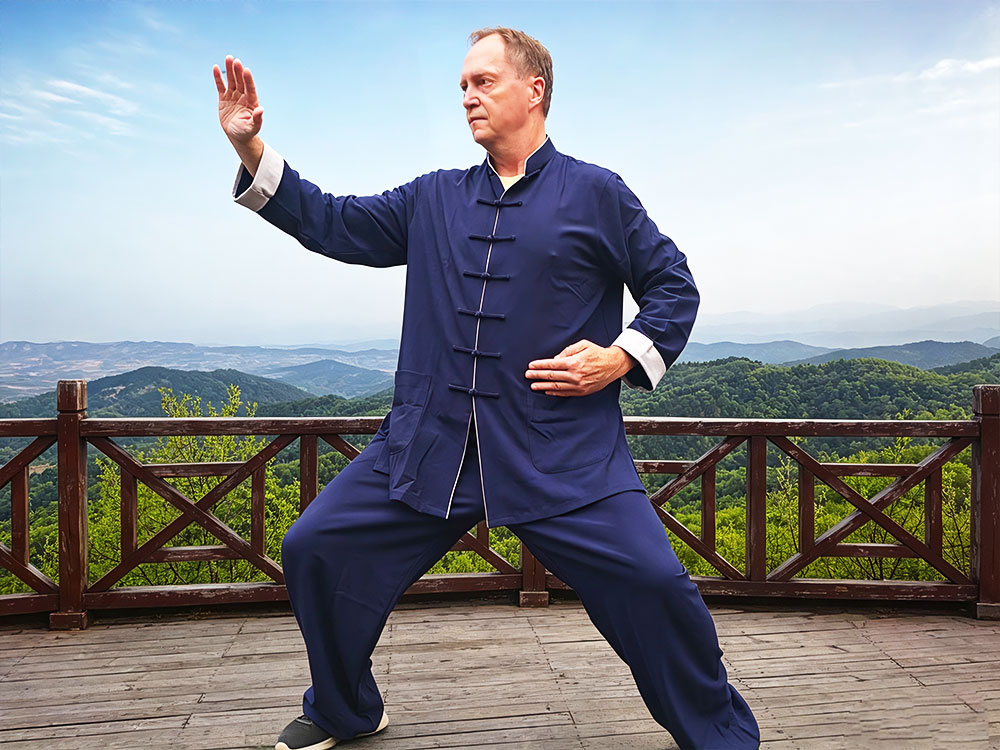
Follow a repeatable 30-day assessment procedure
A fair comparison needs similar conditions. If your first test occurs after a long flight and your final test occurs after a full rest day, the result may reflect recovery more than training. Keep the process plain and repeatable.
- Choose no more than five checks. Select one balance task, one mobility observation, one conditioning drill, one technical movement, and one form section.
- Record your starting point before intensive training. Use a notebook, short video, or both. Note the date, sleep quality, soreness, and any old injury that affects movement.
- Ask for one technical correction. Do not collect ten cues at once. Select the correction that changes the whole movement, such as relaxing the shoulders, aligning the knee, or turning from the waist.
- Practice the correction in small amounts. Revisit it during forms, standing practice, and basic stepping. Repetition with awareness is more useful than rushing through many unrelated exercises.
- Repeat the same tests near the end of the month. Use similar timing and a similar warm-up. Avoid testing immediately after an unusually hard session.
- Retest after returning home. Wait several days, then repeat the same checks without watching your training videos first. This is the clearest comparison between fresh memorization and retained ability.
- Build a continuation plan from the weakest result. If balance improved but the form disappears, give the form a short regular review. If form recall is strong but the stance feels tense, reduce speed and return to structural practice.
Conclusion: test once before training, once near the end, and once after you resume ordinary life. This procedure fits trainees evaluating whether their effort produced a practice they can carry home. It does not create a universal standard because age, previous training, health, and course focus differ.
Common mistakes that make a month look more successful than it is
- Testing only on the final training day: excitement, teacher feedback, and recent repetition can make recall appear stronger than it will be later. Retest after a short gap.
- Changing the drill between tests: a lower stance, faster pace, or longer sequence makes comparison unclear. Keep the same task before increasing difficulty.
- Measuring only flexibility: greater range has value only if control remains. Include balance and alignment in the record.
- Chasing a perfect form video: performance for the camera can hide tension. Record one natural attempt as well.
- Ignoring recovery: soreness, travel, and poor sleep affect results. Write down the conditions rather than calling every difficult day failure.
- Trying to retain every subject equally: a month may include forms, meditation, weapons, and conditioning. Choose one primary practice and one supporting practice for home training.
Martial virtue asks for sincerity. A fair record is part of that discipline. The goal is not to impress a teacher or an audience. It is to see clearly what has entered the body and what still needs patient repetition.
Use personal evidence to plan the practice that follows
A 30-day course often reveals which branch of training speaks most clearly to a student. Some people return home wanting the measured movement of Tai Chi. Others remember the stillness of standing practice, the directness of Shaolin basics, or the focus required by a weapon form. Your final assessment should guide your next step rather than force you into someone else’s plan.
Andrew Williams from the United States spent 30 days training Tai Chi, Zhan Zhuang, and Dao Fa with his son. He described the experience as life-changing physically, mentally, and spiritually, and planned to return the following year. His example is personal, not a promise for every student. Still, it shows why a month can become the beginning of a longer discipline when practice continues after the course.
For a home plan, use a modest weekly structure:
- Two short sessions: review your form section slowly, focusing on the correction noted during training.
- Two standing sessions: practice a comfortable stance, relaxed breathing, and awareness of the feet.
- One conditioning session: repeat basic stepping, stance transitions, or controlled footwork at a pace that preserves form.
- One reflection note: write what became easier, what became tense, and one question for your next instructor.
This structure suits a busy adult who wants continuity without pretending to recreate a full-time training environment. It does not replace in-person correction. If a technique becomes painful, confusing, or increasingly tense, return to simpler fundamentals and ask a qualified instructor for guidance.
SJF Kung Fu School offers flexible study from a one-week intensive course to longer programs, and its 200㎡ indoor training center supports year-round practice. For a student considering a focused return to China, the value of a month lies not only in the training hours but in leaving with a clear method for observing, correcting, and continuing.
Learn about the one month Kung Fu Course and contact SJF Kung Fu School to discuss a training focus that matches your present level and continued practice goals.



 WhatsApp