One-Week Kung Fu: What You Can Really Learn
Is a seven-day course enough to make your trip worthwhile?
Before booking a martial arts program in China, many travelers worry about the same point: will one week be too short to learn anything meaningful? The honest answer is that One Week Kung Fu can be highly worthwhile when your goal is clear. It is long enough to build a sound starting method, correct visible habits, study one focused subject, and experience the rhythm of traditional training life. It is not long enough to master a complete system, develop dependable combat skill, or memorize many forms without continued practice afterward.
At SJF Kung Fu School, short-term students train within a traditional Chinese martial arts setting rather than trying to collect many unrelated techniques. The school offers nine disciplines, including Shaolin Quan, Tai Chi, Qi Gong, Zhan Zhuang, San Da, Qin Na, Ge Dou, Chinese Weapon practice, and Meditation. This range gives each student options, but a short stay works best when the training focus remains narrow.
A first visit should answer a practical question: “What can I take home and continue correctly?” For a beginner, that may be stance alignment, basic punches, kicks, breathing awareness, and a short movement sequence. For an experienced martial artist, it may be adjusting body mechanics, posture, timing, or the details of a form already studied elsewhere.
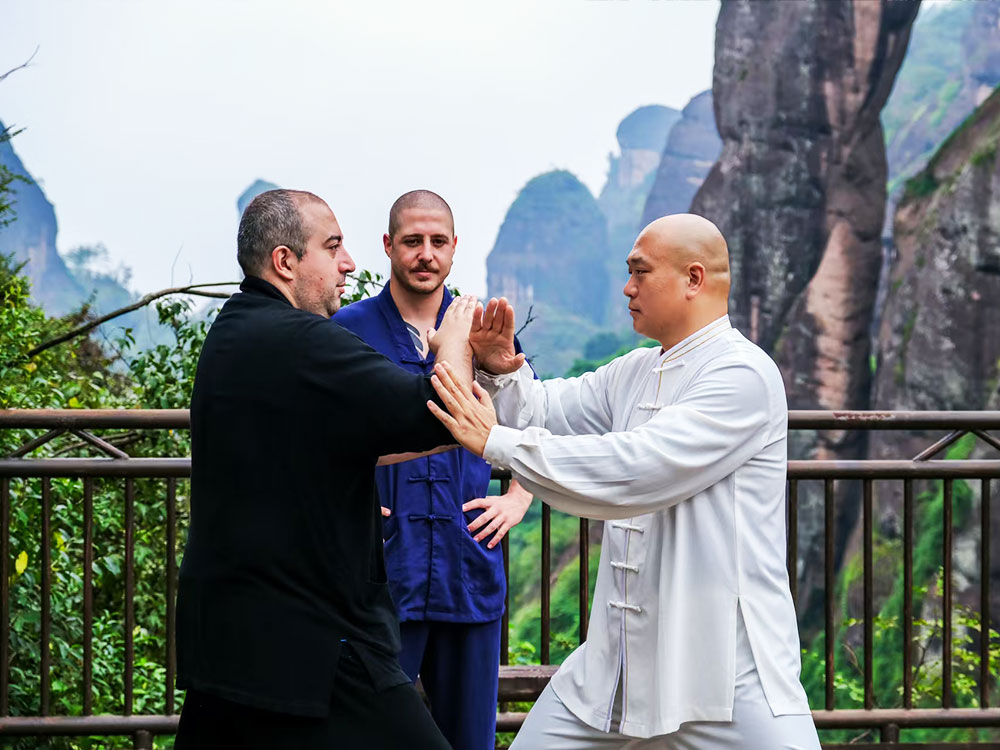
Choose the One Week Kung Fu Course if you want concentrated instruction, cultural study, and a practical foundation to continue at home. Choose a longer stay if your aim is to build endurance over time, learn a substantial form, or receive repeated correction as your body adapts.
What can a beginner realistically learn in one week?
A beginner can learn a usable foundation, not a finished martial art. This is the right expectation because Kung Fu begins with posture, balance, coordination, and attention. These qualities need repetition. A week can introduce the method and help you feel why details such as foot placement, hip position, shoulder relaxation, and breathing affect every technique.
A suitable beginner focus may include basic Shaolin Quan movements, introductory Tai Chi practice, Qi Gong breathing, Zhan Zhuang standing, or simple conditioning. A student who has never trained before should not try to cover all nine styles. Too many topics create a collection of fragments rather than something that can be practiced after returning home.
Beginner outcomes that are reasonable to expect
- Basic stance awareness: learning how to distribute weight, bend the knees safely, and keep the torso organized. This fits complete beginners, but it still requires regular home practice before it feels natural.
- Elementary striking and kicking mechanics: practicing a small number of movements with instructor correction. This helps students understand distance and body connection; it does not create reliable sparring ability in seven days.
- A short sequence of movements: remembering part of a form or set as a practice tool. The value is in repeating it with correct structure, not simply memorizing the order.
- Breathing and standing practice: using quiet, attentive repetition to improve body awareness. Students can continue this independently, although deeper internal training requires patient coaching.
- Martial ethics and training etiquette: beginning to understand Wu De, the martial values of respect, discipline, humility, and responsibility.
For someone mainly interested in slow, concentrated movement, Learn Tai Chi in China through a focused short stay rather than combining it with high-impact work. For someone seeking active external training, introductory Shaolin Quan practice may be a better fit. The limit is simple: a beginner should select one principal direction and let the instructor shape the supporting exercises around it.
Where is the realistic outcome boundary after seven days?
The boundary is between learning a method and owning a skill. In one week, students can receive direct correction, understand the purpose of selected exercises, and establish a home-practice routine. Skills that depend on reflexes, long-term flexibility, power development, and repeated partner work need more coaching.
The table below separates reasonable results from claims that a responsible school should not make. Your prior experience, physical condition, recovery, and willingness to practice after the course will affect the result.
| Training starting point |
What seven days can reasonably provide |
Best training focus |
What usually requires longer coaching |
| Complete beginner |
Stance basics, elementary coordination, a small movement set, training etiquette, and a clear practice routine. |
Shaolin basics, Tai Chi fundamentals, Qi Gong, or Zhan Zhuang. |
Stable low stances, flexible kicks, full forms, controlled sparring, and advanced weapon handling. |
| Experienced martial artist |
Refinement of posture, stepping, body connection, rhythm, and selected applications. |
A single form, Tai Chi structure, striking mechanics, or a focused weapon subject. |
Replacing long-held movement habits, mastering a new style, or gaining reliable skill under pressure. |
| Conditioning-focused traveler |
A demanding short training period that reveals current mobility, balance, stamina, and recovery capacity. |
Stances, basics, controlled drills, and standing practice. |
Lasting strength, major body composition change, or sport-specific conditioning built over many weeks. |
| Student seeking practical application |
An introduction to distance, body alignment, selected drills, and the discipline needed for safe partner practice. |
Introductory San Da, Qin Na concepts, or Ge Dou basics when suitable. |
Reliable defense under stress, partner sensitivity, sparring judgment, and high-speed application. |
This distinction matters. A short course can change how you stand, move, and practice. It cannot substitute for months of repetition. Students who arrive with this understanding often gain more because they listen closely, ask better questions, and leave with a focused plan rather than an unrealistic checklist.
Which subject should you choose for a short stay?
Choose one primary subject and one supporting practice. This combination gives the week direction while allowing the body and mind to recover. For example, Shaolin basics can be supported by standing practice; Tai Chi can be supported by Qi Gong; weapon basics can be supported by footwork and conditioning.
Match your goal to a practical training direction
| Your main goal |
Suitable short-course emphasis |
Why it fits a week |
When it may not fit |
| Learn traditional movement and cultural practice |
Tai Chi, Qi Gong, Meditation, and Zhan Zhuang |
These practices reward careful attention to alignment, breath, and calm repetition from the first session. |
Not ideal if your only aim is high-intensity combat preparation. |
| Build a martial arts foundation |
Shaolin Quan basics, stances, punches, kicks, and footwork |
Fundamental mechanics can be introduced clearly and practiced repeatedly in a short period. |
Not enough time to claim mastery of a full traditional system. |
| Explore practical partner skills |
Introductory San Da training, controlled drills, and movement distance |
Students can study core ideas under supervision and understand how structure affects contact. |
Not suitable for expecting advanced sparring ability after one week. |
| Study a traditional weapon |
Basic weapon handling, grip, footwork, and selected movements |
A focused introduction can develop coordination and respect for the weapon. |
Requires a longer course to build speed, precision, and a complete set. |
Master Shen Jiangfei’s background supports this focused approach. He is a descendant of Liuhe Quan and the 11th-generation inheritor of Chen-style Tai Chi, the oldest of the five primary Tai Chi family styles. His instruction connects external movement with internal principles: stable rooting, coordinated waist movement, relaxed shoulders, clear intent, and disciplined repetition.
For students drawn to stillness and posture, Zhan Zhuang can be especially valuable. Standing practice may look simple, but it asks for patience. A week can teach safe alignment and the purpose of the exercise; it cannot replace the gradual body change that comes from continued daily practice.
What training experience should you expect at SJF Kung Fu School?
Expect a focused training environment with room for individual adjustment, not a hurried sightseeing schedule. The school has a 200㎡ indoor training center, allowing year-round practice regardless of weather. Indoor mats, wooden dummies, traditional weapons, and a meditation hall support different aspects of study.
Training near the Shaolin Temple also places martial arts in a wider cultural setting. More than 30 cultural and historical attractions are nearby. A short stay can therefore include reflection on the relationship between martial practice, Buddhist thought, Chinese history, and daily discipline. Still, cultural visits should support your training purpose rather than replace it. If your priority is physical improvement, protect your rest time and do not fill every free hour with travel.
The school has trained more than 3,000 students worldwide. Individual experiences show why expectations matter. Andrew Williams from the United States trained Tai Chi, Zhan Zhuang, and Dao Fa with his son for 30 days. He described the experience as life-changing physically, mentally, and spiritually, and planned to return. His example supports the value of sustained practice, but it should not be treated as a guaranteed result for every student.
For a shorter example, Pamela Paes Ezawa from Brazil completed a seven-day Chen-style Tai Chi course. She appreciated the traditional training setting, the training-centered accommodation, and the welcoming school community. Her experience shows what a week can offer: concentrated instruction, close contact with Chinese martial culture, and a clear starting point for future practice.

How should you prepare so the week produces lasting value?
Arrive with one training question, realistic physical expectations, and a plan for the first month after you return. Preparation does not need to be complicated. It should make your time with the instructor more useful.
- State your main aim before arrival. Write one sentence, such as “I want correct Tai Chi basics” or “I want to improve my stance and footwork.” This helps avoid an unfocused mix of subjects.
- Share your prior experience honestly. Mention previous martial arts, injuries, mobility limits, and current exercise habits. Training can then be adjusted to your present condition rather than an assumed level.
- Bring simple notes. Record key corrections after class: foot angle, hand position, breathing cue, or sequence order. Notes are useful because memory fades quickly after travel.
- Ask for a small home-practice plan. A plan built around a few exercises is more realistic than trying to recreate an entire training day alone.
- Practice after returning home. Repeat the core work several times each week. If an exercise causes pain rather than normal training fatigue, stop and seek qualified advice.
- Choose a longer program only when your goal needs it. If you want a deeper form study, more body conditioning, or ongoing correction, consider a one month Kung Fu Course rather than expecting seven days to carry the full workload.
When should you book one week, and when should you stay longer?
Book one week when you need a clear introduction, a focused correction period, or a meaningful cultural training experience within limited travel time. It suits beginners who want to test their commitment and experienced practitioners who can arrive with a defined technical question.
A longer stay is the better choice when you want measurable progression through repeated instruction. Consider more time if you hope to learn a longer traditional form, develop a weapon set, improve kicking mobility, work on partner drills, or establish stronger conditioning. These aims depend on gradual adaptation. They are not signs of failure in a short course; they are simply the nature of martial arts.
Martial study rewards sincerity more than speed. A week spent paying attention to one stance, one breath pattern, or one short sequence can begin a practice that stays with you for years. The result depends less on how many techniques you collect and more on whether you continue to train with care after leaving China.
If you would like help selecting the right focus, view the One Week Kung Fu Course and send SJF Kung Fu School your training background and goal for respectful course advice.



 WhatsApp