Plan a Six-Month Kung Fu Course Around Your Goal
Matching Your Six-Month Commitment to Your Personal Goals
Committing to six months of Kung Fu training in China is a significant decision. The success of this time hinges not just on your dedication, but on the structure of the program you choose. A generic, one-size-fits-all curriculum may teach you forms, but it might not align with your core reason for being here. Are you seeking physical and mental well-being, a deep dive into traditional forms and culture, practical self-defense skills, or the foundation to one day teach others? A properly designed Six Month Course should be a direct answer to that question.
At SJF Kung Fu School, we have guided over 3,000 students from around the world through this process. We understand that each student arrives with a unique objective. The key is to map that objective to a focused training pathway from day one. This ensures your 24 weeks are spent building skills that matter most to you, transforming your time from a simple stay into a period of purposeful growth. This approach applies whether you are a complete beginner or an experienced martial artist looking to deepen your practice in styles like Shaolin Quan.
Tailoring Your Training: Four Proven Pathways
Your personal goals should dictate the focus of your training. While every student builds a strong foundation in stances, flexibility, and conditioning, your specialization determines your daily practice. We structure our long-term programs around four primary pathways. Identify which path best describes your motivation to create a clear blueprint for your studies.
Here is how we adapt the curriculum based on your primary objective:
Pathway 1: Health, Fitness, and Well-being
Objective: To improve physical health, reduce stress, and cultivate internal energy and balance. This path is less about combat and more about self-cultivation.
Core Disciplines: Tai Chi (specifically Chen-style), Qi Gong, Zhan Zhuang (standing post meditation), and foundational flexibility and conditioning.
What to Expect: Your training will emphasize slow, controlled movements, deep breathing techniques, and the mind-body connection. You will spend significant time learning to feel and guide your "Qi" (life energy).
Not Suitable If: Your primary goal is to learn high-intensity fighting applications or advanced acrobatics. While Tai Chi has martial roots, this pathway prioritizes its health aspects.
Pathway 2: Traditional Forms and Cultural Immersion
Objective: To learn the classical forms, movements, and philosophies of Chinese martial arts. This is for students fascinated by the history, art, and discipline of Kung Fu.
Core Disciplines: Shaolin Quan, traditional Chinese weapons (Staff, Broadsword, Straight Sword), and cultural and philosophical studies.
What to Expect: A rigorous focus on precision, posture, and sequence memorization. You will learn the stories and applications behind each form, connecting your physical practice to a rich historical lineage.
Not Suitable If: You are only interested in modern combat sports or have no interest in the historical or philosophical context of the movements.
Pathway 3: Practical Fighting and Self-Defense
Objective: To develop effective and practical skills for sparring and self-defense. This path is for those who want to understand and apply the martial side of Kung Fu.
Core Disciplines: San Da (Chinese Kickboxing), Qin Na (joint locks and grappling), and Ge Dou (full-contact fighting).
What to Expect: A high-energy training environment with a focus on partner drills, sparring, application of techniques, and intense physical conditioning.
Not Suitable If: You wish to avoid contact sparring or are primarily interested in the meditative and health-focused aspects of martial arts.
Pathway 4: Foundational Instructor Preparation
Objective: To build a comprehensive and deep understanding of multiple facets of Kung Fu with the long-term goal of teaching.
Core Disciplines: A balanced curriculum of all the above, with an added focus on teaching methodology, the principles of body mechanics, and a deeper study of both internal and external styles.
What to Expect: The most demanding path, requiring proficiency in forms, applications, and theory. You may be asked to assist junior students to develop your teaching skills.
Not Suitable If: You are not ready for a highly disciplined, multi-faceted training regimen or if your interest is limited to only one specific area of Kung Fu.
What a Six-Month Training Arc Looks Like
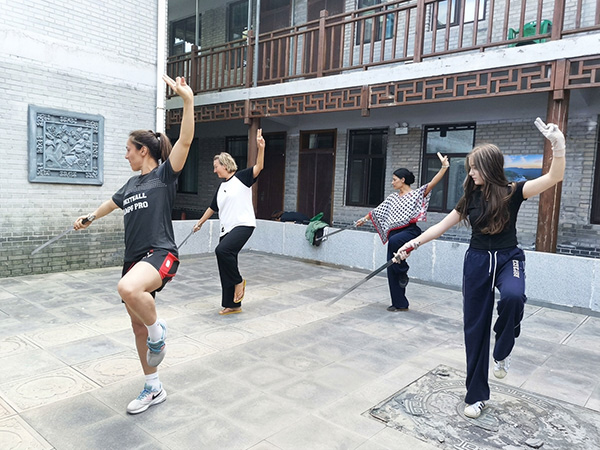
A half-year of training allows for true skill development beyond surface-level knowledge. While your specific pathway will shape your focus, the progression generally follows a three-stage arc. This structured approach ensures you build a solid base before moving to more complex skills, allowing for sustainable progress.
Months 1-2: Building the Foundation
The first two months are dedicated to fundamentals, regardless of your ultimate goal. This is the most critical phase for long-term success. You will focus on:
Ji Ben Gong (Basic Skills): Daily drills to develop stances, kicks, punches, and flexibility.
Stamina and Conditioning: Running, bodyweight exercises, and strength training to prepare your body for the demands of Kung Fu.
Core Principles: Learning the basic theory of body mechanics, breathing, and power generation.
This phase can be challenging. As Austin Erkl from the USA, who completed a 30-day course, noted, it takes time to adjust. But this foundational work is what makes advanced techniques possible later on.
Months 3-4: Specialization and Deepening
With a solid foundation, you will now dedicate the majority of your time to your chosen pathway. If you are on the Traditional Forms path, you will learn more complex Shaolin Quan sequences or begin a new weapon. If your focus is practical combat, you will engage in more intensive sparring and application drills. For those on the Health and Well-being path, this is where you explore the deeper subtleties of Tai Chi and Qi Gong. Training takes place in our 200㎡ indoor training center, ensuring your progress is never halted by weather.
Months 5-6: Integration and Refinement
The final stage is about integrating everything you have learned. You will refine your techniques, increase their speed and power, and develop a more intuitive understanding of the art. For forms practitioners, this means moving with greater fluidity and intent. For fighters, it means reacting instinctively in sparring. For internal arts students, it means achieving a deeper state of calm and connection.
By the end of the Six Month Course, you will not just "know" a set of movements; you will have embodied them. This is the transformation Hayley Noel from the UK experienced during her 120-day course. Her family saw the positive change, writing to Master Shen, "She has had an awesome time, and we are so grateful to you."
Beyond the Training Hall: Cultural and Personal Growth
Training at our school is more than just a physical pursuit. Located near the historic Shaolin Temple and over 30 other places of interest, it is an immersion in the culture that gave birth to these arts. This environment provides a unique context for your learning, connecting your daily practice to centuries of history and philosophy.
Many students find the experience profoundly affects them on a personal level. Andrew Williams from the USA described his 30-day training with his son as a "life-changing experience that strengthened him physically, mentally, and spiritually." Similarly, Klaes Risbjerg Simonsen from Denmark chose our school for a focused experience, noting he "grew a lot both physically and spiritually" and praised Master Shen for adapting the training to his specific needs. This is possible because our head instructor, Master Shen Jiangfei, is not just a teacher but a true lineage holder—a descendant of Liuhe Quan and the 11th-generation inheritor of Chen-style Tai Chi.
Checklist: Preparing for Your Half-Year Immersion
Proper preparation is key to making the most of your six-month stay. A lack of planning can create unnecessary stress, distracting you from your training. Use this checklist to ensure you arrive ready to learn.
| Category | Action Item | Notes |
|---|
| Documentation | Apply for Chinese Visa (X1 or X2) | Start the process at least 2-3 months in advance. We provide the necessary invitation letters upon enrollment. |
| Physical Fitness | Begin a basic conditioning program | Focus on cardiovascular health (running, cycling) and basic flexibility (stretching). Arriving with a base level of fitness will ease your transition. |
| Packing | Pack appropriate training clothes and personal items | Bring loose-fitting, comfortable clothing. Pack for varying seasons. While we provide accommodation, bring personal toiletries and any specific medications. |
| Mental Preparation | Set realistic goals and expectations | Mastery takes a lifetime. Aim for consistent progress, not perfection. Be open to a new culture, a disciplined schedule, and a different way of life. |
| Communication | Inform your bank of your travel plans | Ensure your bank/credit cards will work in China to avoid financial issues. |
| Health | Consult your doctor and purchase travel insurance | Ensure you are physically ready for intensive training and have comprehensive medical coverage for your entire stay. |
Taking these steps will allow you to arrive focused and ready to immerse yourself fully in your training from the very first day, just as Pamela Paes Ezawa from Brazil did. She praised the "welcoming Shifu and community" and the training-focused environment that allowed her to make the most of her time.
A Six Month Course is an opportunity for deep, lasting change. By aligning your program with your personal goals, you ensure that every day of your training is a step toward the transformation you seek.
To discuss how we can tailor a six-month program to your martial arts aspirations, please contact us for a personal consultation.



 WhatsApp