Six Month Course in Kung Fu: Is It Worth It?
Who a Six-Month Stay Really Serves
Six months is long enough to change how you stand, and short enough to fit inside a leave of absence or a gap period. That tension is the whole question. A one month Kung Fu Course lets you taste the daily rhythm. A Three-Month Course gives the forms time to settle. A year or more asks you to rearrange your life around practice. So where does half a year sit?
Our working rule is simple. Choose a Six Month Course if you want two or three subjects to move from "remembered" to "habitual", for example a Tai Chi form, daily standing practice and one weapon, and you can train every day without long interruptions. If you only want to find out whether Kung Fu suits you, six months is more than you need. If your goal is to carry a lineage or teach, six months is a solid foundation, not the finish line.
What Half a Year Means in Traditional Training
In the old teaching houses, nobody measured progress in calendar months. A teacher watched the body. Did the stance hold without trembling? Did the waist lead the arms, or did the shoulders do the work? Was the student's temper steadier when a correction came for the fifth time that morning?
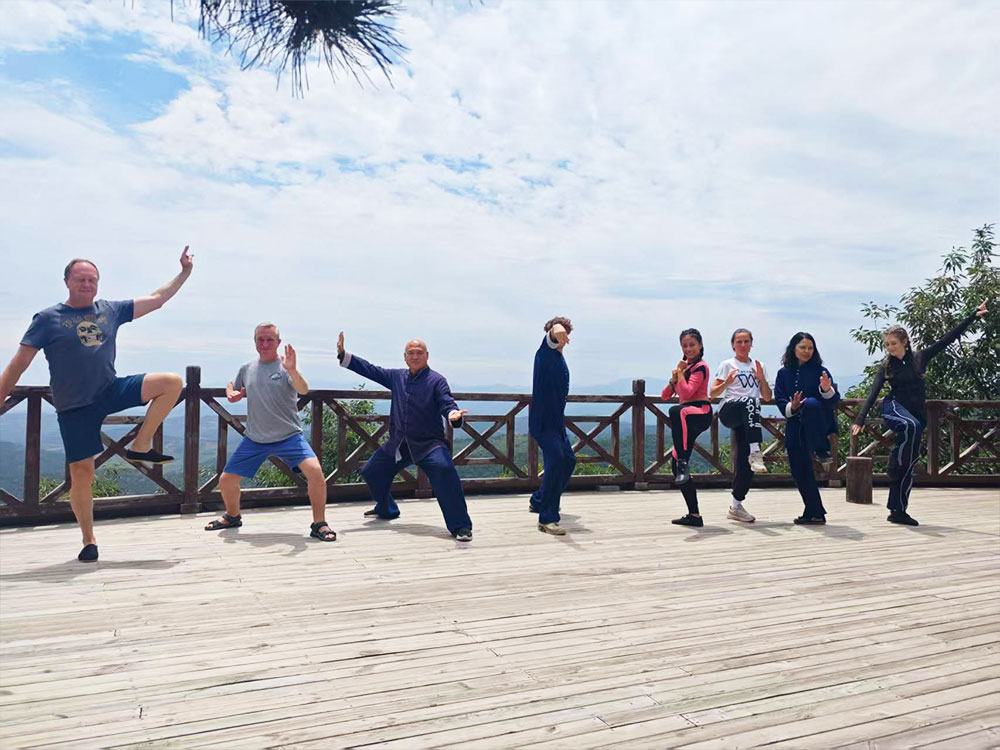
Master Shen Jiangfei, a descendant of Liuhe Quan and the 11th-generation inheritor of Chen-style Tai Chi, teaches in that spirit. The early weeks go to structure: how the feet root, how the hips fold, how the spine stays upright while the legs bear the load. Zhan Zhuang, or standing like a post, is the plainest example. It looks like nothing from the outside. Inside, you learn to let the shoulders drop, to let the breath sink and to stay with discomfort without hurrying away from it.
Wu De, the martial virtues of humility, respect, trust and restraint, grows in the same slow way. A student cannot memorize it. It shows in how they greet a teacher, wait their turn and accept correction. Six months gives that habit room to take root. A single week rarely does.
Training also happens in a particular place. Pamela Paes Ezawa from Brazil, who finished a 7-day Chen-style Tai Chi course, remembered the traditional training environment, the Taoist heartland setting and the welcoming Shifu and community. Over six months, that atmosphere becomes your normal daily life rather than a visit. At SJF Kung Fu School in Shanxi, the 200㎡ indoor training center also keeps practice going through cold mornings and rainy weeks, so the schedule does not stall with the weather.
Realistic Skill Outcomes: Six Months Versus Shorter and Year-Long Stays
This is the comparison most students ask for and few schools answer plainly. The table describes what a diligent adult can reasonably expect, assuming daily training and no major injury. Prior experience and personal discipline move these numbers a lot, so read them as patterns, not guarantees.
| Length of stay | What usually takes shape | What it does not give you | Best fit |
|---|
| One week | The daily rhythm, basic stances, the opening movements of a form, first contact with the teacher and the place | Lasting physical change or a form you can practice alone | First-time visitors, travelers with limited time |
| One month | A form learned in outline, stances that hold longer, a clear sense of whether you want to continue | Reliable memory of the details; corrections are still constant | Beginners testing commitment, summer or holiday windows |
| Three months | A full form with recognizable shape, legs and hips that accept daily load, early feeling for internal versus external force | Stable habits once you leave; a second subject at working depth | Learners who want one subject learned properly |
| Six months | A core form performed with consistent structure, a second subject (a weapon, application work or Qi Gong) at working level, a standing practice you can keep at home | Mastery, teaching readiness, fluent partner or combat skill | Serious beginners and returning practitioners who want a durable base |
| Twelve months or more | Repeated passes through forms with finer detail, several weapons, applications, deeper study of lineage and Wu De as lived practice | A finished art; it simply deepens the base | Future teachers, those building a long relationship with a lineage |
The pattern behind the table is worth reading closely. The jump from one month to three is about shape. The jump from three to six is about reliability: the form stays correct on a tired day, and you can find your own mistakes without a teacher pointing at them. The jump to a year is about refinement, small corrections in the waist, the timing of breath and intent that only appear once the large movements are no longer a worry.
Limits matter here. If you arrive with years of other martial arts, you may reach the "six-month" column sooner, though softening old habits can slow you down at first. If you train only part-time or skip days, the table slides toward the left.
What Past Students Tell Us About the First Months
The students below stayed between 7 and 120 days. We offer them as honest evidence of how the early months feel, not as proof of a six-month result.
- Hayley Noel (UK), 120 days. She trained Tai Chi, Zhan Zhuang, Sword and Broadsword. Her family wrote to Master Shen that they had been worried when she flew to China, but that she loved it and had an awesome time. She plans to return. Four months was enough to touch four subjects, which suggests six could take two of them deeper.
- Klaes Risbjerg Simonsen (Denmark), 30 days. He chose the school because he wanted a focused experience, not a touristy resort. He grew physically and spiritually and noted that the Shifu adapted the training to his needs. That kind of tailoring matters more as the stay grows longer.
- Austin Erkl (USA), 30 days. He admitted he did not love it at first, then settled in and had a great time. Early resistance is normal. A six-month stay should leave room for that adjustment instead of treating it as failure.
- Andrew Williams (USA), 30 days with his son. He trained Tai Chi, Zhan Zhuang and Dao Fa and called it life-changing, strengthening him physically, mentally and spiritually. He plans to return next year, which shows how a shorter stay can lead to a longer one.
Choosing by Situation: When Six Months Fits and When It Doesn't
Choose six months when
- You want a Tai Chi or Shaolin Kung Fu foundation that you can keep practicing alone after you leave.
- You wish to combine a main subject with a second one, such as traditional Chinese weapons or Qi Gong, without rushing either.
- You can take unbroken time, and you value routine over sightseeing.
Choose a shorter stay when
- You have never trained and are unsure of your interest. Start with a One Week Kung Fu Course or the one-month option, then decide.
- Work, family or health limits you to a few weeks. A well-used month beats a half-attended six.
- You expect fast results. Six months rewards patience, not urgency.
Choose a year or more when
- You hope to teach, or to receive the finer details of a lineage.
- You already have a stable base and want repeated refinement. The Long Term Kung Fu Course exists for this.
Common Mistakes When Planning a Six-Month Stay
- Expecting to cover every style. Six months favors depth. Pick one primary subject and one secondary, not six.
- Skipping the rest. Tendons and joints adapt slowly. Plan recovery days and treat sleep as part of training.
- Judging by week two. The first weeks bring soreness and doubt. Austin's honest account is a reminder that enjoyment often arrives later.
- Treating it as a vacation. Quiet mornings and repeated corrections are the point. Sightseeing fits the weekends.
- Leaving without a home plan. Ask your teacher for a daily routine of standing, form and breathing practice before you fly back, or the gains fade.
A Checklist Before You Commit
- Can I train daily for six months without a long break?
- Do I have one main goal, such as a Chen-style form, Zhan Zhuang practice or weapons, that I can name in a sentence?
- Have I trained before, even briefly? If not, would a one-month trial lower the risk?
- Do I accept that correction is the main method of teaching?
- Have I checked my own visa length, travel insurance and health with the proper local authorities?
- Have I asked the school how the teaching would adapt to my age, injuries and experience?
Two things still need confirming with the school directly: your exact start date and which subjects can realistically fit alongside each other in your schedule. Those depend on your level and are best settled in conversation, not guessed from a page.
If this describes what you are seeking, we would be glad to hear from you. Contact SJF Kung Fu School with your goals, your experience and your possible dates, and Master Shen's team will suggest whether a one-month trial, a longer stay or a Six Month Course suits you best.



 WhatsApp