Tai Chi Basics: Fix Wobbly Knees in First Forms
Why Your Knees Shake in the First Forms
You have learned the opening movements of Tai Chi, the shapes look right in the mirror, and then your knees tremble, drift inward, or feel loose halfway through a step. It is unsettling, and it often makes a new student doubt whether the art is meant for them. It usually is. The wobble is information, and it can be read.
Most pages on how to learn Tai Chi beginners' routines list benefits and movement names, then move on. They rarely explain why a knee that behaved on the stairs this morning behaves badly in a simple Brush Knee step. Here we separate what you can see from what you can only guess, and give you an order in which to check things.
A first rule of diagnosis: an observation is not a cause. "My right knee shakes when I sink" is an observation. "My stance is too narrow" is a suspicion until a check supports it. Several causes can sit together, and a video of yourself cannot settle every one.
Stop conditions come first
Fatigue shake is a fine, even tremor in the thighs after you have held a posture for a while. It fades when you stand up. Joint trouble feels different. Stop practicing and seek a medical assessment if you notice any of the following:
Sharp or stabbing pain inside or around the kneecap
Swelling or warmth that appears after practice
A catching, locking, or "giving way" sensation
Pain that is still present the next morning and is not easing
No stance correction should be pushed through any of these. Tai Chi asks the body to soften, not to endure.
Four Quick Checks Before You Change Anything
In Chen-style Tai Chi, the lineage Master Shen Jiangfei carries as its 11th-generation inheritor, the knee is understood as a hinge, not a steering wheel. The hips turn, the foot roots, and the knee follows without being forced. With that in mind, run these checks in this order. They need no equipment, only honest attention.
Locate the sensation. Is it a muscle tremor in the thigh, a loose feeling inside the joint, or pain? Muscle tremor points toward fatigue or strength. Joint looseness or pain points toward alignment, and may warrant a professional opinion.
Check the ground and your feet. A slippery floor, thick-soled shoes, or socks on a polished surface can make the knees stabilize unnecessarily. Flat, thin-soled shoes or bare feet on a non-slip mat remove this variable.
Film yourself from the front and the side. Use the same distance and angle each time. Look at whether the knee stays above the foot, or collapses inward or outward.
Recall what changed recently. A longer practice session, a deeper stance, a new form, or a heavy week of running can all change how the knees respond.
Symptom-to-Cause Chart for Knee Wobble
Work through the rows from top to bottom. The order follows how easy each factor is to see and how quickly it can be changed. Stance width comes first because it costs nothing to test. Depth comes last because lowering or raising the stance changes everything else.
| What you observe | Possible cause | How to check | First adjustment | Stop or escalate if |
|---|
| Knees tremble or sway side to side while holding a posture | Stance width too narrow, so the base is unstable. Or too wide, so the thighs strain to hold you. | From the front, see whether your feet are far narrower than your shoulders. Then see whether the thighs burn within seconds. | Widen or narrow by a small amount, then repeat the same posture. In forward stances, leave a clear gap between the feet's lines so you are not on a tightrope. | Pain appears even in a comfortable width. |
| Knee feels "pushed back" or snaps straight as you stand or step | Locked joints, meaning the knee is held fully straight and the joint takes the load that the muscles should share. | From the side, look for a backward-bent line at the knee. Notice if you feel a small click or pressure behind the joint. | Keep a slight softness in the knee at every moment, including when standing tall. | A catching, clicking, or sharp sensation repeats. |
| Knee wobbles or twists in the middle of a step | Rushed transfer of weight. The new leg is not yet loaded when the old leg lets go. | Slow the movement down by half. If the wobble disappears, speed was the cause. If it remains, look at the foot position. | Finish the shift fully before turning or stepping. The weight arrives first and the movement follows it. | The knee gives way even at very slow speed. |
| Knee shakes more the lower you sink, and the knee collapses inward | Excessive depth for current leg strength and hip flexibility. | Rise by a small amount and check whether the tremor eases and the knee lines up with the second toe. | Practice at a higher stance. Deepen only when the knee stays aligned for the full length of the form. | Pain in the kneecap or joint line at any depth. |
These are possible causes, not verdicts. If two rows both seem to fit, change one thing at a time. If you adjust width, depth, and speed in the same session, you will not know which one helped.
From Cause to Correction, and How to Tell It Worked
A correction is only useful if you can verify it. Use this simple procedure.
Pick the one form that wobbles most, and film it as before.
Choose the single most likely cause from the chart.
Change only that factor, for example a slower weight shift or a slightly higher stance.
Repeat the same form from the same camera angle.
Compare. The knee should stay over the foot, the tremor should begin later or feel smaller, and you should feel no pain that evening or the next morning.
If nothing improved, return to the chart and test the next cause. If one change helped, keep it for a few sessions before changing anything else.
Leg endurance matters too. Static standing practice such as Zhan Zhuang teaches the legs to hold position with soft knees and a relaxed upper body. Used at a comfortable height, it gives you a quiet place to observe your own alignment, free from the complexity of a moving form.
Common Mistakes That Keep the Wobble Alive
Copying a teacher's depth. A trained practitioner's low stance reflects years of conditioning. Your depth should match your current legs.
Forcing the knees outward. Pushing them out by muscle effort creates new strain. Let the hip rotate and the knee follows.
Gripping with the thighs. Tension makes the tremor worse. If the leg feels like a clenched fist, you are too low or too tired.
Practicing through pain. Discipline in the martial arts is not the same as ignoring a warning.
Skipping the warm-up. Gentle ankle, hip, and knee circles before a form prepare the joints for the first low step.
What We Have Seen at the School
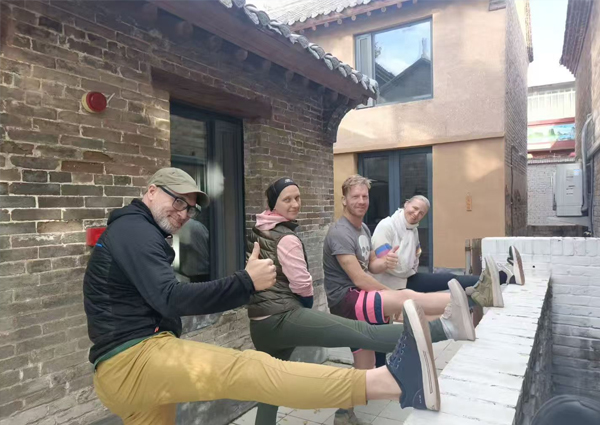
At SJF Kung Fu School, nobody is expected to match the depth or speed of a senior student on day one. Klaes Risbjerg Simonsen from Denmark completed 30 days of Tai Chi, Zhan Zhuang, and Broadsword training. He praised Shifu for being highly qualified and for adapting the training to his specific needs. We cite his experience for the principle behind this chart. Instruction fitted to the individual body matters more than a fixed target.
Pamela Paes Ezawa from Brazil completed a 7-day Chen-style Tai Chi course and valued the traditional training environment and the welcoming Shifu and community. Austin Erkl from the USA admitted that he did not love the training at first, but after adjusting he had a great time. He wrote of the master: "The master is a great guy that cares for his students." These accounts do not describe knee problems, and we do not claim they do. They show how a beginner can settle in when teaching is patient and attentive. The 200㎡ indoor training hall also means practice does not depend on weather or a slippery courtyard.
When to Seek Further Help
Self-checks have limits. A video cannot see inside a joint, and neither can a teacher. Seek medical advice before continuing if any stop condition from the first section appears, or if the wobble stays unchanged after you have tested each cause in the chart.
When you ask a teacher or a physician for help, bring specifics:
Which knee, and where exactly the sensation is
Which form or posture triggers it
Short front and side videos taken at the same distance
What you changed, and what happened after each change
Any previous knee injury, and what recent training load you had
Prevention is quiet and ordinary. Warm up the joints, keep the stance at a height you can hold without strain, finish each weight shift before moving, and rest when the legs are tired. In the old teaching, the root is the foot, the waist is the commander, and the knee is simply the faithful messenger between them.
Bring Your Questions to Master Shen's School
If a knee that wobbles has made you hesitate, we would be glad to hear from you. Send a short video through the enquiry options at SJF Kung Fu School and tell us what you see. Master Shen Jiangfei and his instructors, who have trained over 3,000 students, will tell you honestly what they notice.
For those who want to practice with a teacher at your side, a One Week Kung Fu Course is a gentle first step, and the one month Kung Fu Course allows more time for the body to settle into the forms. Seekers of the quieter side of the art may also want to read about Qi Gong. You are welcome here at whatever level you begin.



 WhatsApp