Taiji Explains Change Through Yin and Yang
What does Taiji mean before it becomes a slow martial arts form, a meditation practice, or a symbol printed on clothing? For beginners, this question matters because the philosophical meaning is broader than the movements commonly called Tai Chi. Taiji describes the source of polarity, change, balance, and transformation in traditional Chinese thought.
At SJF Kung Fu School, students meet this idea through training rather than through abstract theory alone. A stance teaches stability and release. A form teaches how softness may contain strength. Quiet breathing teaches that effort does not always mean tension. These are practical doors into an old philosophical language.

The term is often translated as “the Supreme Ultimate,” but this English phrase can sound distant or fixed. In Chinese philosophy, Taiji is better understood as the great source of movement and distinction: the point at which undivided potential gives rise to Yin and Yang. Yin and Yang are not enemies. They are related qualities that define one another: quiet and active, yielding and firm, inward and outward, dark and light.
For a student considering Learn Tai Chi, this distinction prevents a common misunderstanding. The art is not simply slow exercise. It is a method for studying balance, timing, structure, attention, and the relationship between stillness and action.
Taiji describes the origin of Yin and Yang
The clearest philosophical explanation begins with change. Classical Chinese thought often describes a sequence from undivided unity to differentiated life. Before opposite qualities appear, there is an original wholeness. From this wholeness arise Yin and Yang. Their interaction produces the changing patterns found in nature, human life, health practices, and martial movement.
Yin and Yang should not be treated as fixed labels. A relaxed arm can become active when it issues force. A rooted leg appears still, yet it supports motion above. Breathing in receives; breathing out expresses. Each condition contains the possibility of its opposite.
For a beginner, the useful conclusion is simple: Chinese philosophy does not ask you to choose softness instead of strength or stillness instead of movement. It asks you to recognize when each quality is appropriate. This applies when you are learning a form, sitting in meditation, or responding to a training partner.
Yin qualities include receiving, listening, storing, yielding, resting, and inward attention.
Yang qualities include expressing, extending, issuing, advancing, warming, and outward action.
Balance does not mean equal amounts at every moment. It means using the suitable quality at the suitable time.
Transformation means that one condition can become another when circumstances change.
This principle fits beginners who tend to force every movement. If the shoulders rise, the jaw tightens, and the breath becomes shallow, greater effort may produce less coordination. The limit is equally clear: softness is not collapse. A relaxed posture without alignment cannot transmit power or protect the joints.
The boundary between Taiji philosophy and Tai Chi practice
Taiji as a cosmological principle and Tai Chi as a martial art practice are connected, but they are not interchangeable. The first is a philosophical idea about how unity produces complementary forces. The second is a system of trained movement, body mechanics, partner sensitivity, martial application, breathing, and mental discipline.
Confusing these meanings can lead to vague training. A student may admire Yin and Yang as a symbol but never learn how to shift weight, align the spine, relax the hips, or listen to pressure from a partner. The reverse problem also occurs: someone may memorize a sequence of movements while missing the principle that gives the sequence its internal logic.
| Key parameter | Taiji as philosophy | Tai Chi as practice | What it affects in training | What happens when misunderstood |
|---|
| Primary purpose | Explains the relationship of unity, Yin, Yang, and change. | Trains the body and mind through martial forms and methods. | Helps students connect ideas to repeatable physical work. | Practice becomes either abstract discussion or empty choreography. |
| Stillness and movement | Stillness contains the possibility of movement, and movement returns toward stillness. | A stable stance supports stepping, turning, issuing, and recovery. | Improves timing and prevents unnecessary muscular effort. | Students freeze in positions or rush through transitions. |
| Yin and Yang | Complementary qualities that transform into one another. | Receiving and issuing, empty and full legs, soft contact and directed force. | Guides weight shifting and partner sensitivity. | Weight remains split without purpose, making movement slow and unstable. |
| Mind intention | Attention observes change without clinging to a fixed condition. | Attention directs posture, breathing, and response during movement. | Reduces distraction and makes corrections easier to feel. | The student copies shapes but cannot recognize internal tension or imbalance. |
| Martial meaning | Does not prescribe a fighting method by itself. | Uses trained structure, footwork, distance, and controlled application. | Shows why relaxation must be paired with rooting and clear intent. | A learner assumes slow movements automatically create usable skill. |
The practical conclusion is that philosophy should guide practice, not replace it. This is especially suitable for adults who want cultural understanding alongside movement training. It does not mean that every student must study classical texts before beginning. A beginner can first learn posture and breath, then return to the ideas with direct experience.
How Yin and Yang appear in body mechanics
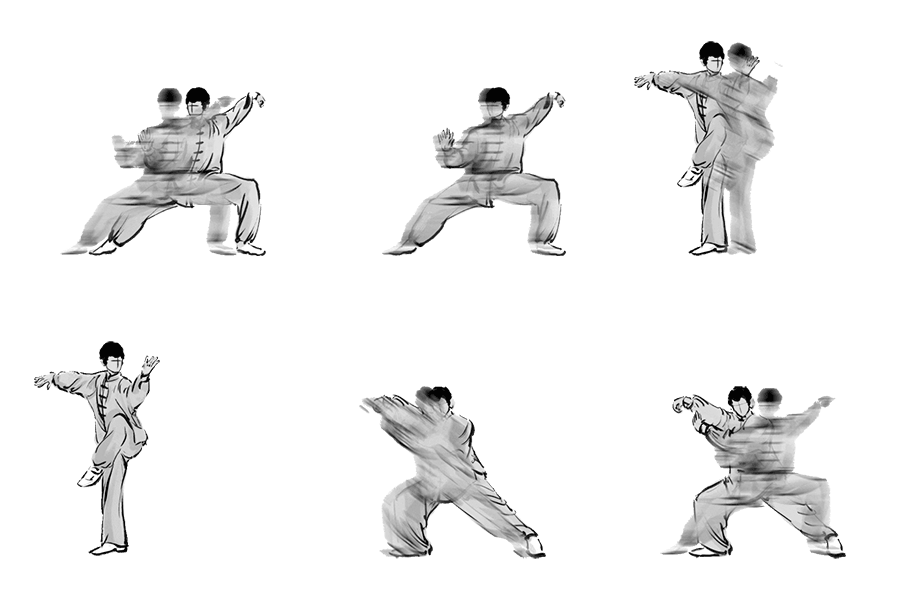
Traditional martial arts make philosophy visible through the body. In Chen style Tai Chi, a student may learn that one leg becomes more full while the other becomes more empty. This does not mean the empty leg has no function. It remains ready to step, turn, stabilize, or kick. The full leg bears more weight; the empty leg preserves possibility.
The same pattern appears in the upper body. One hand may extend while the other gathers. The chest remains open without being pushed outward. The shoulders settle without becoming limp. The waist turns, while the head stays calmly lifted. These paired actions let force travel through connected structure rather than isolated arm strength.

A useful training procedure is to begin with simple observations rather than trying to feel unusual sensations:
Stand naturally. Place the feet comfortably apart and allow the knees to soften without collapsing inward.
Feel both feet. Notice whether one foot carries more pressure. Do not force equal weight.
Shift slowly. Move a small amount of weight from one leg to the other while keeping the head level.
Observe the empty leg. When weight moves into one leg, check whether the other leg can lift or step without delay.
Release the shoulders. Keep the arms supported by posture rather than held up by neck tension.
Return to quiet standing. Let the breath settle and notice whether the body feels more organized.
This method suits a new student with no prior martial arts experience. It also suits experienced practitioners who want to refine basic structure. Its limit is that self observation cannot replace correction from a qualified teacher. A student may mistake stiffness for rooting or collapse for relaxation.
At SJF Kung Fu School, training can include Tai Chi, Qi Gong, Zhan Zhuang, meditation, Shaolin Quan, San Da, Qin Na, Ge Dou, and traditional weapons. These nine distinct study areas provide different ways to examine the same questions: how to remain stable, how to move with purpose, how to control force, and how to maintain awareness.
Why standing meditation gives philosophy a physical form
Standing meditation, commonly called Zhan Zhuang, is one of the clearest beginner methods for experiencing stillness that is not passive. The body appears quiet, yet the mind remains attentive to posture, breath, and tension. The legs support the frame. The spine lengthens naturally. The arms may be held in a simple position. There is little external movement, but much to notice.
The conclusion for beginners is that standing practice is useful when you want to develop patience, posture awareness, and calmer breathing before learning longer forms. It is not a shortcut to martial ability, and it should not be treated as a contest of endurance. If pain becomes sharp, numbness develops, or the knees feel strained, reduce the position and ask for instruction.
Students interested in this method can explore Zhan Zhuang as part of a wider approach to internal training. Pairing it with Qi Gong can help beginners distinguish controlled posture from forced breathing.
Common mistakes when applying philosophical ideas
Trying to be soft all the time: Softness without structure creates weak knees, bent posture, and unclear movement. Use relaxation while maintaining alignment.
Making Yin and Yang rigid categories: A movement can change from receiving to issuing in an instant. Watch the transition rather than assigning permanent labels.
Chasing internal sensations: Warmth, heaviness, or tingling may come and go. Prioritize breath, posture, and regular practice rather than dramatic feelings.
Ignoring martial purpose: Traditional forms have direction, weight transfer, and intent. Study applications carefully and with control.
Using philosophy to avoid correction: A student may call an error “natural.” A teacher’s correction is part of disciplined study.
Forcing low stances too early: Depth is not proof of skill. A higher, aligned stance is better for a beginner than a low stance with pain or collapse.
Taiji in martial virtue and daily conduct
Chinese martial arts are not only concerned with physical techniques. Traditional training also values Wu De, often translated as martial virtue. Wu De includes respect, self control, humility, reliability, patience, and responsibility toward training partners. These qualities give philosophical ideas a human expression.
Yin and Yang can be seen in conduct as well as movement. Confidence needs humility. Determination needs restraint. A student should be willing to ask questions, but also willing to listen. Training with others requires clear boundaries: partner drills need control, consent, and attention to safety.
This matters most when beginners become enthusiastic and want rapid progress. The better path is steady practice. One week of focused study can introduce foundational ideas; a longer stay gives more time for the body to absorb them. SJF Kung Fu School offers programs from one week to long term training, with regular classes open without a minimum enrollment requirement. Group bookings require at least two students.
The school has trained more than 3,000 students from around the world and provides a 200 square meter indoor training center for year round practice. This setting gives students a place to repeat basics in changing weather conditions without losing training time.
How authentic instruction connects philosophy with lived practice
Words about Chinese philosophy become more meaningful when they are tested through daily training. A form corrects posture. Partner work checks whether balance remains under pressure. Quiet sitting exposes restlessness. Repetition reveals habits that a student may not see in ordinary life.
Master Shen Jiangfei, Head Instructor and Founder of SJF Kung Fu School, is a descendant of Liuhe Quan and the 11th generation inheritor of Chen style Tai Chi. His teaching brings together traditional Chinese martial arts, practical movement training, and the patient study of internal methods.
Students have described how this focused environment supported their own learning. Andrew Williams from the United States trained for 30 days with his son in Tai Chi, Zhan Zhuang, and Dao Fa. He described the experience as life changing for physical, mental, and spiritual growth. Klaes Risbjerg Simonsen from Denmark completed 30 days of Tai Chi, Zhan Zhuang, and Broadsword training and praised instruction adapted to his specific needs.
These are individual experiences, not promised outcomes. Their value is in showing what sustained attention can make possible when a student is willing to practice, receive guidance, and live close to the rhythm of training.
For learners who want a broader introduction to traditional practice, a Kung Fu Camp can combine martial study with cultural immersion near the Shaolin Temple, where more than 30 cultural and historical attractions are nearby. Those seeking a more focused period can also consider a One Week Kung Fu Course to begin with structured daily practice.
A beginner checklist for studying the meaning through practice
Before choosing a class or training period, use these questions to keep philosophical interest connected to practical learning:
Can I explain the difference? Taiji is a philosophical principle; Tai Chi is a martial art practice shaped by training methods.
Do I want movement, meditation, or both? Choose Tai Chi forms for coordinated movement, Zhan Zhuang for standing work, Qi Gong for breath and body regulation, or combine them.
Am I ready to begin simply? A stable stance, natural breath, and relaxed shoulders are better starting points than complex theory.
Will I accept correction? Authentic study requires adjustment. Good instruction helps students notice habits without shame.
What training length fits my purpose? A short course can provide an introduction; longer training allows more repetition, feedback, and cultural study.
Do I value the setting? Training near the Shaolin Temple offers access to a place closely connected with Chinese martial culture, but personal commitment remains the foundation.
Taiji offers a way to see that apparent opposites may support one another. Stillness can prepare movement. Yielding can create better position. Discipline can make the mind quieter. For the sincere beginner, these ideas become clearer one stance, one breath, and one respectful practice session at a time.
If you would like guidance on beginning traditional study in China, SJF Kung Fu School welcomes you to contact us for respectful training advice.




 WhatsApp