Zhan Zhuang Meditation: Fix Shaking, Pain, Lost Focus
Shaking, Pain, and a Restless Mind Ask Different Questions
You settle into the stance, and within a few minutes your thighs tremble, a knee starts to complain, or your thoughts have drifted to tomorrow's inbox. Is that normal adaptation, or is the body asking you to stop? In Zhan Zhuang Meditation, the "standing like a post" method we teach as Zhan Zhuang, the three symptoms have different causes and need different responses. Treating them as one problem is why many beginners quit in the first month.
The old teachers kept this simple. Stillness reveals what movement hides. A tremor shows where the muscles are working without support. Pain shows where alignment has failed. A wandering mind shows where attention has no anchor. Read each as information, not as a verdict on your talent. Patience is one of the martial virtues (Wu De), and here it means observing before you correct.
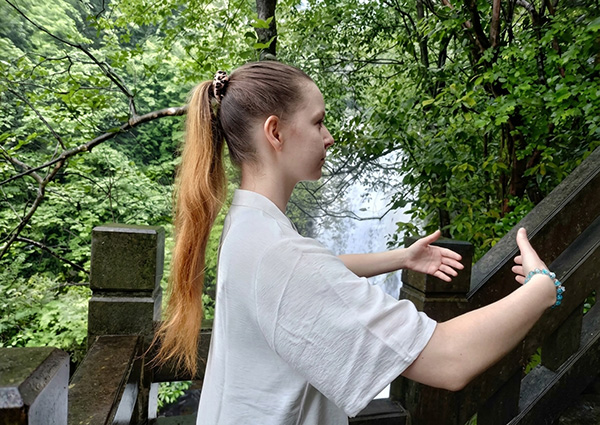
Four Preliminary Checks Before You Change Anything
Most standing problems start in the first ten seconds of the posture, not in the last minute. Run these checks in order, with a mirror or a phone video from the side.
Feet. Place them about shoulder-width apart, parallel, weight spread across the whole sole. If your toes grip the floor or your weight sits on the heels, expect calf and shin tension.
Knees. Bend them slightly and keep them tracking over the middle toes. If they drift inward or push past the toes, the joint takes the load that the hips should carry.
Pelvis and spine. Imagine the tailbone dropping gently toward the floor. If your lower back arches or your belly pushes forward, the thighs fight to compensate.
Shoulders and breath. Let the shoulders sink and the elbows hang slightly rounded. If your breath is high in the chest or held, tension is travelling upward from the legs.
Fix the earliest fault first. Correcting the feet often changes the knees, and correcting the pelvis often calms the legs. Change one thing at a time and re-test, so you know which change helped.
Shaking Legs: Reading the Tremor
Trembling is common when the body holds a position it rarely holds. Muscles that usually work in short bursts must sustain effort, and the nervous system is still learning to share the load. A tremor alone is not a reason to stop. What it feels like and how it behaves tell you what to do next.
| What you observe | Possible cause | What to try next |
|---|
| Fine, even trembling in both thighs that eases as you stay relaxed | Muscles adapting to sustained load | Keep the stance, soften the knees slightly, and end the round while the form is still clean |
| Trembling that grows with tension, clenched jaw, or held breath | Over-gripping and shallow breathing | Release the shoulders and jaw, breathe slowly through the nose, and reduce the knee bend |
| One leg shakes much more than the other | Uneven weight distribution | Check the feet in a mirror and shift weight until both soles feel equally loaded |
| Trembling with sharp or burning sensation in a joint | Not a simple adaptation signal | Come out of the posture and follow the pain checks below |
These are possible causes, not confirmed findings. If the tremor changes after the correction, your hypothesis was probably right. If nothing changes, test the next branch rather than forcing the hold.
Joint Pain: A Diagnosis Order You Can Follow
Muscle fatigue and joint discomfort feel different, and the difference matters. Fatigue is a broad, warm, heavy ache in the thick part of the muscle. Joint trouble tends to be localized, sharp, pinching, or stiff in the knee, hip, ankle, or lower back. Work through these questions in sequence.
Where is it? Muscle belly, or around the joint line? Joint-line discomfort calls for caution.
What is the quality? Heavy and warm points toward fatigue. Sharp, pinching, or catching points toward alignment or a joint issue.
Does posture change it? If a small adjustment, such as straightening the knee tracking or tucking the pelvis, removes it, alignment was the cause.
Does it fade after you stop? Fatigue usually fades within a short rest. Discomfort that lingers into the evening or the next morning means the hold was too long or the form was wrong.
Is it repeating? The same spot hurting session after session is a pattern worth showing to a qualified teacher or a medical professional.
Stop the hold at step 2 if the pain is sharp. Do not try to push through it. A shorter hold done correctly will teach you more than a long hold done badly.
Normal Adaptation Versus Warning Signs
This is the boundary every standing practitioner needs to know. Some discomfort is part of the body adjusting. Other signals mean you should shorten the hold, change the posture, or seek professional advice. The table separates them.
| Signal | Usually normal adaptation | Shorten, adjust, or seek advice |
|---|
| Shaking | Even, mild, eases with relaxation | Violent or one-sided shaking with sharp joint sensation: stop and adjust |
| Pain | Dull, heavy muscle ache that fades soon after rest | Sharp, pinching, or joint-line pain, or soreness lasting into the next day: shorten the hold and change posture; if it repeats, seek professional advice |
| Numbness | Brief warmth or mild tingling in the feet that fades when you shift weight | Numbness that persists, spreads, or comes with weakness: come out of the posture and seek advice |
| Dizziness | None; this is not an expected sign | Lightheadedness, blurred vision, or a feeling of falling: end the hold, sit down, and breathe normally. If it recurs, consult a medical professional |
| Fatigue | Pleasant tiredness after practice, with steadier legs next session | Exhaustion that lasts for hours, or worsening performance across the week: reduce duration and rest |
This guide is not a medical diagnosis. If you have a known knee, back, blood pressure, or balance condition, speak with a doctor before starting, and tell your teacher.
When the Mind Wanders: Giving Attention a Place to Stand
A restless mind in standing practice is rarely a lack of discipline. Usually, attention has nowhere specific to rest. In sitting Meditation, the breath often serves as that anchor. In standing, the body offers more choices, and beginners tend to choose none.
Soles of the feet. Feel the contact with the ground. It is simple, constant, and works well when the legs are busy.
Slow breathing. Count a few full breaths, then stop counting and just follow them.
Body scan from head to feet. Notice each area once, then release it. This suits an agitated mind.
Lower abdomen. Rest awareness below the navel. This matches the classical approach and pairs well with Qi Gong breathing.
If attention collapses whenever the legs burn, the posture is too demanding for your current level. Raise the stance slightly. A mind cannot settle while the body sends alarms.
Chen-style Tai Chi practitioners use standing as the root of every movement. In that tradition, calm focus comes after the structure is relaxed and supported, not before.
Real Cases: What Adjusting Looks Like
Some of our students were not comfortable at first. Austin Erkl from the USA completed a 30-day Tai Chi and Sword course. He admitted he did not love it at the start, but after adjusting he had a great time and kept lifelong memories. Klaes Risbjerg Simonsen from Denmark completed a 30-day Tai Chi, Zhan Zhuang, and Broadsword course. He praised the Shifu for adapting the training to his specific needs. Andrew Williams from the USA trained Tai Chi, Zhan Zhuang, and Dao Fa for 30 days with his son. He called it a life-changing experience that strengthened him physically, mentally, and spiritually.
These are individual experiences, not guarantees. They do show that a good teacher watches your posture, adjusts the load, and treats early difficulty as part of learning.
Common Mistakes That Keep the Problems Alive
Holding longer to prove toughness. Duration without clean form builds tension, not skill.
Squatting too low. A deep bend loads the knees before the hips are ready.
Locking the knees straight. This stops the tremor but also stops the legs from learning to support you.
Ignoring the breath. Held breath tightens the shoulders and drives up the heart rate.
Judging the session by thoughts. A mind that wanders and returns is training correctly.
Practising only when you feel strong. Short, regular rounds teach the body more than occasional heroic ones.
Preventing a Repeat, and When to Ask for a Teacher
Keep a simple practice log. After each session, note the posture height, the duration, where you felt tension, and whether the same symptom appeared the next morning. After a week or two, patterns show up, and you can see whether a correction worked. Rest days matter as much as practice days.
Ask for in-person guidance if pain returns in the same place, if numbness or dizziness appears, or if you cannot find where the tension begins. Send a side-view photo or short video of your stance along with your log, so the teacher can see what you are doing rather than guess. At SJF Kung Fu School, Master Shen Jiangfei, an 11th-generation inheritor of Chen-style Tai Chi and a Liuhe Quan descendant, has taught more than 3,000 students, and correcting standing posture one person at a time is a daily part of that work. Our 200㎡ indoor training center also lets practice continue regardless of the weather.
Zhan Zhuang Meditation rewards the student who stays curious. Shake, ache, and drift are part of the conversation with your own body, and each one can be answered with a calmer, better-supported stance.
Come and Stand With Us
If you would like a teacher to look at your posture in person, you are welcome to join us for a 30 Day Kung Fu Course, where standing practice sits alongside Tai Chi and other traditional training. Send us a message through the website with your experience level, any physical concerns, and what you hope to learn. We will reply with suggestions on the program that fits you best.
View the One Month Course | Book a Consultation



 WhatsApp